11 mins read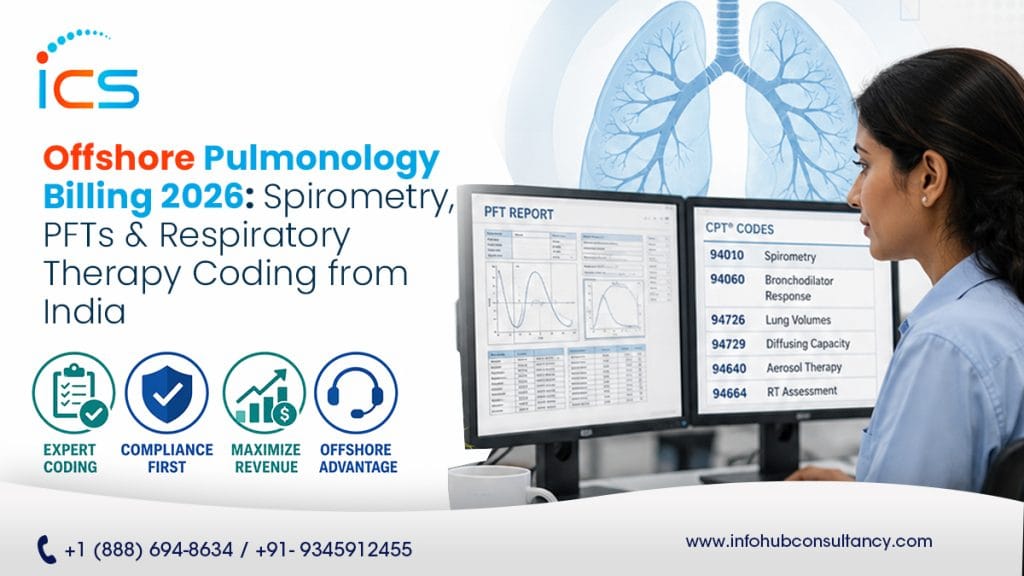
Why Pulmonology Practices Need Offshore Billing in 2026
Pulmonology is one of the most documentation-intensive specialties in medicine. A single patient encounter can involve spirometry with bronchodilator response, full pulmonary function testing with lung volumes and diffusion capacity, bronchoscopy with multiple biopsy sites, and respiratory therapy orders — each billed as separate line items with distinct technical and professional components.
In 2026, pulmonology billing has become even more complex. CMS updated technical standards for spirometry reimbursement requiring at least three acceptable flow-volume loops per test, expanded pulmonary rehabilitation coverage to include post-COVID respiratory conditions (ICD-10: U09.9), and applied the -2.5% efficiency adjustment to non-time-based PFT codes. Commercial payers have increased prior authorization requirements for advanced bronchoscopy procedures and biologic therapies for severe asthma.
InfoHub Consultancy supports medical billing, coding, and revenue-cycle workflows for U.S. healthcare providers. Discuss your needs and proposed scope with our team.
Get a Free Consultation →A dedicated ICS offshore FTE at $8.5/hr per hour manages the full pulmonology billing workflow — from PFT component billing and modifier splits to bronchoscopy bundling compliance to pulmonary rehabilitation session tracking and documentation verification. This guide covers the critical codes, payer rules, and documentation requirements your offshore team needs.
Spirometry Billing: Basic, Bronchodilator & Provocation Testing
Spirometry is the most frequently performed pulmonary diagnostic test, but billing errors are common due to the overlap between basic and bronchodilator codes, the distinction between screening and diagnostic testing, and the technical/professional component split requirements.
Spirometry CPT Code Matrix
| CPT Code | Description | Key Billing Rule |
|---|---|---|
| 94010 | Spirometry (basic), including FVC, FEV1, MVV | Diagnostic only; do NOT bill with 94060 |
| 94060 | Spirometry with bronchodilator response | Includes pre- and post-bronchodilator; bundles 94010 |
| 94070 | Bronchospasm provocation (methacholine challenge) | Separate from 94010/94060; requires supervision |
| 94200 | Maximum breathing capacity (MVV) | Standalone; bundled into 94010 when done together |
| 94375 | Respiratory flow volume loop | Bundled into 94010; do not bill separately |
Scroll left or right to read all columns.
Spirometry Billing Rules
94010 vs. 94060 — Never Bill Both: CPT 94060 includes everything in 94010 (FVC, FEV1, flow-volume loop) plus the bronchodilator administration and post-bronchodilator testing. Billing both 94010 and 94060 on the same claim is the most common pulmonology billing error and triggers automatic NCCI edit denials.
Technical Standards for 2026: CMS requires at least three acceptable flow-volume loops (meeting ATS/ERS repeatability criteria) for spirometry reimbursement. Tests that do not meet this standard risk denial on quality review. Your ICS FTE verifies the technician’s quality report before claim submission.
Modifier -26/-TC Split: When spirometry is performed in a hospital or shared facility, the interpreting physician bills modifier -26 (professional interpretation only) and the facility bills modifier -TC (technical component — equipment, technician, supplies). In an office-based setting where the physician owns the equipment, bill the global code without modifiers.
Screening vs. Diagnostic: Medicare does not cover screening spirometry. The test must be ordered for a specific clinical indication (dyspnea, COPD monitoring, asthma assessment, pre-operative risk evaluation, occupational exposure) and the order must document the clinical question being answered.
Complete Pulmonary Function Testing (PFTs)
Full PFT panels include spirometry, lung volume measurement, and diffusion capacity — each with its own CPT code. The component billing structure and the rules governing which codes can be billed together create significant complexity for billing teams.
PFT Component Codes
| CPT Code | Description | What It Measures |
|---|---|---|
| 94010 | Spirometry | FVC, FEV1, FEV1/FVC ratio, flow rates |
| 94060 | Spirometry with bronchodilator | Pre- and post-bronchodilator response |
| 94726 | Lung volume measurement (plethysmography) | TLC, RV, FRC, RV/TLC ratio |
| 94727 | Lung volume measurement (gas dilution/washout) | TLC, FRC via helium dilution or N2 washout |
| 94729 | Diffusion capacity (DLCO) | Gas transfer across alveolar membrane |
| 94728 | Airway resistance by oscillometry | Impulse oscillometry; not bundled with spirometry |
Scroll left or right to read all columns.
PFT Bundling and Combination Rules
Complete PFT Panel: A typical complete PFT includes 94060 + 94726 + 94729 (spirometry with bronchodilator + lung volumes + diffusion capacity). These three codes can be billed together on the same date when clinically indicated. The total reimbursement for the complete panel is approximately $130-160 depending on the fee schedule.
Lung Volume Methods: 94726 (plethysmography) and 94727 (gas dilution) are alternative methods for measuring lung volumes. Only one can be billed per session — they are mutually exclusive. Plethysmography (94726) is preferred for obstructive disease as it measures trapped gas.
DLCO Adjustments: CPT 94729 (diffusion capacity) requires documentation of the patient’s hemoglobin level and altitude for corrected DLCO calculations. Uncorrected DLCO values may be flagged on quality review. Your ICS FTE verifies that the hemoglobin correction is documented before submission.
Interpretation Reports: Each PFT component requires a separate physician interpretation that addresses the clinical significance. A generic ‘PFTs within normal limits’ is insufficient. The interpretation must reference specific numerical values, compare to predicted values, and state the clinical impression (obstruction severity, restriction, gas transfer impairment).
Bronchoscopy Billing: Diagnostic, Interventional & EBUS
Bronchoscopy procedures are the highest-value billing category in pulmonology, but the complex bundling hierarchy and NCCI edits make them one of the most error-prone. Understanding which codes can and cannot be billed together in the same session is essential for accurate billing.
Core Bronchoscopy CPT Codes
| CPT Code | Description | 2026 Facility Payment |
|---|---|---|
| 31622 | Diagnostic bronchoscopy (with cell wash if done) | $121 (3.60 wRVU) |
| 31623 | Bronchoscopy with brushing | $120 (3.57 wRVU) |
| 31624 | Bronchoscopy with bronchial alveolar lavage (BAL) | $126 (3.72 wRVU) |
| 31625 | Bronchoscopy with biopsy (forceps) | $137 (4.00 wRVU) |
| 31626 | Bronchoscopy with transbronchial biopsy (single lobe) | $164 (4.48 wRVU) |
| 31628 | Bronchoscopy with transbronchial biopsy (add’l lobe) | Add-on to 31626 |
| 31652 | EBUS with transbronchial needle aspiration, 1st node | $252 (6.20 wRVU) |
| 31653 | EBUS with TBNA, each additional node | Add-on to 31652 |
| 31634 | Bronchoscopy with balloon dilation | $183 (5.00 wRVU) |
| 31636 | Bronchoscopy with stent placement | $310 (8.50 wRVU) |
Scroll left or right to read all columns.
Critical Bronchoscopy Bundling Rules
31622 is Never Billed with Other 316xx Codes: Diagnostic bronchoscopy (31622) is inherent in every interventional bronchoscopy code. When any biopsy, lavage, brushing, or therapeutic procedure is performed, 31622 is bundled and must NOT be billed separately. This is the most common bronchoscopy billing error.
Multiple Procedures Same Session: When multiple bronchoscopic procedures are performed (e.g., BAL + forceps biopsy + EBUS-TBNA), each procedure code can be billed separately IF they represent distinct clinical services. Always review NCCI column 1/column 2 edits before submitting multiple 316xx codes.
Add-on Codes: CPT 31628, 31632, 31637, and 31653 are add-on codes that can only be billed with their corresponding primary code. 31628 (additional lobe transbronchial biopsy) requires 31626 as the primary code. 31653 (additional EBUS node) requires 31652.
Specimen Documentation: Every bronchoscopy claim must specify the anatomic sites (lobe, segment, lymph node station), the technique used at each site, and the clinical intent (diagnostic vs. therapeutic). Your ICS FTE cross-references the procedure report against the pathology report to verify consistency.
Pulmonary Rehabilitation and Respiratory Therapy
Pulmonary rehabilitation (PR) is a covered Medicare benefit for patients with moderate to severe COPD, and CMS expanded eligibility in 2025-2026 to include post-COVID respiratory conditions. The billing rules involve specific HCPCS/CPT codes, session limits, and documentation requirements that demand careful tracking.
Pulmonary Rehabilitation Codes
| Code | Description | Session Limit |
|---|---|---|
| 94625 | Outpatient PR, physician services, without continuous SpO2 | 36 sessions (+ 36 if medically necessary) |
| 94626 | Outpatient PR, physician services, with continuous SpO2 | 36 sessions (+ 36 if medically necessary) |
| G0237 | Therapeutic procedures, group (2+ patients) | Part of PR program |
| G0238 | Therapeutic procedures, individual | Part of PR program |
| G0239 | Therapeutic procedures, individual (maintenance) | Post-PR maintenance |
| G0424 | PR services, per session (legacy) | Replaced by 94625/94626 in 2025 |
Scroll left or right to read all columns.
Respiratory Therapy Codes
| CPT Code | Description | Key Rule |
|---|---|---|
| 94640 | Pressurized inhalation treatment (nebulizer) | Per treatment; not billable with 94060 same date |
| 94644 | Continuous inhalation, 1st hour | Acute bronchospasm; requires physician presence |
| 94645 | Continuous inhalation, each add’l hour | Add-on to 94644 |
| 94660 | CPAP initiation and management | Setup and fitting; not routine supply |
| 94662 | BiPAP initiation and management | Non-invasive ventilation setup |
| 94002 | Ventilation management, initial day | Inpatient mechanical ventilation |
| 94003 | Ventilation management, subsequent day | Ongoing vent management per day |
Scroll left or right to read all columns.
Medicare PR Coverage Rules
Session Limits: CMS covers up to 36 sessions of pulmonary rehabilitation (typically twice per week for 18 weeks). An additional 36 sessions can be authorized if the physician documents continued medical necessity and measurable improvement in functional capacity.
Covered Diagnoses: Medicare covers PR for moderate to very severe COPD (GOLD II-IV), post-COVID respiratory conditions (U09.9), and certain other chronic lung diseases. Your ICS FTE verifies the qualifying diagnosis before each session claim.
Direct Supervision: PR sessions require direct physician supervision — the physician must be immediately available in the facility. CMS clarified that virtual supervision via real-time video qualifies under certain conditions, but local MAC policies vary.
Plan of Care: Medicare requires a physician-prescribed plan of care, reviewed and updated every 30 days, for all PR claims. Missing even a single element (exercise prescription, education components, psychosocial assessment, outcome measures) can trigger denials.
Essential ICD-10 Codes for Pulmonology
| ICD-10 Code | Description | Common Use |
|---|---|---|
| J44.0 | COPD with acute lower respiratory infection | COPD exacerbation with pneumonia |
| J44.1 | COPD with acute exacerbation | Most common COPD admission code |
| J44.9 | COPD, unspecified | Stable COPD; office visits |
| J45.20-J45.22 | Mild intermittent asthma | Step 1 asthma management |
| J45.30-J45.32 | Mild persistent asthma | Step 2 asthma |
| J45.40-J45.42 | Moderate persistent asthma | Step 3-4 asthma |
| J45.50-J45.52 | Severe persistent asthma | Step 5; biologic candidates |
| J84.10 | Pulmonary fibrosis, unspecified | ILD workup/monitoring |
| J84.112 | Idiopathic pulmonary fibrosis | IPF; antifibrotic therapy indication |
| J96.00-J96.02 | Acute respiratory failure | Type 1 (hypoxic) / Type 2 (hypercapnic) |
| R06.00 | Dyspnea, unspecified | Initial PFT indication |
| U09.9 | Post-COVID-19 condition | Long COVID; PR eligibility |
| J47.0-J47.9 | Bronchiectasis | With/without infection/hemorrhage |
| C34.10-C34.92 | Malignant neoplasm of bronchus/lung | Bronchoscopy/EBUS indication |
Scroll left or right to read all columns.
The Offshore FTE Advantage for Pulmonology Practices
Pulmonology generates complex claims across four distinct service categories — diagnostic PFTs, bronchoscopy procedures, respiratory therapy, and pulmonary rehabilitation — each with its own coding rules, bundling restrictions, and documentation requirements. The technical/professional component split adds another layer of complexity that overwhelms in-house billing teams.
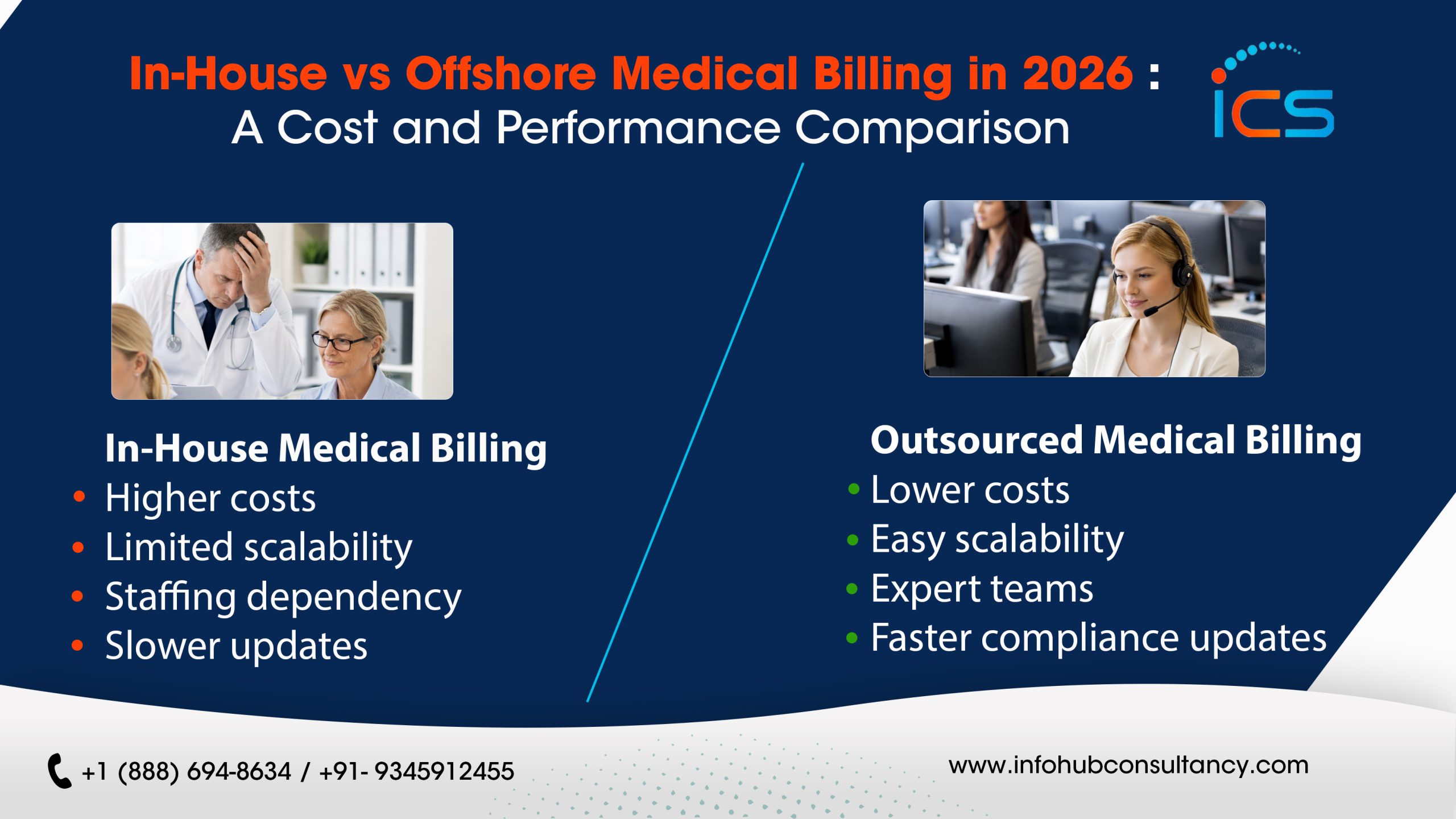
Cost Comparison: In-House vs. ICS Offshore FTE
| Cost Factor | U.S. In-House Biller | ICS Offshore FTE |
|---|---|---|
| Hourly rate | $22-35/hr | $8.5/hr |
| Monthly cost (full-time) | $3,800-6,000 | $1,400 (approx.) |
| Benefits & overhead | $800-1,500/mo additional | Included in rate |
| PFT component billing expertise | Rarely; requires specialty training | Trained on 94010/94060/94726/94729 bundling |
| Bronchoscopy NCCI edit knowledge | Often missed; leads to denials | Pre-submission edit verification on every claim |
| Annual turnover | 30-40% | <10% |
| PR session tracking | Manual spreadsheet | Automated session count + 30-day POC renewal alerts |
Scroll left or right to read all columns.
What Your ICS Pulmonology FTE Handles Daily
- Pre-claim verification of spirometry quality reports — confirming three acceptable flow-volume loops before submission
- PFT component billing — ensuring correct code combinations (94060 + 94726 + 94729) and preventing 94010/94060 double-billing
- Bronchoscopy bundling compliance — reviewing NCCI edits for every multi-procedure bronchoscopy session
- Modifier -26/-TC split management for hospital-based PFTs and shared facility arrangements
- Pulmonary rehabilitation session count tracking — monitoring the 36-session limit and initiating extension requests at session 30
- 30-day plan of care renewal tracking — flagging PR patients approaching documentation deadlines
Top 5 Pulmonology Billing Denial Triggers and Offshore Prevention
1. Billing 94010 and 94060 Together
This is the single most common pulmonology billing error. CPT 94060 (spirometry with bronchodilator) includes all components of 94010 (basic spirometry). Submitting both triggers an automatic NCCI edit denial. Your ICS FTE applies pre-submission edit checks to catch this before every claim goes out.
2. Diagnostic Bronchoscopy (31622) with Interventional Codes
Billing 31622 alongside 31625, 31626, 31652, or any other interventional bronchoscopy code results in automatic denial. The diagnostic bronchoscopy is inherent in all interventional codes. Your FTE reviews every bronchoscopy operative report and removes the 31622 line when any other 316xx code is present.
3. Spirometry Denied for Insufficient Quality
CMS requires at least three acceptable flow-volume loops meeting ATS/ERS repeatability criteria. Claims for spirometry that do not meet these technical standards are denied on quality review. Your ICS FTE reviews the technician quality report and flags substandard tests for repeat before billing.
4. Pulmonary Rehabilitation Without Updated Plan of Care
Medicare requires the physician-prescribed PR plan of care to be reviewed and updated every 30 days. Sessions billed after the 30-day window without a documented plan update are denied retroactively. Your FTE maintains automated alerts at day 25 to trigger plan of care renewals.
5. Missing Modifier -26 on Hospital-Based PFTs
When a pulmonologist interprets PFTs performed at a hospital-based lab, the professional interpretation must be billed with modifier -26. Omitting the modifier results in duplicate billing conflicts with the hospital’s technical component claim, causing denials for both the physician and the facility.
Start with One Dedicated Pulmonology Billing FTE
ICS provides HIPAA-compliant, CPC-certified offshore billing specialists with specific training in pulmonology and respiratory medicine billing — including PFT component coding, bronchoscopy NCCI edit management, and pulmonary rehabilitation session tracking.
At $8.5/hr per hour all-inclusive, one FTE handles the billing volume that would require 2-3 part-time U.S. staff. Start with one FTE and scale as your practice grows.
FAQs – Offshore Pulmonology Billing 2026
1. What is offshore pulmonology billing?
Offshore pulmonology billing involves outsourcing medical billing services to experienced billing professionals in countries like India. These services include coding, claim submission, denial management, and payment follow-ups for pulmonology practices.
2. Why is accurate spirometry and PFT coding important?
Accurate coding for spirometry and pulmonary function tests (PFTs) helps providers avoid claim denials, maintain compliance, and receive proper reimbursements. Correct documentation and coding are essential for faster insurance approvals.
3. How do offshore billing companies handle respiratory therapy claims?
Offshore billing teams manage eligibility verification, claim submission, coding reviews, and insurance follow-ups for respiratory therapy services. This helps pulmonology practices improve collections and reduce billing errors.
4. What are the benefits of outsourcing pulmonology billing to India?
Outsourcing pulmonology billing to India helps practices lower operational costs, improve coding accuracy, reduce administrative workload, and increase revenue cycle efficiency.
5. How can pulmonology practices reduce claim denials in 2026?
Pulmonology practices can reduce denials by ensuring accurate CPT and ICD-10 coding, verifying patient insurance eligibility, maintaining complete clinical documentation, and partnering with experienced offshore medical billing experts.\n
Need help with this billing workflow?
Review ICS pulmonology billing services. For recurring queue capacity, compare a dedicated offshore FTE team, or request a workflow consultation for your payer mix and volume.