


Payment posting records insurance and patient payments, contractual adjustments, denial information and remaining balances in the billing system. Consistent posting and reconciliation help preserve reliable accounts-receivable and financial reporting data.
InfoHub Consultancy Services provides India-based payment posting support for US healthcare organizations. The agreed workflow can cover ERA and EOB posting, adjustments, patient payments, reconciliation, exception reporting and transfer of unresolved balances to the responsible team.
Scope, system access, posting cadence, reconciliation sources, adjustment authority, escalation rules and reporting fields are documented before production begins.

Payment posting in medical billing is the process of recording payments received from insurance companies and patients after claim adjudication.
It includes:
 posting insurance paymentsapplying contractual adjustmentsidentifying and tagging denial codesposting patient paymentsreconciling ERA/EOB detailsupdating account balances
Payment posting is not just data entry — it is financial reconciliation.
In revenue cycle management, payment posting in RCM connects:

 reconciled payment and adjustment recordsreliable AR agingproper denial trackingaudit-ready reporting
Our medical billing payment posting process follows structured controls.

Receive electronic remittance advice (ERA) or explanation of benefits (EOB).

Post:
 paid amountcontractual adjustmentdeductiblecoinsuranceco-pay
Identify and tag:
payment posting denial codespartial paymentszero-pay claims
Match:
posted payments vs deposited fundsclearinghouse reportsbank deposits
Unpaid balances are transferred to AR follow-up or patient billing.

ERA payment posting is automated posting based on electronic remittance files (835 format). ERA-supported workflows can provide:
structured batch processingconsistent remittance data capturedenial and remark-code capturereconciliation and exception reportingThe operating model is agreed around available ERA files, system capabilities, quality checks and exception ownership.

 Claim Submitted
 Claim Adjudicated by Payer
 ERA / EOB Received
 Payment + Adjustment Posted
 Denials Identified
 Balance Updated
 AR / Patient Statement Initiated
This sequence provides a traceable basis for reconciliation and exception follow-up.
Payment posting is directly connected to denial management. When denial codes are identified during posting:
they are categorizedroot causes are flaggedclaims are transferred to denial teamreporting trends are updatedDefined denial mapping helps route unpaid and partially paid claims to the correct follow-up queue. Reporting can separate posting exceptions from adjudication denials so ownership remains clear.
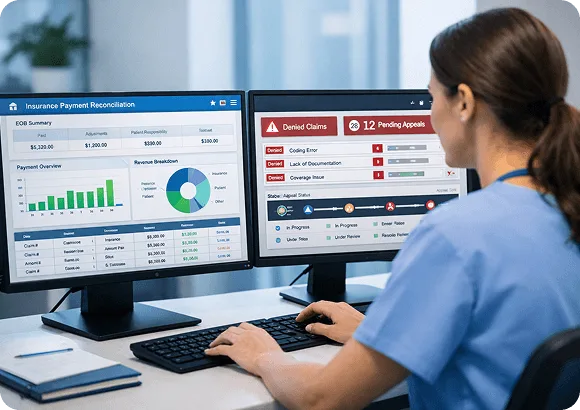
Before posting begins, define:
approved adjustment and write-off codespatient-responsibility and credit-balance routingOperating clarification:
Payment posting is an administrative revenue-cycle function. The approved posting rules, exception thresholds, reconciliation source and escalation owner should be documented for the client workflow.
A common adjudication check compares:
Payment + Contractual Adjustment + Patient Responsibility = Adjudicated Charge
The review should support:
correct remaining-balance statuscorrect AR reportingproper write-off trackingWe provide:

insurance payment posting

ERA posting

patient payment posting

credit balance reconciliation

denial tagging

deposit reconciliation

Healthcare organizations may outsource payment posting to:
add defined queue capacitymanage variable remittance volumeensure structured reconciliationsupport denial trackingscale within an agreed staffing model
An India-based payment posting scope can include:
dedicated payment posting specialistsan agreed ERA and EOB processing cadencestructured reconciliation workflowsdocumented quality and exception reviewdefined capacity and coverage expectationsThis model can add operational capacity while preserving documented handoffs with the client team.

Digital health startups often require:
billing compliancestructured revenue recognitionreconciliation and management reportingscalable posting workflowsAccurate payment posting strengthens financial transparency.
A structured payment posting team includes:
ERA posting specialistsdenial tagging analystsreconciliation auditorsAR transfer coordinatorsDocumented integration with billing and denial teams helps maintain clear ownership and handoffs.

 India-based offshore RCM specialistsIntegrated with AR and denial managementStructured reconciliation controlsSpecialty-focused workflowsScalable for hospitals and startups
ICS provides payment posting through an India-based delivery team operating in client-approved systems. The engagement is structured around defined queues, access roles, posting rules, quality review, exception ownership and reporting responsibilities.
Reporting can be configured around posted batches, unresolved remittances, adjustment categories, denial routing, credit balances and reconciliation exceptions. The exact measures depend on data available in the client workflow.



Payment posting is the process of appropriately documenting patient and insurance payments in your billing system. Even small mistakes in this seemingly simple phase might cause the entire revenue cycle to be disrupted.
The following are some serious consequences of inadequate payment posting:
 Claim Discrepancies and Delays Revenue LeakageCompliance RisksCash Flow DisruptionsIncreased Administrative Burden
Insurance and patient payments are posted using the agreed rules, with exceptions routed for review rather than treated as automatically resolved.

ICS can support a defined payment posting queue as an extension of the client revenue-cycle team. During discovery, we review payer mix, remittance sources, posting rules, adjustment authority, credit-balance handling, denial routing and reconciliation reporting.
The resulting operating plan documents what ICS posts, what requires client approval, how exceptions are escalated and which measures are reviewed. This creates a practical basis for transition and ongoing service discussions without assuming guaranteed financial outcomes.

Insurance payments and adjustments are posted according to agreed rules, cadence and discrepancy checks.
Record supported patient-payment sources and route reconciliation exceptions according to the agreed workflow.
Identify denial, zero-pay and underpayment indicators available in the remittance data and route them for assigned follow-up.
Apply approved contractual adjustments and write-off codes within the client authorization rules.
Compare posted transactions with available ERA, EOB, deposit and claim records to identify exceptions.
Provide agreed reports on posted batches, exceptions, adjustments and unresolved reconciliation items.
Work within the client-approved billing or practice-management system after access and workflow requirements are confirmed.

Numerous medical specialities and practices are supported by our payment posting services, including:
Ambulatory Surgical Centre
Pain Management Practices
Wound Care
Anesthesia
Neurology
Behavioral Health
Remote Patient Monitoring (RPM)
Assisted Living Facility (ALF)
Our solutions are completely personalised to your particular workflow and operational requirements, regardless of whether you are a single doctor, group practice, or multispecialty organisation.
ICS supports US healthcare organizations through a remote delivery model from India. Payer mix, remittance sources, state-program dependencies, adjustment authority and reporting requirements are reviewed during discovery rather than assumed from a location list.


Speak to our Experts on
India-based medical billing support for US healthcare organizations.
Posting rules, adjustment authority, reconciliation sources, required fields, exception thresholds and quality-review steps are documented for the client workflow before production.
The scope can include supported out-of-network, multi-site, zero-pay, partial-payment and non-standard remittance scenarios after the data sources and escalation responsibilities are reviewed.
Reporting can cover posted batches, adjustments, denial and remark codes, credit balances, deposit reconciliation and unresolved exceptions using data available in the client system.
The India-based team works within agreed queues, hours, access roles, handoffs and escalation rules. Commercial terms and staffing are aligned with the confirmed scope and expected volume.
ICS can work within a client-approved billing or practice-management system after compatibility, access, security and workflow requirements are confirmed.
Payment posting can capture denial, zero-pay and underpayment indicators from remittance data and route them to the client or assigned follow-up team. Recovery work should be scoped separately.
Applicable payer and state-program requirements are documented during onboarding using the client payer mix, system configuration and approved procedures.
Define remittance sources, daily or batch cadence, adjustment authority, credit-balance handling, reconciliation sources, escalation contacts and reporting expectations before production begins.

Individual Doctors and Private Practices

Clinics with many specialities and group practices

Health Systems and Hospitals

Ambulatory Surgical Centers (ASCs)

Diagnostic and Urgent Care Facilities

Assisted living and behavioural health practices

Practices that receive a lot of out-of-network or foreign insurance claims
The workflow can be adapted to the organization’s payer mix, remittance sources, posting volume and approved operating procedures.
To ensure top-notch service delivery, we use premier industry platforms similar to










Payment posting should give billing, denial and finance teams a consistent view of payments, adjustments, patient responsibility and unresolved exceptions.
ICS can provide an India-based team operating inside an agreed payment posting scope, with documented access, posting rules, quality review, reconciliation checks and escalation responsibilities.
Request a workflow review to compare your current remittance sources, queues, exception handling and reporting needs with a proposed delivery model.
Use a dedicated offshore FTE team when you need predictable capacity and workflow ownership, or consider percentage-based billing when you prefer fees aligned with collections.
Explore dedicated FTE medical billing teams | Explore percentage-based medical billing | Discuss your requirements with ICS
What is included in payment posting services?
A defined scope can include insurance and patient payment posting, contractual adjustments, ERA and EOB processing, denial and remark-code capture, credit-balance handling, deposit reconciliation, exception reporting and transfer of unresolved balances.
How does an India-based payment posting team work with our US staff?
ICS documents system access, work queues, processing cadence, approval limits, escalation contacts, quality review and reporting responsibilities before production. The client team retains the decisions and approvals assigned to it.
Can ICS post both ERA and manual EOB payments?
The workflow can support available ERA files and approved manual EOB sources. Compatibility, data quality, posting rules and exception handling are confirmed during discovery.
How are adjustments and write-offs controlled?
Contractual adjustments and write-offs follow client-approved codes, limits and authorization rules. Items outside those rules are routed for review rather than posted automatically.
How are denials and underpayments handled during posting?
The posting team can capture denial, zero-pay, partial-payment and underpayment indicators available in remittance data and route them to the assigned follow-up queue. Recovery and appeal work should be scoped separately.
What reconciliation checks can be included?
Checks may compare posted transactions with ERA, EOB, deposit, clearinghouse and claim records available to the team. Unmatched items and credit balances are reported through the agreed exception process.
Can ICS work in our current billing or practice-management system?
Yes, when the system, user roles, security requirements and workflow are approved by the client and confirmed during onboarding.
What information is needed to evaluate a transition?
Useful inputs include monthly remittance volume, payer mix, ERA and EOB sources, current posting cadence, adjustment authority, reconciliation sources, exception backlog, reporting needs and target transition timing.
Tell us which medical billing or RCM workflow needs support.
Build a dedicated offshore team or align billing fees with collections.

“ Partnering with ICS transformed our revenue cycle. Claim approvals are faster, denials have dropped significantly, and we finally have clear visibility into our billing performance. ”
Founder, Sunrise Family Clinic

“ The ICS team is knowledgeable, responsive, and deeply committed to helping our practice grow. Their customized dashboard gives us real-time insights we never had before. ”
Orthopedic Surgeon, CareAxis Hospital
“ We were drowning in paperwork and delays before ICS stepped in. Their team streamlined everything, from eligibility checks to patient billing, and gave us time to focus on care. ”
Practice Manager, Lotus Women's Health Center
“ ICS is more than a billing service—they’re a strategic partner. Their compliance-first approach gives us confidence, and their results speak for themselves. ”
Pulmonologist, Airway Specialty Clinic
“ With ICS, we saw a 35% increase in collections within the first quarter. Their billing accuracy and follow-up on aging claims are unmatched. ”
Dermatologist, ClearSkin Clinic