

Prior authorization services manage the administrative work required before selected services are scheduled or delivered. A controlled queue records the payer requirement, requested service, clinical-documentation status, submission date, payer response, effective dates and next action.
InfoHub Consultancy Services provides India-based prior authorization support for US healthcare organizations as part of our revenue cycle management services. The agreed scope can include requirement checks, request preparation, documentation coordination, payer submission, status follow-up and authorization-record maintenance inside client-approved systems.
Before transition, the organization and ICS define payer queues, requested-service data, clinical-documentation handoffs, submission channels, follow-up cadence, escalation rules, approval limits and reporting fields. Connect this workflow with insurance eligibility verification and denial management services.
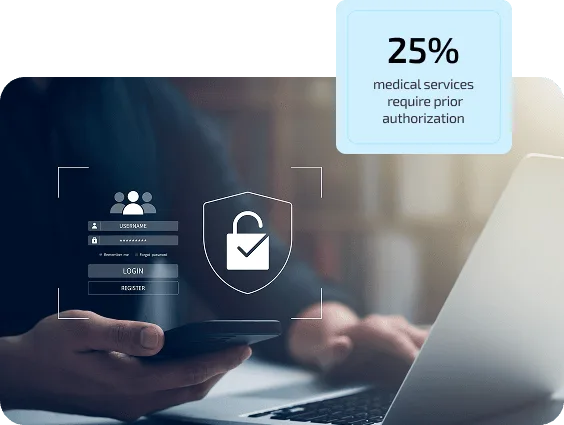
Authorization in medical billing is the administrative process used to request a payer decision before selected procedures, tests, treatments or medications. When a requirement is missed or the approved details do not match the service:
 Claims may be deniedA claim may require additional review or correctionThe account may need documented escalation
Prior authorization (also called pre-authorization) is payer approval required before specific services are performed. Common services requiring prior authorization:

Advanced Imaging
(MRI, CT scans)

Surgeries

Specialty Medications

Behavioral Health Treatments

High-cost Procedures
Pre-authorization and prior authorization are often used interchangeably. Both refer to payer approval before treatment. Some payers distinguish between:
Authorization (general approval)Pre-certification (clinical review-based approval)

Authorization type, effective dates, approved service details and payer conditions should be recorded for the downstream billing workflow.
Required before performing services.
Requested after services are rendered (typically in emergency or urgent scenarios).
Required when a primary care provider refers a patient to a specialist.
Required for hospital admissions.
Certain CPT codes require payer approval before billing.
Authorization plays a major role in authorization in RCM workflows. It connects:

Insurance Verification

Eligibility Confirmation

Scheduling

Billing Readiness

Denial Prevention
A missing, expired or mismatched authorization record should be routed to the documented correction or escalation path before downstream billing action.
Authorization-related denials should be reviewed against the payer response, request record, approved service details, effective dates and claim data.
no authorization obtainedauthorization expiredincorrect authorization numberauthorization not valid for CPT codeauthorization does not match date of servicePayer denial reason and accompanying explanationAuthorization reference and decision statusRequested service, provider and date detailsMissing information and the payer follow-up routeUse the payer response to identify the next administrative step; avoid treating every denial as the same issue.
Our authorization process in medical billing follows clear steps:

Confirm coverage, payer requirements, and benefit details.

Check whether specific CPT codes require authorization.

Submit clinical documentation to payer for review.

Track approval number, effective dates, and service limitations.

Ensure claim submission matches approved authorization.

Retro authorization is requested after services are performed, usually due to:
emergency admissionsurgent treatmentadministrative delaysRetro-authorization availability and requirements depend on the payer, plan, service and circumstances. The client retains clinical and policy decisions while ICS documents the administrative follow-up assigned to its scope.
When required authorization is missing, expired or inconsistent with the billed service, the account may:
remain unresolved in the AR work queuerequire claim correction or payer follow-uprequire a patient-balance hold or reviewmove to the documented appeal or escalation routeA documented authorization workflow gives each request a status, owner, supporting record, next action and escalation path.
Healthcare organizations may outsource authorization tasks to:
assign a documented authorization queueapply an agreed payer follow-up cadencemaintain request and decision records for billing handoffadd capacity within a confirmed staffing modelAs an offshore authorization services provider in India, we offer:
 dedicated authorization specialistspayer-specific rule trackingCPT authorization validationdocumentation coordinationauthorization number management
This India-based model adds defined queue ownership and operating capacity while preserving documented handoffs with the internal team.

Authorization requirements vary by specialty. We support authorization workflows for:
behavioral healthcardiologyorthopedicsoncologyradiologysurgery centersurgent caremental health cliniciansEach specialty has unique payer rules that require detailed tracking.
India-based offshore authorization teamDocumented payer-response and billing handoffsScalable support for multi-location practicesStructured documentation and tracking
Need ICS to handle the administrative queue? Discuss prior authorization support. If your own team will operate the workflow, explore prior authorization software.
Authorization decisions belong to the health plan; approval does not guarantee payment. See the HealthCare.gov explanation of preauthorization.
Build a dedicated offshore billing team for predictable capacity, or align fees with collections through a percentage-based model. Compare both options before choosing the structure that fits your organization.
Explore dedicated FTE medical billing teams | Explore percentage-based medical billing | Discuss your requirements with ICS
What is included in prior authorization services?
A defined scope can include payer-requirement checks, request preparation, documentation coordination, submission, status follow-up, authorization-number and effective-date tracking, exception routing and agreed reporting.
How does an India-based authorization team work with US staff?
ICS documents system access, payer queues, work hours, clinical-documentation handoffs, submission channels, follow-up cadence, escalation contacts, approval limits, quality review and reporting responsibilities before production.
Who makes the authorization decision?
The health plan or payer makes the authorization decision. ICS can perform the administrative tasks assigned in the agreed scope but does not make clinical decisions or guarantee approval or payment.
How are missing clinical documents handled?
The workflow records the missing item, source, responsible team, request date, due date and escalation path. Clinical content and approvals remain with the client or its authorized clinical team.
How are authorization requests tracked?
Tracking can include payer, member, requested service, submission channel and date, reference number, status, effective dates, approved units or limitations, next action and escalation status. Final fields depend on the client system.
How is prior authorization support different from authorization software?
This page describes a human-delivered service in which an ICS team manages the agreed administrative queue. The prior authorization software page is for organizations whose own team will operate a technology workflow.
Can ICS work in our current EHR or practice-management system?
Yes, when the system, user roles, security requirements, payer access and authorization workflow are approved by the client and confirmed during onboarding.
What information is needed to evaluate a transition?
Useful inputs include monthly request volume, payer and specialty mix, current queue status, submission channels, documentation sources, follow-up cadence, escalation rules, system access, reporting needs and target transition timing.
Tell us which medical billing or RCM workflow needs support.
Build a dedicated offshore team or align billing fees with collections.

“ Partnering with ICS transformed our revenue cycle. Claim approvals are faster, denials have dropped significantly, and we finally have clear visibility into our billing performance. ”
Founder, Sunrise Family Clinic

“ The ICS team is knowledgeable, responsive, and deeply committed to helping our practice grow. Their customized dashboard gives us real-time insights we never had before. ”
Orthopedic Surgeon, CareAxis Hospital
“ We were drowning in paperwork and delays before ICS stepped in. Their team streamlined everything, from eligibility checks to patient billing, and gave us time to focus on care. ”
Practice Manager, Lotus Women's Health Center
“ ICS is more than a billing service—they’re a strategic partner. Their compliance-first approach gives us confidence, and their results speak for themselves. ”
Pulmonologist, Airway Specialty Clinic
“ With ICS, we saw a 35% increase in collections within the first quarter. Their billing accuracy and follow-up on aging claims are unmatched. ”
Dermatologist, ClearSkin Clinic