


Medical billing reporting services organize revenue-cycle activity into defined fields, time periods, owners and exceptions. A useful report identifies its source, refresh cadence and calculation rules so US healthcare organizations can review work queues and unresolved dependencies consistently.
InfoHub Consultancy Services provides India-based medical billing reporting and revenue cycle reporting services for US healthcare organizations. The agreed scope can include AR aging, claims status, denials, payment posting, productivity, exception and handoff reporting using data available in client-approved systems.
Before production, the organization and ICS define each metric, source system, report period, refresh schedule, access role, exception category, review owner and escalation route.
Medical billing reports are structured summaries of billing activity, payments, denials, work status and financial fields available in the approved source systems. Depending on the agreed scope, reports can help the organization:
 monitor revenue cycle performancetrack claim submissions and paymentsidentify billing inefficienciesreview denial and delay categoriesreview payment and aging trends
Report usefulness depends on clear definitions, source-data quality, review ownership and consistent refresh rules.

Revenue cycle reporting involves analyzing every stage of the billing lifecycle from patient scheduling to final payment. It includes insights into:
charge entry performanceclaims submission statusdenial trendspayment posting accuracyaccounts receivable (AR) agingRevenue cycle reporting gives authorized reviewers a common view of agreed measures and open exceptions.

Healthcare organizations rely on multiple types of reports to monitor performance.
total chargescollectionsoutstanding balancesnet revenueaging reportspayer-wise ARoutstanding claimsdenial ratedenial reasonspayer-specific denial trendssubmitted claimsrejected claimspending claimsERA/EOB reconciliationpayment accuracyadjustments trackingprovider enrollment statuspayer approvalscredentialing timelines
Revenue cycle management reports provide a complete overview of billing performance. These include:
revenue cycle management reportsrevenue cycle reporting dashboardsKPI-based RCM reportingperformance tracking reportsThe organization can use these reports to review queue status, ownership, aging, exceptions and follow-up actions.

Denials reporting helps identify why claims are not getting paid. Key insights include:
top denial codesmost common denialspayer denial patternsdenial trends over timeDenial reporting should separate reason, payer, service, responsible team, deadline, next action and escalation status.

Credentialing reporting tracks provider enrollment and payer approvals. This includes:
provider credentialing statuspending enrollmentsexpired credentialspayer onboarding timelinesCredentialing delays can directly impact revenue cycle performance.
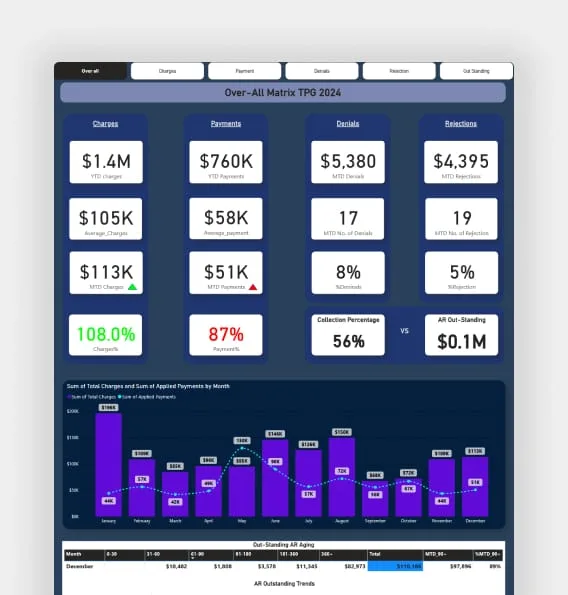
RCM dashboards can present current or scheduled reporting views when source-system access, data availability and refresh timing are agreed.
claim acceptance ratedenial ratedays in ARcollection rateclean claim ratioA centralized revenue cycle reporting view can document metric definitions, reporting periods, assigned owners and open exceptions.
Healthcare organizations also rely on revenue cycle management industry reports to benchmark their performance. Industry reports provide insights into:
billing trendsdenial benchmarksreimbursement patternspayer behaviorExternal benchmarks should be used only when their methodology, reporting period and comparison group are relevant to the organization.


Healthcare organizations may outsource defined reporting tasks when they need additional preparation, validation or distribution capacity.
defined reporting capacity and ownershipdedicated reporting teamsan agreed preparation and review cadenceapproved dashboard or report accesscustomized medical billing reportsscheduled or system-generated revenue cycle reporting when availabledenial and AR trackingKPI dashboardsfinancial performance reportsThe final reporting view depends on the fields, access, refresh cadence and definitions available in the client environment.
Without reporting, providers cannot:
identify revenue losstrack operational inefficienciesmonitor billing team performanceimprove collectionsData-driven reporting is essential for revenue cycle success.

 India-based offshore reporting teamexperience with US healthcare billingdashboard refresh schedules agreed with the clientcustomized reporting solutionsintegration with end-to-end RCM services
Useful reporting defines each KPI, its source, reporting period and responsible reviewer. It separates completed work from unresolved dependencies and makes exceptions traceable to a queue, owner and next action.
ICS documents the reporting scope around the organization’s systems, specialty mix, workflows, available fields, review roles and distribution requirements.
An agreed ICS medical billing reporting scope can include:
Each medical specialty has specific reporting requirements, and ICS provides analytics suited to your clinical domain. We offer end-to-end reports for

Monitor high-cost operation reimbursements using per-case financial analysis.
tracking procedure frequency, code-level revenue, and payer mix.
Examine the healing process and reimbursement outcomes.
Report time units, modifiers, and concurrency for correctness.
EEG reporting reimbursements for high-tech imaging.
measures recurrent billing cycles and patient engagement indicators.
Analyze treatment sessions, code usage, and session-level productivity.
Combine facility-level care with off-site physician billing information.
Whether you operate independently or manage a provider network, ICS structures reports to present a practical revenue-cycle view.



Speak to our Experts on
India-based medical billing support for US healthcare organizations.
Discuss report fields, source systems, refresh cadence, access roles and review ownership.
Agree the daily, weekly or monthly preparation, validation and distribution schedule for each report.
Document each report source, field, calculation rule, period and responsible reviewer before production.
Organize denial, rejection, underpayment and filing-deadline exceptions by agreed categories and owners.
Present agreed aging, payment, adjustment and unresolved-balance fields from the approved source systems.
Distribute approved views to authorized roles such as administrators, billing leaders or operational owners.
Assign report review, exception follow-up, change requests and escalation responsibilities during onboarding.
To ensure top-notch service delivery, we use premier industry platforms similar to











We take data security seriously. Our systems are HIPAA-compliant, with end-to-end encryption and role-based access restrictions. Role-based reporting helps your team understand where data is managed, who can access it, and how it is evaluated.
Do you need help interpreting your reports? Our support team can provide walkthroughs, trend analysis, and guidance tailored to your reporting requirements.
Use a dedicated offshore FTE team when you need predictable capacity and workflow ownership, or consider percentage-based billing when you prefer fees aligned with collections and an organization-level commercial model.
Explore dedicated FTE medical billing teams | Explore percentage-based medical billing | Discuss your requirements with ICS
What is included in medical billing reporting services?
A defined scope can include AR aging, claim status, payer response, denials, payment posting, adjustments, productivity, exceptions, deadlines and workflow handoffs using fields available in client-approved systems.
How does an India-based reporting team work with US staff?
ICS documents source systems, report definitions, refresh cadence, access roles, preparation and review responsibilities, distribution rules, exception ownership and escalation contacts before production.
Which RCM reports can ICS prepare?
Reports can be aligned to claims, AR, denials, payments, underpayments, rejections, filing deadlines, productivity and other agreed operational fields. Availability depends on the source data and client requirements.
Are the dashboards real time?
Refresh timing depends on the client system, available integration, export method and approved workflow. ICS confirms whether each view is real time, scheduled or manually prepared before the engagement begins.
How are reporting metrics defined?
Each metric should have a documented source, formula or rule, reporting period, inclusion and exclusion criteria, refresh schedule and responsible reviewer.
Can reports be customized by specialty, payer or location?
Yes, when the required fields are available and the client approves the grouping, definitions, access roles and distribution method.
Can ICS work in our existing billing or practice-management system?
Yes, when the system, user roles, security requirements, data access and reporting workflow are approved by the client and confirmed during onboarding.
What information is needed to evaluate a reporting transition?
Useful inputs include current report samples, required fields, source systems, metric definitions, reporting periods, refresh cadence, recipients, access roles, review responsibilities, exception categories and target transition timing.
Tell us which medical billing or RCM workflow needs support.
Build a dedicated offshore team or align billing fees with collections.

“ Partnering with ICS transformed our revenue cycle. Claim approvals are faster, denials have dropped significantly, and we finally have clear visibility into our billing performance. ”
Founder, Sunrise Family Clinic

“ The ICS team is knowledgeable, responsive, and deeply committed to helping our practice grow. Their customized dashboard gives us real-time insights we never had before. ”
Orthopedic Surgeon, CareAxis Hospital
“ We were drowning in paperwork and delays before ICS stepped in. Their team streamlined everything, from eligibility checks to patient billing, and gave us time to focus on care. ”
Practice Manager, Lotus Women's Health Center
“ ICS is more than a billing service—they’re a strategic partner. Their compliance-first approach gives us confidence, and their results speak for themselves. ”
Pulmonologist, Airway Specialty Clinic
“ With ICS, we saw a 35% increase in collections within the first quarter. Their billing accuracy and follow-up on aging claims are unmatched. ”
Dermatologist, ClearSkin Clinic