

Hospital billing is one of the most complex areas of medical billing, covering inpatient admissions, outpatient services, observation care, consultations, discharges, and post-hospital follow-up visits. Each encounter touches multiple departments, CPT codes, ICD-10 diagnosis codes, and payer-specific rules.
Hospital medical billing is one of the most complex areas of healthcare revenue cycle management, involving facility fee billing, DRG assignment, inpatient and outpatient coding, and compliance with CMS regulations. ICS provides comprehensive hospital billing services that help US hospitals and health systems optimize reimbursement and reduce claim denials.
We provide hospital billing services and end-to-end hospital revenue cycle management (RCM) for community hospitals, children’s hospitals, critical access hospitals, and multi-facility healthcare organizations across the USA. Our offshore delivery model supports U.S. hospitals from India while maintaining compliance, accuracy, and transparency.
Hospital billing differs from physician billing. While professional billing focuses on provider services, hospital medical billing includes facility charges, room and board, supplies, pharmacy, lab, imaging, and ancillary services.

Inpatient hospital billing
Outpatient hospital billing
Observation hospital billing
Emergency and consult billing
Discharge and follow-up billing
A strong hospital billing process ensures clean claims, timely payments, and fewer denials.

Hospital billing covers inpatient services billed on UB-04 forms using ICD-10-CM/PCS codes and DRG groupings, outpatient facility services, emergency department billing, observation stays, and revenue code assignment. Hospitals must navigate complex Medicare billing regulations including the two-midnight rule, condition code reporting, and the Hospital Outpatient Prospective Payment System (OPPS). Charge capture, revenue integrity, and clinical documentation improvement (CDI) are critical components
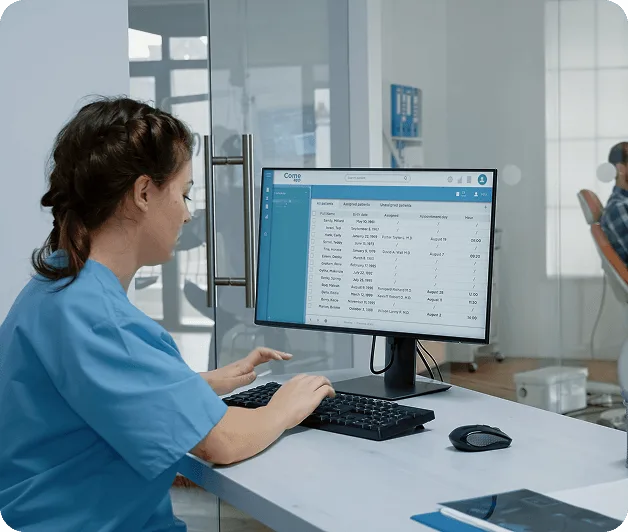
Our medical coders are proficient in all Hospital CPT codes, including:
DRG 470 — Major joint replacement (hip/knee)
DRG 291 — Heart failure and shock with MCC
Revenue Code 0450 — Emergency room
Revenue Code 0360 — Operating room
99291 — Critical care, first 30-74 minutes
93306 — Echocardiography, complete
0300 — Laboratory revenue code
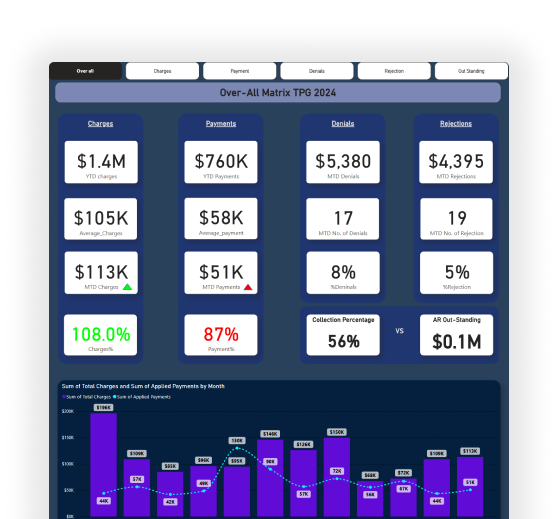
Hospital revenue cycle management is the financial backbone of a hospital. It tracks the patient journey from registration to final payment.
Patient access and eligibility
Charge capture and coding
Claim submission
Denial management
Payment posting and patient billing
Understanding what is revenue cycle management in hospitals helps leadership improve margins without compromising care.
Our hospital revenue cycle management process focuses on:

accurate coding at the point of care

faster claim turnaround

reduced AR days

improved patient payment workflows
This approach supports both Medicaid and commercial payers while aligning with CMS rules.
Hospital billing is fraught with complexities that can lead to claim denials and revenue loss. Common challenges include:
Complex DRG assignment and optimization
Two-midnight rule compliance for inpatient vs observation status
Revenue code and charge description master (CDM) management
High-value claim audits and RAC audit defense
Coordination of benefits for dual-eligible Medicare-Medicaid patients

Hospital billing uses a wide range of CPT codes depending on the level of care.
These cover:
CPT code for hospital admission
Initial hospital care CPT code
CPT code for inpatient hospital admission
Daily rounding and continued care use:
CPT code for subsequent hospital care
Subsequent hospital care CPT code
CPT code for hospital follow up visit
Discharge billing includes:
CPT code for hospital discharge
CPT code for discharge from hospital
Time-based discharge management codes
Hospitals bill for:
Hospital consult CPT codes
CPT code for hospital consultation
Hospital observation CPT codes
CPT code for observation in hospital
Accurate diagnosis coding drives correct reimbursement.

ICD 10 code for hospital follow up
ICD 10 code for post hospital follow up
ICD 10 code for hospital acquired pneumonia
ICD 10 code for inpatient hospital admission
ICD 10 code for hospital discharge follow up
We ensure diagnosis codes fully support medical necessity and payer audits.

Inpatient billing covers:
Room and board
Inpatient procedures
Hospital stay CPT codes
Place of service and revenue codes

Outpatient billing includes:
Clinic visits
Same-day procedures
Outpatient hospital visit CPT codes

Observation services follow strict CMS rules and require precise start and stop times for compliant billing.

Correct hospital place of service codes are critical for:
Inpatient hospital POS
Outpatient hospital POS
Hospital-based clinic billing
Errors here often cause denials or underpayment.
Many providers struggle with the difference between hospital billing and physician billing.
Hospital billing = facility charges
Physician billing = professional services
Different claim forms and reimbursement logic
Understanding professional billing vs hospital billing prevents duplicate or missing claims.


Children’s hospital billing
Children’s hospital billing departments
Community hospital billing offices
Pediatric hospital billing requires special attention to age-specific CPT and ICD-10 rules.

Common causes of hospital billing denials include:
Incorrect CPT selection
Missing medical necessity
POS mismatches
Incomplete discharge documentation
Our team focuses on strategies to reduce denials in hospital revenue cycle management through proactive audits.

Many hospitals choose to outsource hospital billing services to reduce costs and improve accuracy.
U.S. payer expertise
India-based certified coders
HIPAA-aligned workflows
Scalable RCM support
We act as an extension of your hospital billing department.
Hospital billing systems
Hospital management systems
Automated medical billing solutions
This avoids workflow disruption while improving efficiency.

Complete hospital RCM services
CPT and ICD-10 accuracy
Inpatient and outpatient expertise
Children’s and community hospital experience
Offshore scalability with U.S. compliance
ICS hospital billing specialists provide end-to-end revenue cycle support including charge capture review, coding validation, claim submission, and denial management. Our team works with hospital CDI teams to ensure accurate DRG assignment and maximum reimbursement for all levels of care.
As a trusted offshore medical billing partner for US healthcare providers, ICS combines deep specialty knowledge with HIPAA-compliant processes, transparent reporting, and a dedicated FTE model that scales with your practice. Contact us today for a free consultation.

ICS hospital billing specialists provide end-to-end revenue cycle support for hospitals — from charge capture and DRG optimization to denial management and RAC audit defense. Our dedicated team works with hospital CDI and coding departments to ensure maximum reimbursement for inpatient and outpatient services. Contact ICS for comprehensive hospital billing solutions.
These checkpoints summarize published CMS guidance for hospital claims. The payer’s policy and the rule in effect for the date of service always apply.
CMS describes the practitioner order to admit as a critical element that is required for all hospital inpatient cases. Without it, Part A inpatient coverage and payment do not apply.
CMS tells physicians to use the expectation of a stay crossing two midnights as a benchmark for ordering admission. The medical record must support that reasonable expectation at the time of the order.
Meeting the two-midnight benchmark does not by itself make a beneficiary an inpatient. CMS states inpatient status depends on a formal admission under an order from an ordering practitioner.
CMS ties the inpatient order to documentation in the medical record. If it is not properly documented before the patient leaves, the hospital should not submit a Part A claim.
Observation is outpatient care made up of short term treatment, assessment and reassessment. Hospitals use it to decide whether a patient needs inpatient admission or can be discharged.
Inpatient hospital discharges are assigned to MS-DRGs under the acute care payment system. CMS defines each group by similar clinical conditions and services that need similar resources.

Who We Are?
We’re a team of Indian grounded experts streamlining medical billing
services to US-based healthcare professionals for more than 10 years. We strategise specialty-specific conditions and agree working windows with each client, offering customized services.

Speak to our Experts on
End-to-End Medical Billing Services provider across entire US.

We offer medical billing services that feed to different types of medical practices.
 Ambulance
 Cardiology
 Radiology
 Family Practice
 Ophthalmology
Whether you operate as an individual practitioner or manage a healthcare association with multiple sites, we offer a solution tailored to your requirements.

With over a decade of experience serving diverse specialties and provider groups across the U.S., we ensure you get local-quality support, regardless of location.
 Trusted by 140+ Providers in All 50 States HIPAA-Compliant Offshore Billing Experts Specialized Teams for State-Specific Billing Needs
Select your location below to learn how we support practices like yours.
To ensure top-notch service delivery, we use premier industry platforms similar to










Also, we offer support for custom APIs and integrations with customer systems, streamlining data synchronization and billing operations.

Discuss your Hospital billing workflow, payer mix, backlog and reporting requirements with ICS. Compare a dedicated offshore FTE team with a percentage-based billing model, then choose the structure that fits your volume and control requirements.
What CPT codes are used for hospital visits?
Hospital visits use admission, subsequent care, discharge, consultation, observation, and outpatient CPT codes.
What is the difference between inpatient and outpatient hospital billing?
Inpatient billing uses UB-04 with DRG payment under IPPS. Outpatient billing uses APC payment under OPPS. ICS handles both billing types accurately.
How do you handle observation status billing?
We ensure accurate observation vs inpatient status determination, apply condition codes correctly, and bill Medicare self-administered drug charges appropriately.
Can ICS handle billing for critical access hospitals?
Yes, CAH billing has unique cost-based reimbursement rules. Our team is trained in CAH-specific billing requirements.
What is hospital revenue cycle management?
It is the process of managing hospital finances from patient registration to final payment.
Can hospital billing be outsourced?
Yes. Many U.S. hospitals outsource billing to reduce denials and operational costs.
What is the role of ICD-10 in hospital billing?
ICD-10 codes support diagnosis, medical necessity, and payer reimbursement.
Who decides whether a patient is admitted as an inpatient?
CMS assigns that decision to the physician or other practitioner responsible for the patient's care at the hospital. It is a medical judgment, not a billing decision.
Who can order observation services?
CMS covers observation only when a physician orders it, or another individual authorized by state licensure law and hospital staff bylaws to admit patients or order outpatient tests.
What determines MS-DRG assignment?
CMS says the principal diagnosis, secondary diagnoses, procedures performed, sex, age and discharge status determine the MS-DRG. Accurate coding of these elements therefore drives the group assigned.
Tell us your specialty, payer mix and billing priorities.
Build a dedicated offshore team or align billing fees with collections.

“ Partnering with ICS transformed our revenue cycle. Claim approvals are faster, denials have dropped significantly, and we finally have clear visibility into our billing performance. ”
Founder, Sunrise Family Clinic

“ The ICS team is knowledgeable, responsive, and deeply committed to helping our practice grow. Their customized dashboard gives us real-time insights we never had before. ”
Orthopedic Surgeon, CareAxis Hospital
“ We were drowning in paperwork and delays before ICS stepped in. Their team streamlined everything, from eligibility checks to patient billing, and gave us time to focus on care. ”
Practice Manager, Lotus Women's Health Center
“ ICS is more than a billing service—they’re a strategic partner. Their compliance-first approach gives us confidence, and their results speak for themselves. ”
Pulmonologist, Airway Specialty Clinic
“ With ICS, we saw a 35% increase in collections within the first quarter. Their billing accuracy and follow-up on aging claims are unmatched. ”
Dermatologist, ClearSkin Clinic