Revenue Cycle Management
  Medical Billing Services
  Medical Coding Services
  Specialty Medical Billing
 Healthcare Medical Billing
  Healthcare Medical Coding
  Insurance Verification
  Prior Authorization
  Appointment Scheduling
  Charge Entry
  Charge Review & Auditing
  Claims Submission
  Denials Management
  AR Follow-Up
  Payment Posting
  Patient Statements
  Reporting & Analytics
  Credentialing & Enrollment
  Compliance & Audit Readiness
  Clearing House & EDI Management
  Healthcare BPO
  Healthcare Back Office
  Full-Time Equivalent (FTE) Model
 6 mins read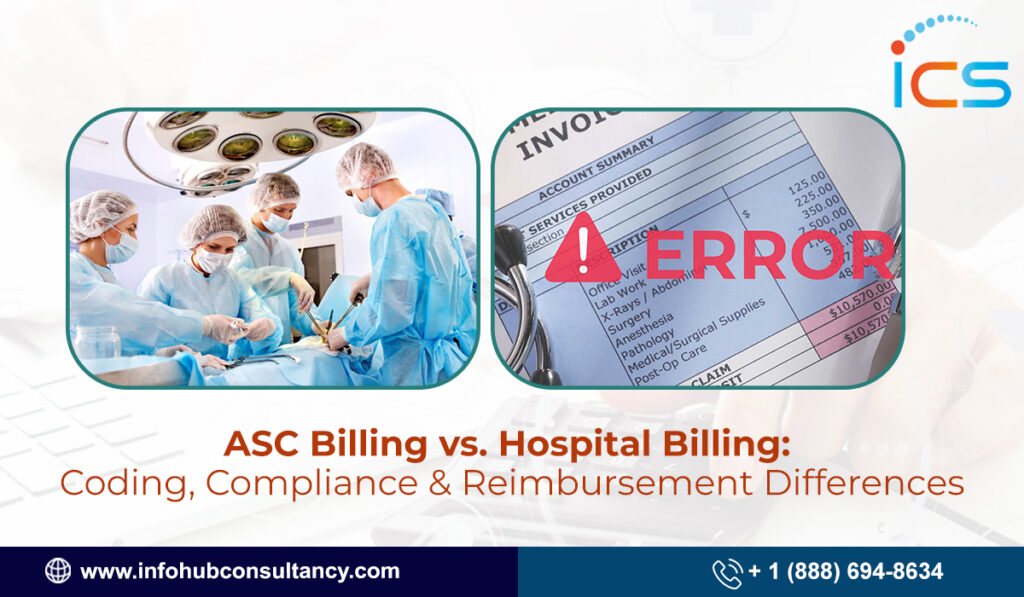
ASC billing and hospital outpatient billing can describe the same procedure but follow different facility, claim and payment rules. A freestanding ambulatory surgical center bills its facility service under the ASC payment system, while a hospital outpatient department bills under the Hospital Outpatient Prospective Payment System (OPPS). Professional fees are separate from both facility claims.
ASC billing vs hospital billing at a glance
| Billing element | Freestanding ASC | Hospital outpatient department |
|---|---|---|
| Medicare facility payment system | ASC Payment System | Hospital OPPS |
| Typical facility claim | 837P/CMS-1500 pathway for the ASC facility service | 837I/CMS-1450 (UB-04) institutional pathway |
| Procedure eligibility | Procedure must meet ASC coverage and payment requirements, including the ASC Covered Procedures List when applicable | OPPS status indicators and hospital outpatient payment rules apply |
| Payment grouping | ASC payment indicators and ASC rates | Ambulatory Payment Classifications, status indicators and OPPS packaging |
| Professional claim | Surgeon and other practitioner services are billed separately | Surgeon and other practitioner services are billed separately |
| Common billing risk | Wrong facility/professional split, non-covered procedure, implant or device reporting error | Wrong revenue code, status indicator, packaging or outpatient/inpatient classification |
The payer contract and current billing instruction control the final claim. Commercial payers may use different forms, groupers, authorizations and reimbursement terms from Medicare, so teams should not automatically copy Medicare logic to every payer.
InfoHub Consultancy handles complete medical billing, coding, and RCM for US healthcare providers — HIPAA compliant, offshore efficiency, proven results.
Get a Free Consultation →What is ASC billing?
ASC billing covers the facility resources used for an eligible outpatient surgical procedure in a freestanding ambulatory surgical center. The facility claim may include items and services packaged into the ASC payment plus separately payable ancillary services when Medicare rules allow them. The surgeon, anesthesia professional, pathologist or other practitioner generally submits a separate professional claim for their work.
For Medicare, the procedure must satisfy the rules of the ASC payment system. CMS publishes the regulations, annual files, payment indicators and covered-procedure information on its ASC Regulations and Notices page.
What is hospital outpatient billing?
Hospital outpatient billing covers services furnished by a hospital outpatient department. Medicare facility reimbursement is generally processed through OPPS using HCPCS codes, revenue codes, Ambulatory Payment Classifications, status indicators and packaging rules. Hospital departments also need the institutional data elements associated with the 837I or CMS-1450 claim.
CMS publishes current policy files, quarterly updates and payment-system resources on the official Hospital Outpatient PPS page.
The six billing differences that matter most
1. Facility eligibility and place of service
The billing entity and care setting determine which facility payment system applies. Teams should confirm the facility’s enrollment, certification, service location and payer contract before claim creation. The place of service on a practitioner’s claim must also align with where the service occurred.
2. Claim format and data structure
A freestanding ASC and a hospital outpatient department do not use identical facility-claim structures. Using the wrong transaction, bill type, revenue code or provider identifier can cause front-end rejection before medical necessity or coding is reviewed.
3. Payment indicators and packaging
The ASC payment system and OPPS have different indicators, relative weights and packaging logic. A device, drug or ancillary service that is packaged in one setting may require different reporting or payment treatment in another. Use the file and quarter effective for the date of service.
4. Covered procedure rules
For Medicare ASC payment, teams must confirm that the procedure is eligible under current ASC rules. Hospital outpatient reporting uses OPPS logic and its own status indicators. Clinical suitability and payer coverage remain separate from code availability.
5. Professional and facility claim separation
The facility payment does not automatically include every professional service. Surgeon, anesthesia, pathology and other practitioner claims must be coordinated without duplicating items already included in the facility payment. A reconciliation step should compare the operative record, facility claim and professional claims before release.
6. Authorization, documentation and payer policy
Authorization may be tied to a specific site of service. A procedure authorized for a hospital outpatient department may not automatically be authorized at a freestanding ASC, or vice versa. The medical record should support the procedure, laterality, implants, anesthesia, diagnosis, discharge status and any modifier used.
What changed for Medicare ASC and OPPS billing in 2026?
CMS updates both payment systems annually and publishes quarterly operational changes. For calendar year 2026, CMS finalized a 2.6% payment-rate update for qualifying hospitals under OPPS and a 2.6% update factor for ASCs that meet the relevant quality-reporting requirements. CMS also revised the ASC Covered Procedures List criteria and added procedures to the list. The official CY 2026 OPPS and ASC final-rule fact sheet summarizes these changes.
A rate update does not mean every claim increases by the same percentage. Payment still depends on the service, indicators, wage adjustments, packaging and other applicable rules. Teams should use the current CMS addenda and payer contract rather than applying a blanket percentage to expected reimbursement.
Pre-bill checklist for surgical facility claims
- Confirm the facility type, enrollment and exact site of service.
- Verify eligibility, benefits, authorization and network requirements for that site.
- Use the correct facility claim pathway and provider identifiers.
- Validate procedure eligibility and the current payment/status indicators.
- Reconcile procedure, diagnosis, laterality, devices, drugs, units and modifiers to the record.
- Separate facility and professional services without duplicate reporting.
- Run payer edits, review acknowledgments and track denials by root cause.
Common ASC and hospital outpatient denial causes
- Procedure is not payable in the reported setting.
- Authorization names a different facility or site of service.
- Facility and professional claims use inconsistent procedure details.
- Revenue code, bill type, place of service or provider identifier is incorrect.
- Device, drug, implant or ancillary-service reporting does not follow payer rules.
- Documentation does not support modifier, units, laterality or medical necessity.
- Quarterly payment-system updates were not loaded into the billing workflow.
Choose the right billing workflow for your facility
ICS supports US healthcare organizations with setting-specific claim review, coding coordination, denial follow-up and reporting. The comparison page explains the rules; the dedicated service pages remain the commercial owners for ASC and hospital billing.
ASC billing vs hospital billing FAQs
Is ASC billing the same as hospital outpatient billing?
No. Medicare uses separate facility payment systems and claim structures for freestanding ASCs and hospital outpatient departments. Coverage, packaging and payment indicators can differ even when the procedure code is the same.
Do surgeons bill separately from an ASC or hospital facility?
Generally, yes. The facility and practitioner report their respective services on separate claims. The claims should be reconciled to the same operative record without duplicate reporting.
Can every outpatient surgery be performed and billed in an ASC?
No. The procedure, patient, facility and payer rules must support the ASC setting. For Medicare, teams should check the current ASC Covered Procedures List and related payment instructions.
Why can reimbursement differ between an ASC and hospital outpatient department?
The settings use different payment systems, indicators, weights, packaging and adjustments. Contract terms and payer policies may also differ. Expected reimbursement should be calculated using the applicable setting-specific rule.
Information is current as of September 2026 and is intended for general billing education. Verify the payer, CMS and MAC instructions that apply to the specific date of service.
Related Blogs


InfoHub Consultancy handles complete medical billing, coding, and RCM for US healthcare providers — HIPAA compliant, offshore efficiency, proven results.
Get a Free Consultation →