Revenue Cycle Management
  Insurance Verification
  Appointment Scheduling
  Charge Entry
  Denials Management
  Medical Billing
  Claims Submissions
  Payment Posting
  AR – Follow-ups
  Medical Coding
  Reporting
  Patient’s Statement
  Authorization
  Charge Review & Auditing (Coding & Billing)
  Compliance & Audit Readiness
  Clearing House & EDI Management
  Credentialing
  View All 65
Specialties
View All 65
Specialties Allergy and Immunology
  Ambulance
 Ambulatory Surgical Center
 Anesthesia
 Assisted Living Facility (ALF)
 Behavioral Health
 Cardiology
 Chiropractic
 Chronic Care Management (CCM)
 Community Behavioral Health
 Dental
 Dermatology
 Durable Medical Equipment
 Emergency Room
 Endocrinology & Diabetes
 Family Practice
 Gastroenterology
 General Surgery
 Geriatrics
 Healthcare
 7 mins read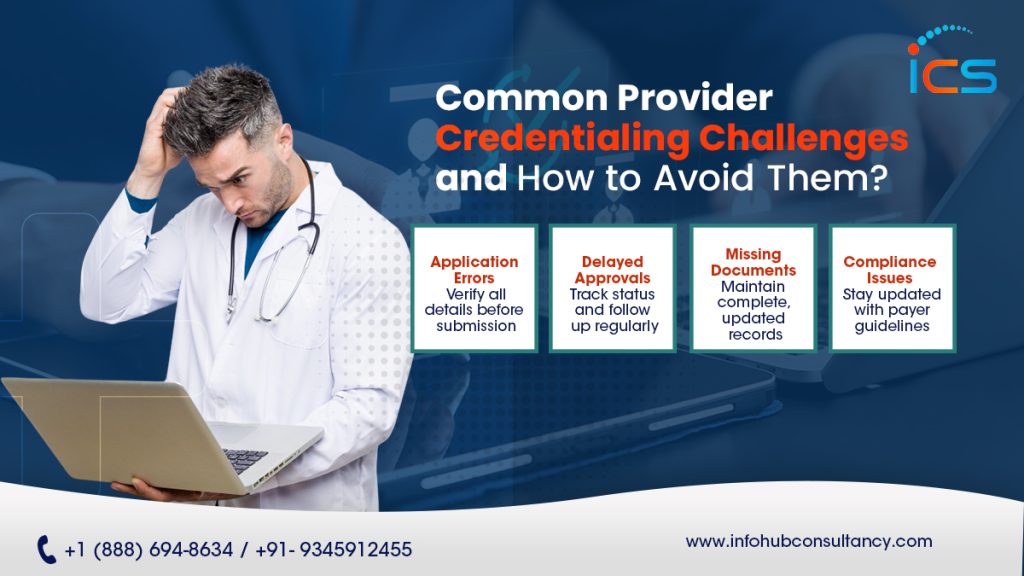
Why does a process meant to verify provider qualifications end up delaying care, revenue, and operations for months? In many healthcare organizations, provider credentialing takes an average of 90 to 120 days, and in some cases even longer depending on payer requirements.
According to the research, over half of healthcare organizations experience revenue losses due to credentialing delays, with some hospitals reporting losses exceeding $1 million annually.
These numbers highlight a deeper issue which makes credentialing a critical factor influencing financial performance, compliance, and patient access. Therefore, understanding where challenges arise and how to address them effectively has become essential for healthcare organizations aiming to operate efficiently.
This blog explores the most common provider credentialing challenges and outlines practical strategies to overcome them.
What are the Provider Credentialing Challenges?
Provider credentialing often presents multiple operational and administrative challenges that can delay approvals and affect revenue cycles. These issues usually arise due to process gaps, lack of coordination, or outdated systems. Therefore, identifying these challenges clearly helps healthcare organizations take corrective actions and improve overall credentialing efficiency.
Delayed Provider Onboarding Timelines
Credentialing timelines often extend between ninety to one hundred eighty days, which significantly delays provider onboarding. This directly affects the ability to begin billing and generate revenue. Therefore, prolonged processing periods can disrupt workflows and require proactive planning to minimize financial impact and operational inefficiencies across healthcare organizations.
Incomplete Initial Application Submissions
Applications are often submitted with missing information or incomplete supporting documents, which leads to delays or rejections. Even minor omissions can slow down the entire process. Therefore, ensuring that every required field is completed accurately is essential to maintain efficiency and avoid unnecessary interruptions in credentialing workflows.
Data Discrepancies Across Platforms
Differences in provider information across systems such as CAQH and payer applications can create confusion during verification. In fact,inconsistent employment details or credentials often trigger additional reviews. Therefore, maintaining uniform and accurate data across all platforms is essential to ensure smooth processing and prevent avoidable credentialing delays.
Expired Licenses, Certifications, and Registrations
Lapsed licenses or certifications can immediately halt credentialing progress and create compliance issues. Providers may be restricted from delivering services until renewals are completed. Therefore, tracking expiration dates and ensuring timely renewals is critical to maintaining uninterrupted operations and meeting regulatory requirements consistently.
Inefficient Document Storage and Retrieval
Poorly organized document systems make it difficult to access important records when required. In fact, missing or misplaced files can delay submissions and verification processes. Therefore, maintaining a structured and easily accessible documentation system is essential to support efficient credentialing workflows and reduce administrative delays.
Lack of Real-Time Status Tracking
Without proper tracking systems, healthcare organizations often struggle to monitor the progress of credentialing applications. This lack of visibility can lead to missed updates and delayed actions. Thereby, implementing real-time tracking helps identify bottlenecks early and ensures timely completion of each stage in the credentialing process.
Limited Follow-Up with Payers
Infrequent follow-up with payers can cause applications to remain pending for extended periods. In fact, lack of consistent communication slows down approvals and the resolution of issues. As a result, regular and structured follow-up is essential to keep the process moving forward and ensure timely credentialing outcomes.
Variability in Payer-Specific Requirements
Different payers have unique forms, documentation standards, and submission processes, which increases complexity. In fact, managing these varying requirements can lead to confusion and errors. Therefore, understanding and organizing payer-specific guidelines is essential to ensure accurate submissions and reduce delays in credentialing approvals.
Credentialing Backlogs During High Growth
During periods of expansion, healthcare organizations may onboard multiple providers simultaneously, creating credentialing backlogs. Increased workload without adequate resources slows down processing times. Therefore, proper planning and resource allocation are necessary to manage higher volumes efficiently and prevent delays in provider approvals.
Compliance Risks Due to Documentation Gaps
Incomplete or outdated documentation can increase the risk of non-compliance with regulatory standards. Missing records may lead to audit issues or penalties. Therefore, maintaining accurate and up-to-date documentation is essential to ensure compliance and support smooth credentialing processes without disruptions.
How to Avoid Credentialing Challenges?
Undoubtedly, addressing credentialing challenges requires a proactive and structured approach that focuses on accuracy, organization, and timely action. In fact, healthcare organizations can streamline processes and reduce delays by implementing effective strategies. Therefore, adopting these solutions helps improve efficiency, ensure compliance, and support consistent provider onboarding.
Initiate Credentialing at the Pre-Hiring Stage
Starting the credentialing process before the provider officially joins allows sufficient time for verification and approvals. In fact, early initiation helps avoid onboarding delays and ensures readiness for service delivery. Therefore, proactive planning supports smoother transitions and enables providers to begin billing without unnecessary interruptions.
Standardize Application Data Collection
Using structured templates to collect provider information ensures consistency and completeness across all applications. This reduces the risk of missing or incorrect data. Therefore, standardized data collection improves accuracy, speeds up submissions, and minimizes delays caused by incomplete or inconsistent information.
Maintain a Single Source of Truth for Provider Data
Centralizing provider information in one reliable system ensures consistency across all credentialing platforms. This reduces discrepancies and duplication of records. Therefore, maintaining a single source of accurate data supports smooth verification processes and helps prevent delays caused by conflicting information.
Implement Automated Expiry and Renewal Alerts
Automated systems can track expiration dates of licenses and certifications while sending timely reminders. This reduces the risk of missing important renewals. Therefore, automation helps maintain compliance, ensures continuous credential validity, and prevents disruptions in provider eligibility and service delivery.
Use Secure Digital Document Management Systems
Digital platforms allow organized storage and easy retrieval of credentialing documents. This minimizes the risk of losing or misplacing important records. Therefore, secure document management systems improve operational efficiency and support faster processing of applications with reduced administrative burden.
Establish Real-Time Tracking Dashboards
Tracking dashboards provide clear visibility into the status of each credentialing application. This helps teams identify delays and take corrective actions quickly. Therefore, real-time monitoring improves control over the process and ensures timely completion of credentialing activities.
Create a Structured Follow-Up Protocol
Establishing a routine follow-up schedule with payers ensures that applications are actively monitored and progressed. Regular communication helps resolve issues promptly. Therefore, a structured follow-up approach prevents unnecessary delays and keeps the credentialing process moving efficiently.
Develop Payer-Specific Requirement Checklists
Maintaining detailed checklists for each payer ensures that all submission requirements are met accurately. This reduces confusion and prevents missing documentation. Therefore, organized checklists improve submission accuracy and streamline the credentialing process across multiple insurance providers.
Allocate Dedicated Credentialing Resources
Assigning trained professionals such as InfoHub Consultancy Services to manage credentialing tasks improves accountability and efficiency. In fact, dedicated staff focus on submissions, tracking, and follow-ups. Therefore, having specialized resources ensures better coordination and faster completion of credentialing processes without unnecessary delays.
Conduct Periodic Compliance Audits
Regular audits help identify gaps in documentation and credentialing processes before they become serious issues. This ensures continuous compliance with regulatory standards. Therefore, periodic reviews support ongoing improvements and reduce the risk of errors, delays, or penalties.
Optimize Credentialing Efficiency via Outsourcing Medical Billing and Coding Service Providers in India
Outsourcing credentialing to specialized partners such as InfoHub Consultancy Services allows healthcare organizations to handle complex enrollment workflows with greater precision. These providers bring structured processes, payer-specific expertise, and dedicated follow-up systems. In fact, practices can reduce administrative delays, improve approval timelines, and maintain consistent compliance by leveraging ICS support.
FAQs
What is provider credentialing in healthcare?
It is the process of verifying a provider’s qualifications to ensure they meet payer and regulatory requirements.
Why is credentialing important for healthcare organizations?
It ensures providers are authorized to deliver care and receive reimbursements from insurance companies.
What role does CAQH play in credentialing?
It acts as a centralized database where providers store and share their professional information with payers.
Related Blogs
Credentialing operates as an essential cornerstone within the healthcare industry as it only authorizes skilled healthcare professionals to offer patient Read more
Credentialing is a vital process that verifies healthcare providers' qualifications to treat patients and work with insurance companies. This verification Read more
Healthcare practices are constantly navigating the complexities of both patient care and administrative tasks. Credentialing, a critical aspect of healthcare Read more