Revenue Cycle Management
  Insurance Verification
  Appointment Scheduling
  Charge Entry
  Denials Management
  Medical Billing
  Claims Submissions
  Payment Posting
  AR – Follow-ups
  Medical Coding
  Reporting
  Patient’s Statement
  Authorization
  Charge Review & Auditing (Coding & Billing)
  Compliance & Audit Readiness
  Clearing House & EDI Management
  Credentialing
  View All 65
Specialties
View All 65
Specialties Allergy and Immunology
  Ambulance
 Ambulatory Surgical Center
 Anesthesia
 Assisted Living Facility (ALF)
 Behavioral Health
 Cardiology
 Chiropractic
 Chronic Care Management (CCM)
 Community Behavioral Health
 Dental
 Dermatology
 Durable Medical Equipment
 Emergency Room
 Endocrinology & Diabetes
 Family Practice
 Gastroenterology
 General Surgery
 Geriatrics
 Healthcare
 6 mins read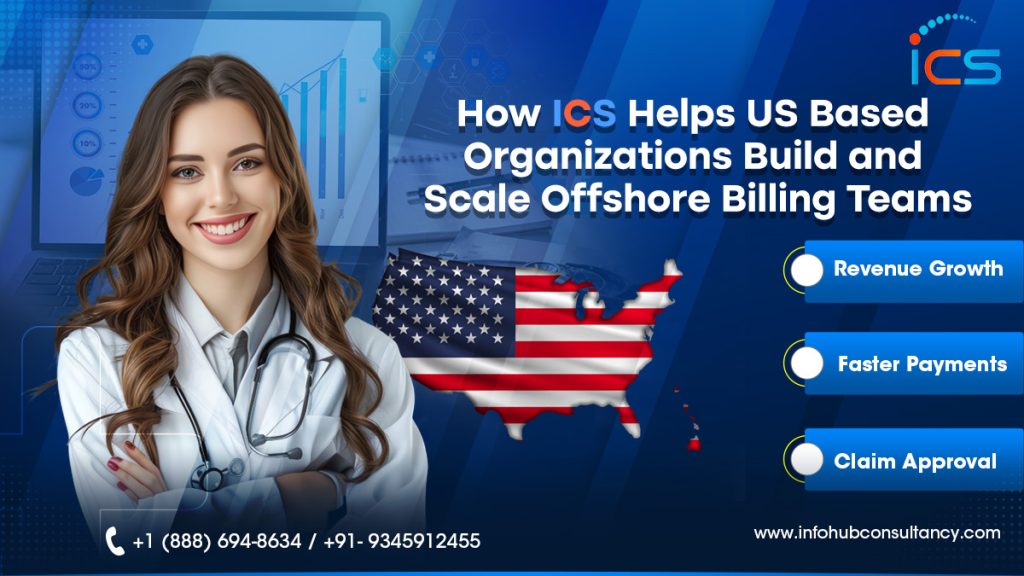
Healthcare billing is becoming increasingly complex and the pressure to maintain strong revenue performance continues to intensify.
According to the research, denial rates across medical claims can range between 5% and 10%, while staffing shortages in revenue cycle roles remain a persistent challenge in the U.S. At the same time, operational costs continue to rise.
How can billing companies grow under these conditions without stretching internal teams too thin? How can expansion happen without multiplying fixed expenses?
Scaling successfully demands a structured model that balances cost efficiency, compliance, accuracy and speed. Though offshore billing has emerged as a strategic growth lever, the real differentiator lies in how it is built, managed, and aligned with existing operations.
This blog examines how ICS helps the U.S.-based organizations strategically build and scale offshore billing teams in India.
-
Workforce Planning
A successful offshore setup begins with a detailed assessment of billing workflows, claim volumes, payer mix, and specialty requirements. ICS evaluates operational gaps and identifies the exact roles needed to maintain efficiency. In fact, reporting structures, workload distribution, and measurable benchmarks are clearly defined during this phase. This planned workforce structure ensures that the offshore team supports current demands while remaining adaptable for long-term expansion.
-
Talent Selection
Building a dependable billing team requires thorough screening and skill validation. ICS selects professionals with proven experience in U.S. medical billing processes and coding standards. Communication abilities and technical knowledge are assessed before final deployment. This careful selection process strengthens quality control and ensures that only competent professionals become part of the offshore team.
-
Rapid Hiring
Scaling operations often demand quick staffing solutions to avoid workflow disruptions. ICS maintains access to trained billing professionals, which significantly reduces recruitment timelines. Therefore, organizations avoid extended hiring cycles and internal training delays. Faster deployment helps manage sudden workload increases and supports business growth without interrupting billing continuity.
-
Structured Onboarding
Every team member follows a defined onboarding framework aligned with the client’s billing systems and processes. Training focuses on specialized roles such as coding, charge entry, AR follow-up, payment posting, and denial management. Internal guidelines and performance expectations are incorporated into daily operations. This structured transition process minimizes initial errors and builds operational consistency.
-
Continuous Training
Regulatory updates and payer policy revisions require billing teams to remain informed and adaptable. ICS provides ongoing education covering CMS updates, payer rule changes, and coding revisions including ICD-10 and CPT updates. In fact, regular skill enhancement improves claim accuracy and reduces preventable denials. Therefore, continuous learning keeps offshore teams aligned with evolving industry standards.
-
Flexible Engagement Models
Operational requirements vary depending on volume and business objectives. ICS offers flexible models such as Full-Time Equivalent staffing and transaction-based engagement options. As a result, resource allocation can be adjusted based on workload fluctuations or seasonal changes. Therefore, financial planning becomes more controlled while operational capacity remains scalable.
-
Specialty Expertise
Different medical specialties require distinct billing knowledge and documentation standards. ICS trains professionals across more than 40 specialties to ensure accurate coding and claim submission. In fact, understanding specialty-specific modifiers and payer complexities enhances precision. Improved expertise directly supports higher clean claim rates and reduced revenue leakage.
-
Technology Compatibility
Efficient collaboration depends on familiarity with widely used U.S. billing platforms and EMR systems. ICS professionals are trained to work within established software environments, which reduces integration challenges. Moreover, workflow synchronization occurs smoothly without extensive system adjustments. Technical readiness strengthens coordination between offshore and in-house teams.
-
Compliance & Data Security
Patient information protection remains a critical component of offshore billing. ICS implements secure infrastructure, encrypted systems, and controlled access protocols aligned with HIPAA standards. Regular monitoring safeguards data integrity and confidentiality. This compliance-focused framework protects organizations from regulatory risks while maintaining operational trust.
-
Performance Monitoring
Measurable outcomes are essential for sustainable scaling. ICS tracks key performance indicators such as clean claim rates, AR aging, denial trends and turnaround times. Structured reporting enables timely identification of inefficiencies and improvement opportunities. Data-driven oversight ensures consistent productivity and supports long-term revenue cycle optimization.
-
Cost Efficiency
Offshore operations in India provide substantial cost advantages while maintaining quality standards. Organizations can reduce billing expenses by 40–60 percent compared to domestic staffing models. These financial savings create opportunities for reinvestment in expansion, technology upgrades, or strategic initiatives. Cost optimization supports both operational stability and growth.
-
24/7 Workflow Coverage
Time-zone differences create continuous workflow support across business hours. Offshore teams process claims, post payments, and manage denials during U.S. off-hours. Faster processing cycles improve turnaround times and accelerate cash flow. Continuous operational coverage strengthens revenue realization and enhances overall efficiency.
-
Scalability Planning
Business growth requires billing infrastructure that expands without disruption. ICS designs team structures that allow additional professionals to be integrated smoothly when demand increases. Expansion can occur incrementally or rapidly depending on client needs. A scalable model ensures that billing operations evolve alongside organizational growth objectives.
-
Quality Assurance Controls
Maintaining high accuracy requires systematic internal reviews and monitoring practices. ICS conducts audits, peer evaluations, and claim sampling to detect inconsistencies early. Corrective feedback is implemented promptly to maintain precision. Strong quality controls reinforce reliability and protect revenue performance as operations scale.
Integration as a Seamless Extension of In-House Teams
ICS approaches offshore collaboration as a strategic operational partnership rather than a traditional vendor arrangement. The offshore billing team is integrated into the client’s daily processes and aligns with internal workflows, reporting structures and performance expectations. As a result, responsibilities are clearly mapped to complement existing in-house functions without creating overlap or confusion.
In fact, the communication channels remain structured yet responsive, which enables timely updates and faster resolution of operational concerns. Additionally, teams maintain full visibility into productivity, quality indicators, and workflow progress through transparent reporting systems. This coordinated model allows organizations to expand billing capacity while preserving internal culture, maintaining operational consistency, and retaining complete decision-making control.
FAQs
Can small billing companies benefit from offshore scaling?
Even small firms can expand capacity strategically without heavy capital investment.
Can offshore teams handle multi-provider or multi-location billing?
Teams are structured to manage complex provider networks and multiple facility workflows.
What happens if billing volumes suddenly increase?
ICS can quickly expand team capacity to accommodate higher claim volumes.
How does ICS ensure long-term team stability?
Structured retention strategies and internal performance management maintain continuity.
Related Blogs

Is your startup or new medical practice struggling to balance growth with the demands of billing and coding? Are rising Read more
Healthcare organizations are facing growing financial pressure as administrative costs continue to rise and reimbursement processes become more complex. Studies Read more
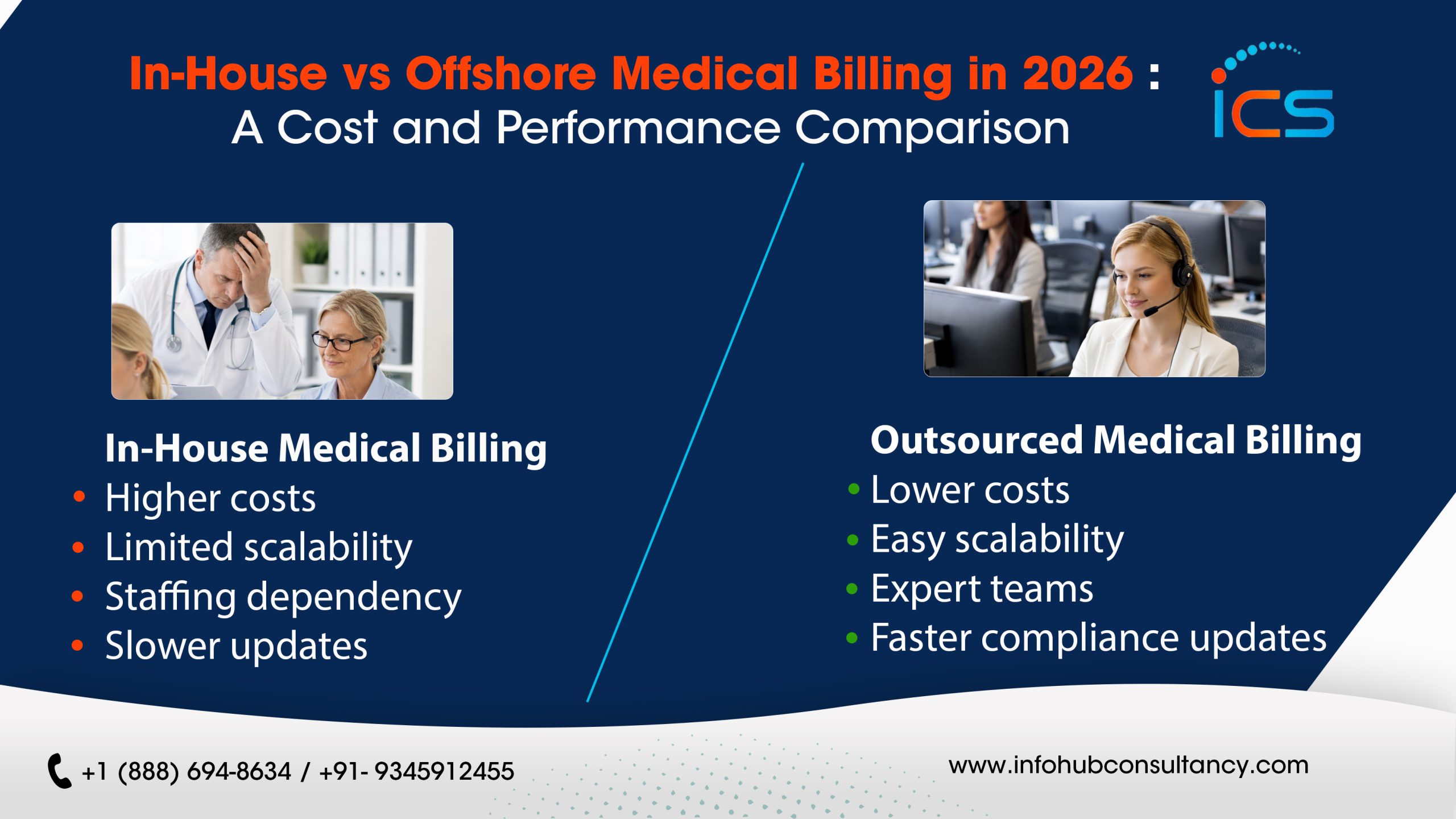
As healthcare operations become more complex in 2026, medical practices are increasingly rethinking how they manage billing. In fact, rising Read more