Revenue Cycle Management
  Insurance Verification
  Appointment Scheduling
  Charge Entry
  Denials Management
  Medical Billing
  Claims Submissions
  Payment Posting
  AR – Follow-ups
  Full-Time Equivalent (FTE) Model
 Medical Coding
  Reporting
  Patient’s Statement
  Authorization
  Charge Review & Auditing (Coding & Billing)
  Compliance & Audit Readiness
  Clearing House & EDI Management
  Credentialing
  View All 65
Specialties
View All 65
Specialties Allergy and Immunology
  Ambulance
 Ambulatory Surgical Center
 Anesthesia
 Assisted Living Facility (ALF)
 Behavioral Health
 Cardiology
 Chiropractic
 Chronic Care Management (CCM)
 Community Behavioral Health
 Dental
 Dermatology
 Durable Medical Equipment
 Emergency Room
 Endocrinology & Diabetes
 Family Practice
 Gastroenterology
 General Surgery
 Geriatrics
 Healthcare
 6 mins read
Healthcare organizations lose nearly 5–10 percent of their annual revenue due to billing inefficiencies, delayed claims, and avoidable denials, while persistent staffing shortages continue to strain internal billing teams.
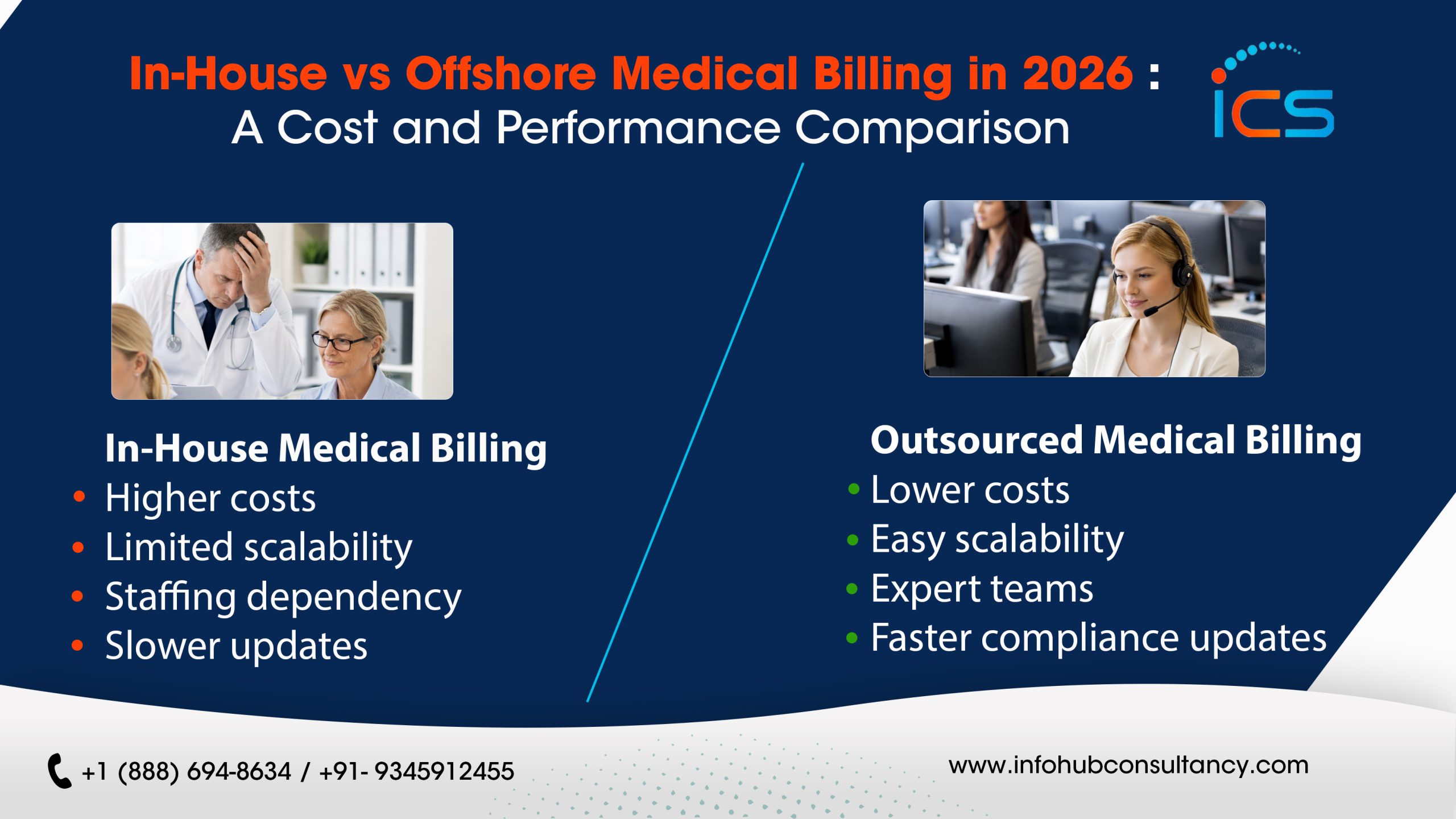
At the same time, practices leveraging offshore billing support report 20–30 percent faster claim processing and improved revenue cycle performance, highlighting the positive impact of effective integration.
However, outsourcing alone does not guarantee results. Instead, sustainable success depends on how well offshore billing teams integrate with in-house operations. When alignment, accountability, and collaboration are established effectively, offshore teams operate as a natural extension of internal staff, building on the advantages discussed above.
InfoHub Consultancy handles complete medical billing, coding, and RCM for US healthcare providers — HIPAA compliant, offshore efficiency, proven results.
Get a Free Consultation →This blog explains how structured integration enables accuracy, continuity, and long-term revenue stability across healthcare billing operations.
Technology Alignment and System Access
Common Billing Systems
Offshore billing teams use the same EHR and practice management platforms as internal teams, creating a single source of truth for billing data. This shared environment supports smooth task transitions, consistent claim handling, and reliable coordination across locations, helping revenue cycle activities progress without disruption or data inconsistency.
Secure System Access
System access for offshore teams is enabled through tightly controlled, encrypted remote environments. These security layers protect sensitive patient information while allowing uninterrupted billing operations. In fact, the healthcare organizations maintain compliance standards without slowing daily workflows or limiting offshore productivity by combining accessibility with strict safeguards.
Real-time Workflow Visibility
Offshore and in-house teams track billing progress, claim status, and work queues simultaneously. This shared visibility improves coordination and reduces dependency on manual updates. In fact, they are identified earlier when issues arise, allowing teams to respond quickly and keep workflows aligned without unnecessary delays or operational bottlenecks.
Standardized Workflows and SOP Consistency
Unified Billing Processes
Offshore teams follow the same billing workflows and standard operating procedures as internal staff. This consistency ensures tasks are completed uniformly across locations. Standardized execution reduces variability, improves predictability in billing outcomes, and supports smoother coordination throughout each stage of the revenue cycle.
Coding and Payer Rules
Coding standards and payer-specific requirements are applied consistently across offshore and in-house teams. In fact, uniform interpretation of ICD-10, CPT, and payer guidelines improves claim accuracy and reduces avoidable denials. This alignment strengthens compliance, supports timely reimbursements, and minimizes financial discrepancies caused by inconsistent rule application.
Documentation Standards
Clear documentation guidelines define how billing information is captured, stored, and referenced. Consistent documentation improves data reliability across claims and patient records. It also supports audits, reduces rework, and ensures downstream billing activities are based on complete and accurate information.
Time-Zone–Driven Operational Continuity
Round-the-Clock Processing
Offshore teams operating in different time zones allow billing work to continue beyond in-house business hours. This approach keeps workflows moving without extending internal schedules. Continuous activity reduces idle time, supports faster claim progression, and maintains steady momentum across revenue cycle functions.
Overnight Claim Handling
During overnight hours, offshore teams process claims, denials, and accounts receivable follow-ups. As a result, tasks are already advanced and ready for review by morning. This handoff model improves daily productivity, shortens processing cycles, and prevents backlogs from accumulating during off-hours.
Faster Revenue Movement
As billing activities continue, delays across the revenue cycle are reduced. Shorter processing timelines support quicker reimbursements and more predictable cash flow. This operational efficiency strengthens financial stability while allowing organizations to maintain compliance and quality standards.
Clearly Defined Roles and Task Segmentation
In-House Focus Areas
Internal billing teams retain responsibility for complex cases, payer escalations, and compliance-sensitive decisions. Keeping these tasks in-house ensures direct oversight, stronger accountability, and accurate handling of high-risk scenarios that require institutional knowledge and regulatory judgment.
Offshore Task Execution
Offshore billing teams manage high-volume, routine functions such as charge entry, claim submission, and payment posting. In fact, assigning these repetitive tasks offshore increases throughput while maintaining accuracy, allowing internal teams to focus on strategic and exception-based work.
Balanced Workload
Clearly defined responsibilities prevent duplication of effort and confusion between teams. In fact, balanced task distribution reduces pressure on internal staff, improves productivity, and supports steady workflow progression across all billing functions without overloading any single group.
Leadership and Reporting Structure
Offshore Team Leads
Offshore team leads oversee daily operations, monitor productivity, and ensure adherence to established workflows. Therefore, they maintain performance consistency, address issues promptly, and keep operations aligned with organizational expectations by acting as a bridge between offshore staff and in-house managers.
Clear Escalation Paths
Defined escalation protocols outline how billing issues are reported and resolved. This clarity ensures accountability at every level and prevents delays caused by unclear ownership. Structured escalation supports faster resolution while keeping workflows stable and uninterrupted.
Communication and Collaboration Framework
Scheduled Check-Ins
Regular meetings create structured touchpoints for reviewing progress, priorities, and challenges. These sessions improve coordination, provide opportunities for clarification, and ensure both offshore and in-house teams remain aligned on daily and weekly objectives.
Issue Resolution
Transparent communication channels enable billing issues to be identified and addressed quickly. Early resolution minimizes disruptions, prevents small errors from escalating, and supports smoother workflow continuity across interconnected billing tasks.
Operational Alignment
Ongoing collaboration keeps billing activities synchronized across locations. Clear handoffs, shared updates, and consistent communication reduce errors and ensure tasks move seamlessly between offshore and in-house teams while maintaining quality and compliance.
Compliance, Security, and Quality Assurance
Regulatory Compliance
Offshore billing operations follow HIPAA and data privacy regulations to protect patient information. In fact, adherence to compliance standards reduces legal risk, supports audit readiness, and reinforces confidence in offshore billing partnerships.
Quality Monitoring
Routine audits and quality checks assess accuracy, consistency, and adherence to processes. Continuous monitoring helps identify gaps, supports corrective actions, and ensures billing operations meet organizational and regulatory expectations.
Data Protection
Robust security measures safeguard patient and financial data throughout the billing lifecycle. Secure handling practices prevent unauthorized access, protect confidentiality, and allow offshore and in-house teams to collaborate effectively within a trusted operational framework.
Conclusion
Effective integration between offshore billing teams and in-house operations goes beyond cost optimization and task delegation. It requires a structured, relationship-driven approach built on trust, accountability, and shared performance goals. When offshore teams operate as an extension of internal staff, the healthcare organizations gain greater operational stability, improved responsiveness, and the flexibility to scale billing functions without disruption. In fact, the true value lies in long-term partnership, continuous improvement, and operational alignment rather than short-term outsourcing decisions.
InfoHub Consultancy Services supports this integration-driven model by providing offshore billing teams that are aligned with internal workflows, performance expectations, and regulatory standards. Through a collaborative and structured approach, ICS helps healthcare organizations build sustainable billing operations that support efficiency, consistency, and long-term revenue growth.
FAQs
What happens if payer rules change suddenly?
Integrated offshore teams adapt quickly through centralized updates and rapid retraining.
Are offshore billing teams customizable by specialty?
Teams are often trained for specialty-specific billing and payer requirements.
How does offshore integration impact staff burnout?
It reduces in-house workload pressure, improving retention and staff satisfaction.
Related Blogs


InfoHub Consultancy handles complete medical billing, coding, and RCM for US healthcare providers — HIPAA compliant, offshore efficiency, proven results.
Get a Free Consultation →