Revenue Cycle Management
  Insurance Verification
  Appointment Scheduling
  Charge Entry
  Denials Management
  Medical Billing
  Claims Submissions
  Payment Posting
  AR – Follow-ups
  Medical Coding
  Reporting
  Patient’s Statement
  Authorization
  Charge Review & Auditing (Coding & Billing)
  Compliance & Audit Readiness
  Clearing House & EDI Management
  Credentialing
  View All 65
Specialties
View All 65
Specialties Allergy and Immunology
  Ambulance
 Ambulatory Surgical Center
 Anesthesia
 Assisted Living Facility (ALF)
 Behavioral Health
 Cardiology
 Chiropractic
 Chronic Care Management (CCM)
 Community Behavioral Health
 Dental
 Dermatology
 Durable Medical Equipment
 Emergency Room
 Endocrinology & Diabetes
 Family Practice
 Gastroenterology
 General Surgery
 Geriatrics
 Healthcare
 6 mins read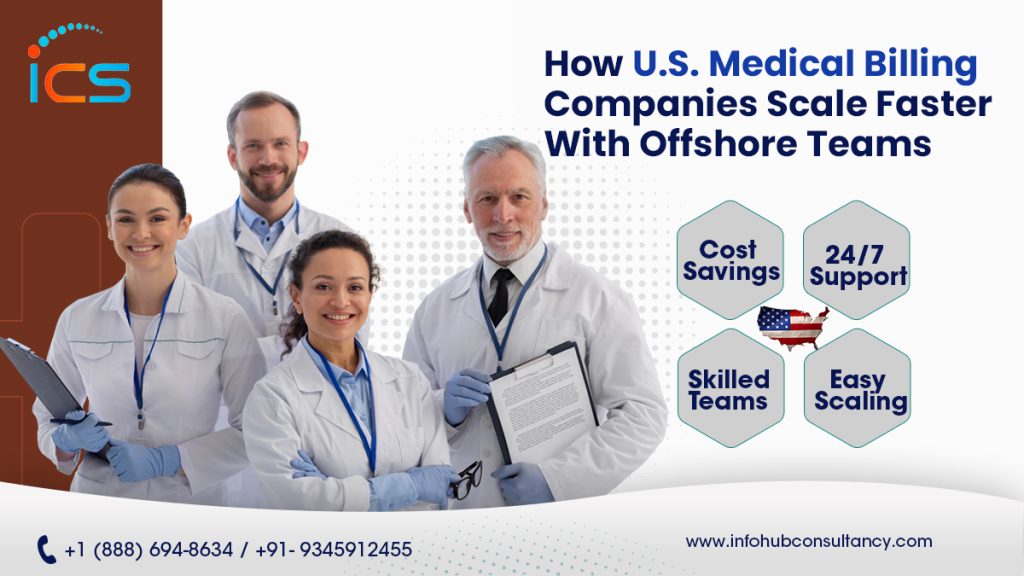
Why are U.S. medical billing companies finding it more challenging to scale with in-house teams alone?
Every year, the healthcare system processes billions of claims, yet a large percentage still contain errors on first submission.
What happens next?
Denials increase, payments slow down, and internal teams become overwhelmed. At the same time, labor costs are rising, staffing shortages persist, and compliance requirements continue to change.
So how do billing companies grow without adding complexity? This shift has led many organizations to rethink traditional models and turn to offshore teams as a practical way to expand capacity, improve efficiency, and scale faster in an increasingly demanding healthcare industry.
This blog will explore how offshore teams help U.S. medical billing companies scale faster without increasing operational complexity.
How Offshore Teams Power Rapid Growth in the U.S. Medical Billing Companies
U.S. medical billing companies are under constant pressure to grow while controlling costs, maintaining compliance, and meeting payer demands. However, scaling with in-house teams alone often leads to delays, higher expenses, and operational strain. As a result, offshore teams have become a strategic enabler to help billing companies expand faster by improving capacity, efficiency, and revenue performance without adding internal complexity.
-
Multi-Specialty Expertise
Offshore teams bring hands-on experience across multiple medical specialties, enabling U.S. billing companies to expand their service offerings quickly. Instead of investing time in training internal staff for each specialty, companies gain immediate access to skilled professionals. As a result, onboarding new clients becomes faster, accuracy improves and internal expertise gaps no longer limit growth.
-
24/7 Revenue Cycle Continuity
With offshore teams working in different time zones, billing activities continue beyond U.S. working hours. Though onshore teams log off, offshore professionals handle claim submissions, follow-ups, and denial reviews. As a result, work progresses without interruption, turnaround times shorten and payments move through the revenue cycle faster. This continuous workflow plays a critical role in supporting rapid operational scaling.
-
Rapid Team Deployment
Scaling an in-house team often involves lengthy recruitment, onboarding, and training processes. In contrast, offshore partners can deploy trained billing and coding professionals within a short timeframe. Therefore, U.S. medical billing companies can respond immediately to new client demands or volume increases. This speed eliminates growth bottlenecks and allows businesses to scale capacity without slowing operations.
-
System-Ready Integration
Offshore billing teams are already experienced with widely used EHR and practice management platforms. As a result, they integrate smoothly into existing workflows without requiring system changes or extensive setup. This compatibility reduces operational friction and ensures consistency across processes. Consequently, billing companies can scale their operations without disrupting established systems or retraining internal teams.
-
Growth-Aligned Performance Models
Many outsourcing medical billing and coding service providers in India operate under performance-based engagement models tied to measurable outcomes. As a result, offshore teams focus on efficiency, accuracy, and turnaround times that directly support business growth. This alignment ensures that scaling does not compromise performance. Instead, billing companies benefit from structured accountability while expanding their client base and operational reach.
-
Technology Without Capital Spend
Offshore partners often provide access to cloud-based billing tools and automation as part of their services. Therefore, U.S. billing companies gain modern capabilities without investing in expensive infrastructure. This allows organizations to improve efficiency and process large claim volumes with ease. As operations grow, technology supports scalability rather than becoming a limiting factor.
-
Specialty-Focused Coding
Offshore providers frequently assign coders to specific medical specialties. As a result, coding accuracy improves, and specialty-related errors decline. This targeted approach helps maintain consistency even as claim volumes increase. Consequently, billing companies experience fewer denials and more predictable revenue outcomes as they expand into new service areas.
-
Built-In Compliance Readiness
Offshore teams follow structured documentation practices and stay up to date on regulatory changes through continuous training. As a result, billing companies remain aligned with compliance requirements as they scale. This proactive approach reduces audit risk and operational disruptions. Therefore, growth can occur without exposing the organization to compliance-related setbacks.
-
Operational Stability
In-house teams often face challenges such as turnover, leave, or unexpected absences. However, offshore partners provide built-in coverage to ensure continuity. As a result, billing operations continue without delays, even during high-volume periods. This reliability allows companies to scale confidently without worrying about staffing gaps affecting performance.
-
Data-Driven Expansion
Offshore teams deliver structured performance reports that highlight trends, bottlenecks, and areas for improvement. Therefore, billing companies gain better visibility into operational health as they grow. These insights support informed decision-making and process optimization. As a result, scaling becomes more strategic, controlled, and aligned with long-term business goals.
-
Flexible Cost Models
Offshore engagement models offer flexibility through options such as full-time equivalents or transaction-based pricing. Consequently, billing companies can scale operations without taking on fixed overhead costs. This adaptability supports growth while maintaining financial stability. As demand fluctuates, companies can adjust resources without disrupting profitability.
-
Accelerated AR Turnover
Offshore teams help reduce aging receivables by accelerating claim submission and follow-up processes. As a result, cash flow becomes more stable even as billing volumes grow. In fact, this financial consistency supports expansion and reinvestment. Therefore, faster AR movement ensures that scaling operations do not strain revenue cycles or liquidity.
Conclusion
Scaling a medical billing business today requires more than adding staff or extending working hours. It demands operational discipline, measurable performance, and the ability to adapt quickly without increasing internal complexity. Offshore teams play a critical role in enabling this shift by acting as long-term operational extensions rather than short-term support resources.
InfoHub Consultancy Services supports U.S. medical billing companies by building structured offshore teams that align with business goals, compliance expectations, and revenue targets. Instead of offering one-size-fits-all outsourcing, ICS focuses on process ownership, accountability, and continuous improvement. This approach allows billing companies to grow with confidence, maintain control, and scale sustainably in an increasingly demanding healthcare environment.
FAQs
How quickly can an offshore billing team become operational?
Most offshore teams can be fully operational within a few weeks, depending on workflow complexity.
Is offshoring suitable for small medical billing companies?
Offshore teams allow small billing companies to grow without committing to large in-house investments.
Are offshore billing teams scalable during peak claim periods?
Offshore teams can quickly expand capacity during seasonal or volume-based spikes.
How do offshore teams contribute to faster onboarding of new clients?
They increase operational bandwidth, allowing billing companies to onboard clients without delays.
Related Blogs
Did you know that ICD-10 codes change every year and have a direct impact on hospitals, coders, and providers? ICD-10-CM Read more

Every day, healthcare providers face increasing financial pressures. In fact, rising costs, stricter reimbursement policies and complex payer rules make Read more

Undoubtedly, cash flow is the lifeline of any medical practice. But still many providers face the challenge of waiting 60 Read more