Revenue Cycle Management
  Medical Billing Services
  Medical Coding Services
  Specialty Medical Billing
 Healthcare Medical Billing
  Healthcare Medical Coding
  Insurance Verification
  Prior Authorization
  Appointment Scheduling
  Charge Entry
  Charge Review & Auditing
  Claims Submission
  Denials Management
  AR Follow-Up
  Payment Posting
  Patient Statements
  Reporting & Analytics
  Credentialing & Enrollment
  Compliance & Audit Readiness
  Clearing House & EDI Management
  Healthcare BPO
  Healthcare Back Office
  Full-Time Equivalent (FTE) Model
 7 mins read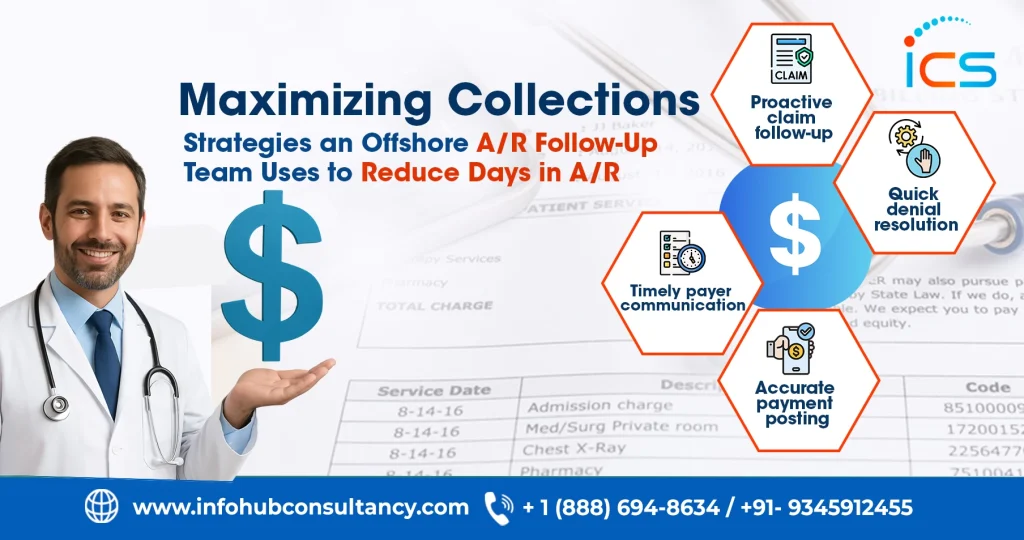
Have you ever questioned why some healthcare organizations manage to receive reimbursements quickly whereas others struggle with long payment delays?
The answer often lies in how well they handle their accounts receivable (A/R) processes. In an era where billing accuracy and timely collections directly impact financial stability, even minor inefficiencies in claim submission or follow-up can result in significant revenue slowdowns.
Offshore A/R follow-up teams have emerged as a powerful solution, offering expertise, round-the-clock operations and technology-driven processes that accelerate collections and improve cash flow.
InfoHub Consultancy handles complete medical billing, coding, and RCM for US healthcare providers — HIPAA compliant, offshore efficiency, proven results.
Get a Free Consultation →This blog will examine the key strategies used by offshore teams to reduce days in accounts receivable (A/R) and enable healthcare practices to maximize their collections effectively.
1. Front-End and Claim Submission
Ensuring Accurate Information
The first step toward faster collections starts at the registration desk. Accurate patient demographics and verified insurance details help prevent claim denials from the outset. This process is supported by offshore teams, who cross-check eligibility and benefits before the claim is created. They ensure that every claim submitted stands a significantly higher chance of being accepted on the first attempt.
Automating Data Entry
Manual data entry often leads to minor but costly errors. Outsourcing medical billing and coding service providers in India use automation tools that integrate with practice management systems to capture and validate data automatically. This reduces human error, speeds up charge entry, and ensures that all patient and claim details are recorded correctly before submission.
Submitting Clean Claims
A “clean claim” means one that contains accurate, verified, and complete information, leaving no reason for a payer to reject it. Offshore teams work within standardized workflows that emphasize claim quality checks before submission. They eliminate delays caused by rejections and rework by consistently sending out clean claims, thereby reducing the overall number of days in A/R.
2. Denial Management
Identifying and Analyzing Denial Trends
When denials occur, they must be treated as opportunities for process improvement. The team of offshore medical billing and coding services in India categorizes denials based on payer type, denial reason, or department, and then analyzes the data to spot recurring issues. This helps identify root causes so that the same mistakes are not repeated.
Proactive Denial Resolution
Instead of waiting for denials to accumulate, offshore teams act immediately upon receiving a denial. They review the claim, correct errors, and resubmit or appeal within the shortest possible time. This proactive approach ensures that claims do not age unnecessarily and that reimbursements are recovered promptly.
Continuous Improvement
Denial management is an ongoing process that depends heavily on knowledge and communication. Offshore billing specialists undergo regular training on payer updates, coding changes and compliance rules. This continuous improvement helps maintain a lower denial rate and ensures smoother cash flow.
3. Follow-Up and Collections
Implementing a Consistent Follow-Up Schedule
Timely and consistent follow-up is key to ensuring that no claim goes unnoticed. Offshore A/R follow-up teams operate according to a predefined schedule to track claims, set reminders and contact payers at regular intervals. As a result, they prevent claims from aging and ensure every pending payment is actively pursued.
Prioritizing Claims by Age and Value
As all claims are different, offshore teams prioritize high-value or older claims first to make the most significant impact on cash flow. This structured approach enables them to manage workloads efficiently and focus on claims that matter most to the healthcare organization’s financial health.
Documenting Every Interaction
The offshore team carefully documents every communication with payers or patients. These records serve as proof of action and make it easier to track progress. Proper documentation also ensures that any team member can pick up where another left off for maintaining consistency and accountability throughout the follow-up process.
Speeding Up Payment Posting
Once payments are received, outsourcing medical billing and coding service providers in India handle posting quickly and accurately. In fact, automated tools help match payments with claims and immediately highlight any discrepancies. This real-time reconciliation ensures that account records are always up to date to give an accurate picture of outstanding balances and reduce unnecessary delays.
4. Patient Payment
Collecting Copays at the Time of Service
Collecting copays upfront is a simple yet highly effective way to reduce patient-related accounts receivable. Offshore teams can support front-desk staff by verifying copay amounts before appointments and reminding patients about their financial responsibilities. When payments are collected early, the overall amount in accounts receivable naturally decreases.
Offering Flexible Payment Options
Patients are more likely to pay quickly when payment is easy and convenient. Offshore billing teams help practices set up online portals, mobile apps, and secure payment links that allow patients to pay at any time. They can also manage recurring payment options and autopay features that ensure consistent monthly collections.
Providing Clear Support
Confusing medical bills often lead to delayed or missed payments. Offshore AR teams help by ensuring that patient statements are clear, detailed and easy to understand. They may also manage patient inquiries or send payment reminders, which encourages timely payment and prevents accounts from aging into bad debt.
5. Utilizing Offshore Advantages
Around-the-Clock Follow-Up
One of the most substantial benefits of an offshore team is time-zone flexibility. Though the local staff ends their day, the offshore team continues follow-ups and claim processing. This 24/7 operation ensures there is no downtime and allows the claims to progress uninterrupted.
Scalability and Cost Efficiency
Offshore teams offer flexibility to scale operations up or down according to claim volume. This adaptability enables healthcare organizations to manage peak workloads without incurring significant cost increases. It ensures that productivity remains high, even during periods of high activity.
Data-Driven Insights and Reporting
Using dashboards and analytics tools, offshore teams monitor key performance indicators, such as denial rate, first-pass resolution rate, and days in accounts receivable. These reports provide valuable insights into collection trends to help in making informed decisions for ongoing improvement.
Ensuring Compliance and Data Security
Trust and security are essential in medical billing. Offshore partners adhere to strict HIPAA and data security standards to ensure that all patient and payer information remains confidential and protected. In fact, regular audits and compliance checks ensure that the processes meet the same standards as those of domestic operations.
Conclusion
Reducing days in A/R depends on how efficiently each part of the revenue cycle is managed from front-end data accuracy to timely collections. Offshore A/R follow-up teams play a vital role by ensuring continuous claim processing, proactive denial handling and smooth patient payment coordination. Their structured processes, use of automation, and ability to work across time zones help minimize claim delays and improve cash flow consistency. With this approach, healthcare organizations can maintain financial stability and achieve faster reimbursements without overburdening their internal staff.
Among the trusted offshore partners, InfoHub Consultancy Services has earned recognition as a reliable outsourcing medical billing and coding service provider in India. The company’s skilled professionals specialize in claims management, denial resolution and end-to-end A/R follow-up to help healthcare providers recover payments efficiently. ICS ensures accuracy, transparency, and measurable improvement in collection outcomes by combining deep industry expertise with advanced technology and strict compliance practices.
FAQs
Can offshore teams work with multiple EHR or billing platforms?
Most offshore billing experts are trained to efficiently handle a wide range of EHR and PMS software.
How do offshore teams improve first-pass claim acceptance rates?
They perform detailed data validation and coding checks before submitting claims.
How quickly can offshore teams start working with a new healthcare provider?
Implementation usually takes a few weeks, depending on system integration and workflow setup.
See how ICS delivers these workflows through AR follow-up services for US healthcare providers.
Related Blogs
InfoHub Consultancy handles complete medical billing, coding, and RCM for US healthcare providers — HIPAA compliant, offshore efficiency, proven results.
Get a Free Consultation →