Revenue Cycle Management
  Insurance Verification
  Appointment Scheduling
  Charge Entry
  Denials Management
  Medical Billing
  Claims Submissions
  Payment Posting
  AR – Follow-ups
  Medical Coding
  Reporting
  Patient’s Statement
  Authorization
  Charge Review & Auditing (Coding & Billing)
  Compliance & Audit Readiness
  Clearing House & EDI Management
  Credentialing
  View All 65
Specialties
View All 65
Specialties Allergy and Immunology
  Ambulance
 Ambulatory Surgical Center
 Anesthesia
 Assisted Living Facility (ALF)
 Behavioral Health
 Cardiology
 Chiropractic
 Chronic Care Management (CCM)
 Community Behavioral Health
 Dental
 Dermatology
 Durable Medical Equipment
 Emergency Room
 Endocrinology & Diabetes
 Family Practice
 Gastroenterology
 General Surgery
 Geriatrics
 Healthcare
 7 mins read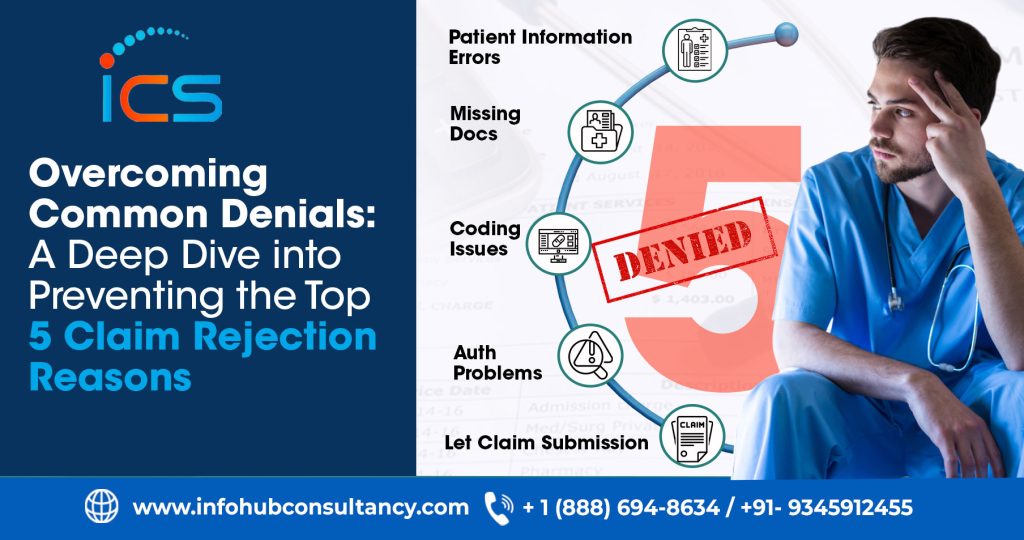
Have you ever felt that claim denials appear out of nowhere, even when everything seems correct on your end?
What if the real issue isn’t just one mistake but a series of small gaps happening across the entire billing process?
Imagine how much revenue can be protected if every team, tool, and step worked together like a well-coordinated system.
Instead of constantly fixing denials after they occur, what if you could stop them at the source with a smarter, clearer framework?
This blog will discuss how to build a simple denial-prevention system that improves accuracy and keeps reimbursements on track.
How to Stop the Top 5 Claim Denials
Preventing claim denials requires a proactive approach that emphasizes accuracy, verification and robust internal processes. When practices take time to validate information at the beginning and build reliable workflows, they reduce the risk of rejections that delay payments. In fact, healthcare providers can simplify billing tasks and improve first-pass approval rates by addressing the most common problem areas.
-
Incorrect Patient Information
Incorrect patient information is one of the quickest ways to trigger a denial, as payers rely on accuracy to match the claim to the patient’s policy. Even minor typing errors such as a missing digit in the insurance ID or a spelling mistake in the patient’s name, can cause the system to reject the submission. Therefore, practices must take extra care at registration to ensure every detail is entered correctly.
Additionally, front-desk staff should verify patient information during every visit to avoid outdated or incomplete data. Furthermore, asking patients to show their current insurance card and confirm their demographic details helps prevent mistakes that may have occurred since their last appointment. When practices consistently double-check these details, they significantly reduce avoidable rejections and improve their overall billing efficiency.
-
Insurance Eligibility Issues
Eligibility issues often occur when a patient’s coverage has expired, changed, or no longer includes the service they are receiving. As insurance plans are updated frequently, a policy that was active during the last visit may no longer be valid today. As a result, confirming active coverage before providing services is essential to prevent eligibility-related denials.
Moreover it is crucial to verify that the patient’s plan covers the specific procedure especially for specialized or high-cost treatments. Practices should also check whether coordination of benefits is required when a patient has multiple insurance policies. Therefore, providers can avoid submitting claims to the wrong payer or to billing services not included under the patient’s plan by integrating real-time eligibility checks into their workflow.
-
Coding Errors
Coding errors remain one of the most frequent causes of claim rejections as payers require accurate CPT, ICD-10, and HCPCS codes that match the services delivered. When codes do not align with documentation or when outdated codes are used, the claim is likely to be denied. Therefore maintaining thorough, up-to-date documentation is essential to support accurate coding decisions.
As a result, practices should invest in regular coder training and use claim-scrubbing tools that review claims before submission to strengthen accuracy. These tools help identify missing modifiers, mismatched codes, or outdated entries that may lead to denials. Therefore, coders can correct errors early and ensure that claims reflect the exact services provided for improving the chances of approval on the first attempt.
Lack of Prior Authorization or Referral
Prior authorization denials often occur when practices overlook payer requirements or assume that certain services do not need approval. As many insurance plans require pre-approval for imaging, specialty procedures, and high-cost treatments, obtaining authorization beforehand is critical. Missing or incorrect authorization numbers can also lead to rejections, even when the patient is fully eligible.
As a result, practices should maintain a clear system for checking authorization requirements for each payer to prevent these issues. In fact, creating a centralized list of services that need pre-approval helps staff stay consistent and reduces confusion. Furthermore tracking authorization dates and ensuring they remain valid at the time of service keeps claims compliant and minimizes delays caused by missing approvals.
-
Duplicate Claims
Duplicate claims are typically rejected when the payer receives the same claim more than once, either due to system errors or attempts to resubmit too quickly. This often happens when staff are unsure whether the original claim has gone through and submit another claim without checking its status first. As a result, the payer flags the second claim as a duplicate and denies it.
The practices should use a clear tracking system that records each claim from submission to payment. In fact, reviewing the claim status before resubmitting prevents unnecessary duplicates and reduces administrative workload. When automated tools are used alongside proper internal checks, practices can confidently monitor claims and avoid repeat submissions that lead to preventable denials.
Creating a Denial Prevention Framework
When practices streamline their front-end, mid-cycle, and back-end processes, they reduce mistakes that commonly lead to claim rejections. This can be done by:
-
Building a Denial-Prevention Workflow
A denial-prevention workflow connects registration, coding, and billing so each step supports the next. Therefore, teams verify patient details early, apply accurate coding mid-cycle and submit clean claims during the final stage. As a result errors are reduced, processing becomes smoother and reimbursement moves forward without unnecessary delays.
-
Role of Automation and Technology
Automation strengthens denial prevention by identifying issues before claims reach payers. Consequently, eligibility APIs confirm coverage instantly, claim scrubbers detect inconsistencies, and EHR tools validate documentation in real time. These features reduce manual effort, speed up reviews, and ensure that claims are submitted with greater accuracy and confidence.
-
Staff Training and Accountability
Consistent training helps staff understand evolving payer rules and documentation needs. Moreover, regular audits highlight problem areas and offer clear opportunities for correction. With structured feedback loops, staff stay informed, improve accuracy, and maintain a shared responsibility for cleaner claims and stronger overall billing performance.
-
Monitoring and Reporting
Tracking denial patterns by type, payer and provider gives organizations clear visibility into recurring issues. Also trend analysis reveals whether problems stem from process gaps or policy shifts. With this insight, teams can direct improvement efforts toward the highest-risk areas which results in more predictable, stable reimbursement outcomes.
How does Outsourcing Make Denial Prevention Even Easier?
Though building a denial-prevention framework improves financial performance, maintaining it requires time, expertise, and consistent monitoring. In fact, many practices find it challenging to manage coding updates, eligibility checks, authorization rules, and claim follow-ups along with day-to-day patient care.
As a result, practices gain access to skilled professionals, advanced technology, and end-to-end denial management support by outsourcing medical billing and coding services in India to InfoHub Consultancy Services. ICS’s team ensures accurate coding, timely authorizations, clean claim submission, and continuous tracking to help providers reduce denials and improve collections without adding internal workload.
FAQs
Why is documenting payer-specific rules important?
Payer rule sheets help teams submit claims that meet each insurer’s unique requirements.
Why is validating charge capture essential?
Accurate charge capture ensures that every service provided is billed correctly.
Why should healthcare organizations track first-pass resolution rates?
It shows how many claims succeed the first time to help teams measure effectiveness.
How does prioritizing high-value claims support denial management?
Focusing on high-value claims protects significant revenue from avoidable loss.
Related Blogs

Have you ever wondered how much revenue your medical practice loses each year due to claim denials? Recent studies reveal that nearly one in Read more

Healthcare providers often face challenges with delayed payments, aging receivables and constant cash flow pressure. These issues not only slow down revenue Read more

Claim denials are a significant drain on provider revenue and operational efficiency. According to the latest research, insurers denied approximately Read more