7 mins read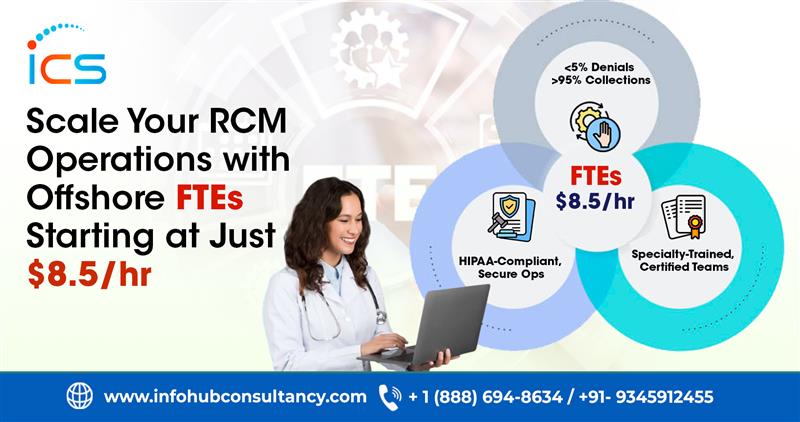
Are you finding it challenging to manage the increasing workload of medical billing and coding efficiently?
Have you considered how offshore teams could help streamline your Revenue Cycle Management operations without increasing overhead costs?
Offshore Full-Time Equivalents (FTEs) offer a strategic way to handle complex RCM tasks. They provide access to experienced professionals who specialize in claim submissions, denial management, coding and payment posting. In fact, practices can reduce turnaround times, improve cash flow and enhance overall operational accuracy by integrating offshore FTEs. Moreover, this model allows healthcare providers to quickly adjust staffing levels according to patient volume to give them the flexibility that traditional hiring cannot match.
InfoHub Consultancy handles complete medical billing, coding, and RCM for US healthcare providers — HIPAA compliant, offshore efficiency, proven results.
Get a Free Consultation →With dedicated teams monitoring trends in denials, claim errors, and reimbursement delays, practices can implement corrective measures faster and more effectively. This proactive approach not only minimizes revenue leakage but also strengthens compliance and reporting standards.
This blog will explain how healthcare practices can scale their RCM operations using offshore FTEs by outlining the steps for successful implementation.
How to Scale Your RCM Operations with Offshore FTEs
Scaling revenue cycle management operations with offshore FTEs is an effective strategy for healthcare providers to improve efficiency, reduce costs and maintain high-quality service. The process involves careful planning, structured workflows and continuous monitoring such as:
Step 1: Strategize and Structure Your Offshore RCM Team
1.1 Identify Tasks Suitable for Offshoring
Before outsourcing, it is vital to identify which RCM functions can be handled by offshore teams. In fact the most common tasks include:
- Credentialing- Offshore staff can manage provider enrollments, renewals, and insurance updates to ensure compliance with payer requirements.
- Charge Entry– They can accurately enter billing data into the RCM system to reduce delays and errors.
- Payment Posting– Offshore FTEs can record payments from both insurers and patients to keep accounts up-to-date.
- Denial Management– Teams can identify claim denials, analyze trends and take corrective action to prevent future errors.
- Patient Billing- They can generate and send invoices to patients in a timely and accurate manner.
Identifying these tasks allows healthcare practices to focus on higher-level strategies with outsourcing medical billing and coding service providers handling operational workloads.
1.2 Define Roles and Responsibilities
Once tasks are identified, it is vital to define clear roles for offshore FTEs to ensure accountability and efficiency.
- Medical Coders: Assign coding tasks based on specialty, ensuring accurate use of ICD-10, CPT and HCPCS codes. This helps prevent claim rejections.
- Billing Specialists: These professionals handle claims submission, follow-ups, and payment reconciliation. Their focus is to maintain a steady revenue flow.
- Denial Analysts: They monitor denial patterns, identify root causes and implement corrective actions to reduce future denials.
Therefore it is crucial to clearly define the roles as it prevents overlaps and improves collaboration between in-house and offshore teams.
Step 2: Establish Clear Goals and Quality Control
2.1 Set Key Performance Indicators (KPIs) and Service-Level Agreements (SLAs)
Establishing measurable goals is essential to monitoring offshore performance effectively. In fact, the crucial metrics include:
- Days in Accounts Receivable (A/R): Target 28–32 days to ensure timely cash flow.
- Claim Denial Rate: Maintain a denial rate below 5% to optimize reimbursements.
- Net Collection Rate: Aim for above 95% to maximize revenue capture.
Therefore, it is important to define such metrics as it allows both in-house and offshore teams to work in the direction of transparent and shared objectives.
2.2 Implement Reporting Systems
It is vital to establish reporting systems that monitor offshore performance consistently. Using dashboards and automated reports allows managers to track metrics in real time. This transparency helps in quickly identifying bottlenecks or errors and enables proactive decision-making. Additionally, regular reporting promotes accountability and ensures that offshore teams remain aligned with hospital goals.
2.3 Focus on Quality Control
It is crucial to maintain high-quality standards in offshore medical billing and coding services in India. Such teams should follow structured processes such as:
- Regular Audits – Conduct periodic reviews of coding, billing and payment posting to ensure accuracy.
- Feedback Mechanisms – Provide timely feedback to offshore staff for continuous improvement, and skill development.
It is important to keep in mind that quality control ensures that the outsourced work consistently meets regulatory and hospital standards.
Step 3: Build a Robust Technology Infrastructure, and Training
3.1 Prioritize Technology
A robust technology infrastructure is critical to successful offshore RCM operations. It is crucial to ensure that EHR systems, billing software and IT platforms are up-to-date and secure as this reduces errors and supports smooth integration. Furthermore compatible technology enables offshore medical billing and coding teams to access necessary information efficiently and collaborate seamlessly with in-house staff. Therefore investing in reliable technology forms the foundation of scalable RCM operations.
3.2 Provide Comprehensive Training
Thorough training is essential for offshore teams to perform efficiently. In fact, training should cover:
- System Usage: Teach offshore staff how to navigate your software, enter data and generate reports.
- Compliance Requirements: Educate on HIPAA rules, payer guidelines, and regulatory standards.
- Process Workflows: Align offshore teams with your internal processes to maintain consistency and quality.
Therefore well-trained staff can adapt quickly and perform tasks with minimal supervision.
Step 4: Foster a Strong Team Culture
4.1 Create a Positive Work Environment
Developing a strong team culture is essential for collaboration between in-house and offshore staff. In fact, regular communication, team meetings and virtual interactions promote a sense of belonging and encourage engagement. Thereby healthcare practices can enhance motivation and productivity across both teams by fostering a positive work environment.
4.2 Focus on Retention
Retention of offshore staff is crucial for long-term operational stability. In fact, providing career development opportunities enables employees to grow professionally. Similarly, recognition programs that reward high performance help maintain motivation and reduce turnover. Therefore prioritizing retention ensures that the offshore team remains experienced, reliable and committed to organizational goals.
Step 5: Implement, Test and Scale
5.1 Start with a Pilot Program
Before full-scale implementation initiating a pilot program allows practices to test workflows and integration processes. In fact, assigning a few tasks initially helps identify potential challenges and refine procedures. This step ensures that the offshore model is effective and aligned with hospital needs.
5.2 Scale Gradually
Scaling should be gradual to maintain efficiency and quality after a successful pilot. Expanding the number of FTEs or increasing task complexity should be based on performance metrics and operational readiness. Therefore such a phased approach minimizes risks and ensures sustainable growth.
5.3. Continuous Monitoring and Optimization
Continuous monitoring is necessary to maintain operational excellence. Tracking KPIs, auditing workflows and providing feedback allow ongoing improvements. Therefore, healthcare practices can ensure that offshore RCM operations remain accurate, compliant and responsive to increasing volumes by regularly optimizing processes.
Conclusion
Scaling your RCM operations becomes simple with ICS’s offshore FTE model. Info 0Hub Consultancy Services allows healthcare providers to reduce costs without compromising quality by offering skilled billing, coding and accounts receivable professionals at a competitive rate of $8.5 per hour.
Moreover ICS provides a dedicated outsourcing medical billing and coding service provider in India that integrates seamlessly with your in-house staff. This ensures that claims are processed accurately, denials are minimized and payments are posted on time. Overall, ICS’s offshore FTE model is a practical and strategic way to enhance operational efficiency. It helps healthcare organizations scale RCM operations successfully while achieving financial growth and stability.
FAQs
Q: Can offshore FTEs handle multiple specialties simultaneously?
Ans: They can manage coding and billing across different medical specialties efficiently.
Q: Are offshore FTEs trained in the latest coding updates?
Ans: Reputable offshore teams stay updated on ICD, CPT, and HCPCS changes.
Q: Can offshore FTEs assist with insurance payer communication?
Ans: They can handle routine follow-ups and clarifications with payers.
Q: Do offshore FTEs support both inpatient and outpatient billing?
Ans: They are equipped to manage claims for both inpatient and outpatient services.
Related Blogs

InfoHub Consultancy handles complete medical billing, coding, and RCM for US healthcare providers — HIPAA compliant, offshore efficiency, proven results.
Get a Free Consultation →