Revenue Cycle Management
  Insurance Verification
  Appointment Scheduling
  Charge Entry
  Denials Management
  Medical Billing
  Claims Submissions
  Payment Posting
  AR – Follow-ups
  Medical Coding
  Reporting
  Patient’s Statement
  Authorization
  Charge Review & Auditing (Coding & Billing)
  Compliance & Audit Readiness
  Clearing House & EDI Management
  Credentialing
  View All 65
Specialties
View All 65
Specialties Allergy and Immunology
  Ambulance
 Ambulatory Surgical Center
 Anesthesia
 Assisted Living Facility (ALF)
 Behavioral Health
 Cardiology
 Chiropractic
 Chronic Care Management (CCM)
 Community Behavioral Health
 Dental
 Dermatology
 Durable Medical Equipment
 Emergency Room
 Endocrinology & Diabetes
 Family Practice
 Gastroenterology
 General Surgery
 Geriatrics
 Healthcare
 6 mins read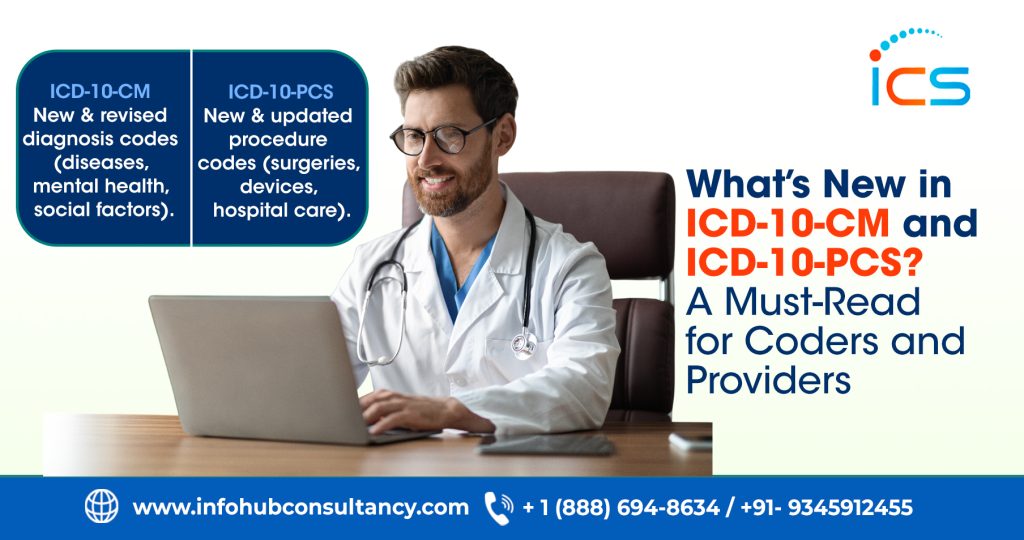
Did you know that ICD-10 codes change every year and have a direct impact on hospitals, coders, and providers?
ICD-10-CM and ICD-10-PCS are more than just lists of codes. In fact, they are powerful systems that shape how diagnoses and procedures are recorded, billed, and reimbursed across the healthcare industry.
ICD-10-CM ensures that every patient’s condition is captured accurately, whereas ICD-10-PCS provides detailed insight into the procedures performed during inpatient stays. Together they not only streamline claims and reimbursement but also improve data for research, compliance and public health.
With medicine constantly advancing and new challenges emerging, these codes are updated annually by the Centers for Disease Control and Prevention (CDC) and the Centers for Medicare & Medicaid Services (CMS) to reflect real-world needs.
This blog will explore all such changes in ICD-10-CM and ICD-10-PCS for hospitals, coders, and providers.
ICD-10-CM and ICD-10-PCS Updates
Every year, the CDC and CMS release updates to ensure that medical billing and coding keep up with new diseases, treatments, and healthcare practices. The FY 2026 updates effective from October 1, 2025, to September 30, 2026 include:
ICD-10-CM FY 2026 Changes
● New, Deleted, and Revised Codes
The FY 2026 ICD-10-CM code set introduces 487 new diagnosis codes, removes 28 outdated codes, and revises the titles of 38 existing codes. These changes allow coders and providers to capture diagnoses with greater accuracy which helps improve claims reporting and reimbursement.
● Guideline Updates
The official coding guidelines have also been updated. Updated HIV coding guidance reorganizes and clarifies sequencing and selection of HIV-related codes (see Section I.C.1.a.2 and its subsections) to improve consistent reporting of B20, Z21, R75, and related codes. Coders should review the FY-2026 guidelines to avoid sequencing errors. Additionally, a guideline was added for Type 2 Diabetes Mellitus in Remission (code E11.A) with instructions on documentation and assignment.
● Alphabetic Index and Tabular List Changes
Several terms have been added, corrected, or reclassified in the Alphabetic Index and Tabular List. These edits enhance the process of locating and applying the correct codes, thereby reducing confusion and ensuring accurate code selection. In fact, corrections also address inconsistencies in spelling, cross-references and sequencing notes.
● Expanded Specificity by Chapter
To improve documentation and capture clinical detail, new and revised codes were added across multiple chapters:
- Chapter 4 (Endocrine, Nutritional, and Metabolic Diseases): Expanded codes for conditions such as hyperoxaluria, familial hypercholesterolemia, and diabetes remission.
- Chapter 6 (Nervous System): New multiple sclerosis subtype codes to reflect different disease variations.
- Chapter 7 (Eye and Adnexa): Refinements in codes for laterality and inflammatory conditions.
- Chapter 12 (Skin and Subcutaneous Tissue): More detailed non-pressure chronic ulcer codes that capture severity, laterality, and site.
- Chapter 17 (Congenital Malformations): New codes for genetic disorders and rare syndromes.
- Chapter 19 (Injury, Poisoning, and External Causes): New injury codes for sites such as the flank, abdomen, and groin, along with additional poisoning and substance-related codes, as well as codes for certain exposure-related conditions.
● POA Exempt Codes and Conversion Tables
The Present on Admission (POA) exempt codes list has been updated to reflect the latest clinical guidelines. Additionally, CMS has published conversion tables to help providers transition from old codes to the updated versions.
ICD-10-PCS FY 2026 Changes
● New, Deleted, and Revised Codes
ICD-10-PCS for FY-2026 contains 156 new procedure codes and 27 deletions. But a small number of PCS titles/entries were revised. These changes expand documentation for surgical procedures, implants and new treatment techniques.
● Guideline Updates
The guidelines for New Technology coding (E.1a and E.1b) have been updated to include more current examples. This helps coders understand how to assign codes for emerging procedures and technologies. Additionally, some root operation definitions and examples have been clarified to ensure consistency in coding complex surgical procedures.
● Alphabetic Index Changes
There are extensive updates in the PCS Alphabetic Index and addenda. These updates add new values for body parts, devices, and substances while also correcting index directions. For example, the body part “Cricoid cartilage” is now directed to the Larynx instead of the Trachea, which ensures greater anatomical accuracy. Smaller changes were also made to correct misclassified terms and index cross-references.
● Table Updates
Several procedure tables have been updated in the Medical and Surgical section, including new codes for the dura mater and spinal meninges. The New Technology section has also been expanded, with additional device and substance values introduced to reflect innovation in medical practice.
● Examples of New Procedure Codes
Some of the new PCS codes include:
- 00W20KZ – Revision of nonautologous tissue substitute in the dura mater, open approach.
- 03120JY – Bypass of the innominate artery to an upper artery using a synthetic substitute, open approach.
- 09XL0Z3 – Transfer of nasal turbinate to the sphenoid bone, open approach.
- 0C1S3E4 – Bypass of larynx to cutaneous with endotracheal airway, percutaneous approach.
- 0F198D3 – Bypass of the common bile duct to the duodenum with an intraluminal device, endoscopic approach.
- 0RRJ008 – Replacement of the right shoulder joint with a reverse ball-and-socket prosthesis using a subscapularis-sparing technique, open approach.
- 0SRD07D – Replacement of the left knee joint with autologous tissue substitute, medial meniscus, open approach.
● Device and Substance Updates
In addition to new procedures, the FY 2026 update includes new device values, renaming of existing device categories, and retirement of outdated values. Multiple new substances and devices were added to the Introduction (XW) tables in the New Technology section, which allows accurate coding of the latest treatment options.
Conclusion
The FY 2026 updates to ICD-10-CM and ICD-10-PCS highlight the importance of staying informed and prepared for every coding change. As a result, coders and providers must take proactive steps such as reviewing the updated guidelines, attending training sessions, and utilizing official resources from the CDC and CMS to ensure accuracy in documentation and reporting.
Simultaneously, healthcare organizations should strengthen their internal auditing and education programs to maintain compliance and avoid costly mistakes. However, many providers are also turning to professional outsourcing medical billing and coding service providers in India given the complexity and volume of these updates. In fact, the providers can stay compliant and reduce administrative burden by combining internal training with reliable outsourcing support.
FAQs
Are there any changes to code sequencing rules?
Some chapters have revised sequencing and instructional notes.
Do the updates include new codes for rare diseases?
Yes, including conditions like Kabuki Syndrome and Usher Syndrome.
Do outpatient coders need to know ICD-10-PCS updates?
Generally no as ICD-10-PCS is inpatient-specific, but awareness is still useful.
Are there new Z codes in FY 2026?
Yes, including updates for family history, genetic susceptibility, and SDOH.
Related Blogs

Every day, healthcare providers face increasing financial pressures. In fact, rising costs, stricter reimbursement policies and complex payer rules make Read more

Undoubtedly, cash flow is the lifeline of any medical practice. But still many providers face the challenge of waiting 60 Read more

Did you know why your medical practice still struggles with cash flow, even when patient visits are at an all-time Read more