Revenue Cycle Management
  Medical Billing
  Medical Coding
  Full-Time Equivalent Employees (FTE)
 Speciality medical billing
 Insurance Verification
  Appointment Scheduling
  Charge Entry
  Denials Management
  Claims Submissions
  Payment Posting
  AR – Follow-ups
  Reporting
  Patient’s Statement
  Authorization
  Charge Review & Auditing (Coding & Billing)
  Compliance & Audit Readiness
  Clearing House & EDI Management
  Credentialing
  10 mins read
The math behind medical billing staffing has fundamentally shifted. A single in-house medical biller in the United States now costs between $60,000 and $90,000 annually when you factor in salary, benefits, payroll taxes, training, and software licenses. That translates to $5,000 to $7,500 per month per employee, and that is before accounting for the industry’s staggering 30-40% annual turnover rate that forces practices into a constant cycle of recruiting, onboarding, and retraining.
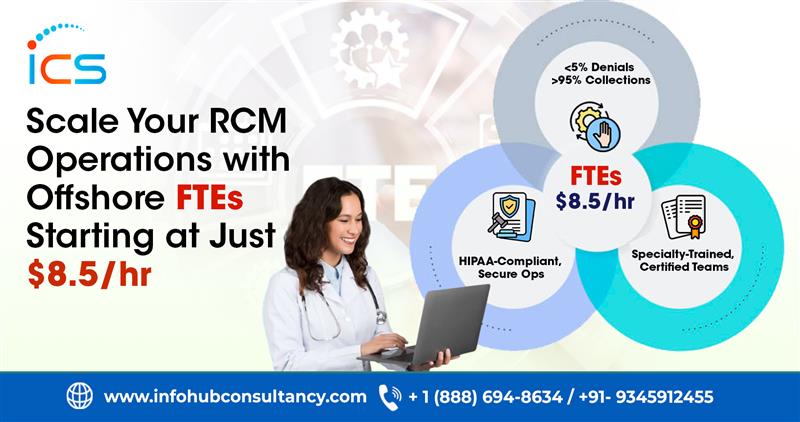
Meanwhile, the U.S. medical billing outsourcing market has surged to $6.95 billion in 2025 and is projected to reach $17.69 billion by 2033, growing at 12.56% annually. The reason is simple: dedicated offshore Full-Time Equivalent (FTE) staff can deliver the same or better billing performance at a fraction of the cost. At Info Hub Consultancy Services, our dedicated FTE medical billing professionals start at $1,250 per month, a 70-83% cost reduction compared to in-house equivalents, with zero compromise on quality, compliance, or specialization.
This guide breaks down exactly how the dedicated FTE model works, why it consistently outperforms in-house billing operations, and what US healthcare providers need to evaluate before making the switch.
InfoHub Consultancy handles complete medical billing, coding, and RCM for US healthcare providers — HIPAA compliant, offshore efficiency, proven results.
Get a Free Consultation →The True Cost of In-House Medical Billing in 2026
Most practice owners significantly underestimate what in-house billing actually costs. The salary line item tells only part of the story. When you account for the full burden of employment, the numbers paint a very different picture.
Complete In-House Cost Breakdown
| Cost Component | Annual Cost | Monthly Cost |
| Base Salary (Medical Biller) | $45,000 – $65,000 | $3,750 – $5,417 |
| Payroll Taxes (7.65% FICA) | $3,443 – $4,973 | $287 – $414 |
| Health Insurance | $8,000 – $12,000 | $667 – $1,000 |
| 401(k) Match (3-5%) | $1,350 – $3,250 | $113 – $271 |
| PTO / Sick Leave (15 days) | $2,596 – $3,750 | $216 – $313 |
| Workers’ Compensation | $450 – $900 | $38 – $75 |
| Billing Software License | $3,000 – $12,000 | $250 – $1,000 |
| Training & Continuing Education | $1,500 – $3,000 | $125 – $250 |
| Office Space & Equipment | $3,600 – $6,000 | $300 – $500 |
| Recruitment Cost (amortized) | $2,500 – $5,000 | $208 – $417 |
| TOTAL PER BILLER | $71,439 – $115,873 | $5,953 – $9,656 |
The hidden killer in these numbers is turnover. Medical billing has one of the highest turnover rates in healthcare administration at 30-40% annually. Every time a biller leaves, your practice absorbs recruiting costs ($2,500-$5,000), 4-8 weeks of reduced productivity during onboarding, knowledge loss on payer-specific requirements and practice workflows, and increased denial rates during the transition period. When you factor turnover into the equation, the true cost of maintaining a single in-house biller position approaches $7,000-$10,000 per month on a sustained basis.
The Dedicated FTE Model: How It Works
The Full-Time Equivalent (FTE) model is fundamentally different from both traditional outsourcing (percentage-based) and staffing agencies. With a dedicated FTE, you get a named, full-time billing professional who works exclusively for your practice, follows your workflows, and integrates with your team, but is employed, managed, and supported by the offshore partner.
FTE Model vs. Traditional Outsourcing vs. In-House
| Feature | In-House Staff | Traditional Outsourcing (% of Collections) | Dedicated FTE Model |
| Monthly Cost | $5,953 – $9,656 | 5-8% of collections | $1,250 flat per FTE |
| Staff Dedication | 100% dedicated | Shared team | 100% dedicated |
| Control Over Workflow | Full control | Limited | Full control |
| Transparency | Full visibility | Black box | Full visibility + daily reports |
| Scalability | Slow (hire cycle) | Moderate | Fast (add FTEs in 2-4 weeks) |
| Turnover Risk | 30-40% annual | Managed by vendor | Managed by vendor + backup |
| Training Investment | Practice bears 100% | Vendor manages | Vendor manages + practice input |
| HIPAA Compliance | Practice responsibility | Shared | Vendor certified + BAA |
| Software Costs | Practice bears | Included | Uses your existing systems |
The key distinction is that a dedicated FTE works inside your practice management system, follows your SOPs, attends your team meetings (virtually), and becomes an extension of your office, not a faceless outsourced process. The FTE is hired, trained, and managed by the offshore partner, but they report to you.
What $1,250/Month Gets You: The ICS FTE Package
At Info Hub Consultancy Services, the $1,250/month FTE rate is not a bare-bones offering. It includes a comprehensive set of services and infrastructure that would cost significantly more to replicate in-house.
Dedicated Full-Time Professional: A named biller/coder who works exclusively on your account, 8 hours per day, 5 days per week. No shared resources, no split attention.
US Healthcare Training: Every FTE is trained on US payer requirements, CMS regulations, ICD-10-CM/PCS coding, CPT/HCPCS coding, and specialty-specific billing workflows across 51+ medical specialties.
HIPAA-Compliant Infrastructure: Secure facilities with biometric access, encrypted VPN connections, HIPAA-compliant workstations, and signed Business Associate Agreements (BAAs). Regular HIPAA audits and staff training are included.
Management Layer: A dedicated account manager and team lead oversee your FTE’s work, conduct quality audits, and handle performance management. You get the output of a managed team without the management overhead.
Technology Stack: FTEs work directly in your existing PMS/EHR (eClinicalWorks, Kareo, AdvancedMD, Athenahealth, NextGen, DrChrono, and 30+ others). No migration, no new software costs.
Backup Coverage: Cross-trained backup staff ensure continuity during PTO, sick days, or attrition. No single point of failure, unlike a single in-house biller.
Annual Cost Comparison: One FTE Position
| In-House (US) | Offshore FTE (ICS) | |
| Annual Cost | $71,439 – $115,873 | $15,000 ($1,250 x 12) |
| Benefits / Taxes | Included above | $0 (vendor managed) |
| Software License | $3,000 – $12,000 extra | $0 (uses your system) |
| Training / Onboarding | $1,500 – $3,000 extra | $0 (vendor managed) |
| Backup Coverage | None (single point of failure) | Included |
| Management Overhead | Your time | Account manager included |
| TRUE ANNUAL TOTAL | $75,939 – $130,873 | $15,000 |
| ANNUAL SAVINGS | — | $60,939 – $115,873 (80-88%) |
For a practice that needs three billers, the math is even more compelling: $227,817 to $392,619 annually in-house versus $45,000 with ICS. That is a savings of $182,817 to $347,619 per year that can be redirected to clinical staff, technology upgrades, or practice expansion.
Why Offshore FTEs Consistently Outperform In-House Billers
Cost savings alone do not justify the switch if quality suffers. But the data consistently shows that well-managed offshore FTE teams match or exceed in-house performance across every key billing metric.
Key Performance Indicators: Offshore FTE vs. In-House
| KPI | Industry Average (In-House) | ICS Offshore FTE Target |
| First-Pass Clean Claim Rate | 80 – 85% | 95%+ |
| Days in Accounts Receivable | 40 – 50 days | 28 – 35 days |
| Denial Rate | 8 – 12% | < 5% |
| Collection Rate | 85 – 90% | 95%+ |
| Charge Entry Turnaround | 48 – 72 hours | 24 hours |
| AR Follow-Up Frequency | Weekly at best | Daily |
| Coding Accuracy | 90 – 93% | 97%+ |
These performance improvements stem from several structural advantages of the offshore FTE model. First, specialization: ICS FTEs are trained in specific specialties rather than being generalists who handle everything from dermatology to cardiology. Second, daily AR follow-up: offshore teams operating in IST (India Standard Time) can work US after-hours, chasing payer follow-ups and processing denials while your US office is closed, creating a virtual 24-hour billing cycle. Third, continuous quality monitoring: dedicated account managers audit claims, track denial patterns, and implement corrective actions in real time.
HIPAA Compliance and Data Security: Addressing the Top Concern
The most common hesitation US providers express about offshore billing is data security. This concern is valid and should be taken seriously. Here is how a compliant offshore FTE operation addresses every element of HIPAA requirements.
Business Associate Agreement (BAA): Every ICS engagement begins with a signed BAA that legally binds the offshore partner to the same HIPAA standards as any US-based vendor. This is non-negotiable and should be a deal-breaker with any offshore partner that hesitates to sign one.
Physical Security: HIPAA-compliant facilities include biometric access controls, CCTV surveillance, restricted USB/external device policies, no-phone zones in production areas, and visitor management protocols.
Technical Safeguards: End-to-end VPN encryption, role-based access controls, multi-factor authentication, DLP (Data Loss Prevention) software, and automated session timeouts ensure PHI never leaves the secure environment.
Administrative Controls: Regular HIPAA training for all staff, background checks, confidentiality agreements, incident response procedures, and annual third-party security audits demonstrate ongoing compliance commitment.
Audit Trail: All system access and actions are logged and available for review. ICS provides monthly compliance reports documenting access patterns, security incidents (if any), and training completions.
51+ Medical Specialties Covered Under One FTE Model
One of the biggest advantages of the offshore FTE model is access to specialty-trained billing staff without paying specialty-premium salaries. In the US, a biller with orthopedic surgery or interventional cardiology experience commands significantly higher pay. With the FTE model, specialty expertise is included at the same $1,250 rate.
ICS provides dedicated FTEs with specialty training across more than 51 medical specialties including: internal medicine, family practice, cardiology, orthopedics, neurology, gastroenterology, urology, dermatology, ophthalmology, ENT, pulmonology, nephrology, oncology/hematology, physical therapy, occupational therapy, pain management, anesthesiology, radiology, pathology, general surgery, vascular surgery, podiatry, chiropractic, behavioral health, urgent care, OB/GYN, pediatrics, endocrinology, rheumatology, allergy/immunology, infectious disease, hospice/palliative care, home health, DME, ambulance billing, and many more.
Each FTE receives specialty-specific training on common CPT codes, ICD-10 diagnosis coding patterns, payer-specific requirements, prior authorization triggers, and documentation standards unique to that specialty. This means your offshore FTE understands not just how to submit claims, but how to optimize reimbursement for your specific field.
How to Transition to the Offshore FTE Model
Transitioning from in-house billing to an offshore FTE model does not have to be disruptive. A well-planned implementation follows a structured timeline.
Week 1-2 — Discovery & Setup: ICS analyzes your current billing workflow, PMS/EHR setup, payer mix, specialty requirements, and performance benchmarks. Secure VPN access is configured. BAA is signed.
Week 3-4 — FTE Selection & Training: A dedicated FTE is assigned based on your specialty requirements. They undergo practice-specific training on your SOPs, fee schedules, payer contracts, and documentation preferences.
Week 5-6 — Parallel Run: The FTE begins working alongside your existing billing staff (if applicable) with full quality audits on every claim. This overlap period catches any workflow gaps before go-live.
Week 7+ — Full Production: The FTE assumes full production responsibility with ongoing QA monitoring. Daily productivity reports, weekly performance reviews, and monthly KPI dashboards keep you in complete control.
Addressing Common Objections to Offshore Billing
Despite the clear financial and performance advantages, some practice owners hesitate. Here are the most common objections and the reality behind each.
“I’ll lose control over my billing.” Reality: With a dedicated FTE, you have more control than traditional outsourcing. The FTE works in your PMS, follows your workflows, and reports to you. Daily reports provide granular visibility into every claim, denial, and payment.
“Communication will be a problem with time zone differences.” Reality: ICS FTEs work overlapping US business hours. The IST time zone actually creates an advantage: your FTE can process end-of-day charges and follow up on claims during US evening hours, giving you a next-morning head start.
“My patients’ data won’t be safe overseas.” Reality: HIPAA applies to all business associates regardless of location. A properly secured offshore facility with BAA, encryption, and access controls is no less safe than a US billing office, and often more rigorously audited.
“It’s too complicated to switch.” Reality: With a structured 6-week transition plan, most practices are fully operational on the FTE model within two months. ICS handles all training, setup, and onboarding. Your only requirement is providing system access and initial workflow documentation.
Frequently Asked Questions (FAQ) — Offshore FTE Medical Billing
Q1: How much does a dedicated offshore medical billing FTE cost?
At Info Hub Consultancy Services, dedicated FTE medical billing staff start at $1,250 per month. This includes a full-time professional (8 hours/day, 5 days/week), management oversight, HIPAA-compliant infrastructure, backup coverage, and specialty-specific training. Compare this to the $5,953-$9,656/month true cost of an in-house US biller.
Q2: What is the FTE model in medical billing?
The FTE (Full-Time Equivalent) model provides a dedicated, named billing professional who works exclusively for your practice but is employed by the offshore partner. Unlike percentage-based outsourcing where you share a team, FTE gives you full control over workflows, direct communication with your biller, and complete transparency into daily productivity.
Q3: Is offshore medical billing HIPAA compliant?
Yes, when properly structured. HIPAA compliance requires a signed Business Associate Agreement (BAA), physical security controls (biometric access, CCTV), technical safeguards (VPN encryption, MFA, DLP), and administrative controls (staff training, background checks, audit trails). ICS maintains all these controls and provides monthly compliance reports.
Q4: What medical specialties can offshore FTEs handle?
ICS provides specialty-trained FTEs across 51+ medical specialties including cardiology, orthopedics, neurology, gastroenterology, oncology, pain management, physical therapy, radiology, behavioral health, urgent care, DME, and many more. Each FTE is trained on specialty-specific CPT codes, ICD-10 coding patterns, and payer requirements.
Q5: How long does it take to transition to an offshore FTE?
A typical transition takes 6-7 weeks: 2 weeks for discovery and setup, 2 weeks for FTE selection and training, 2 weeks for parallel running alongside existing staff, then full production. Most practices are fully operational on the FTE model within two months.
Related Blogs

InfoHub Consultancy handles complete medical billing, coding, and RCM for US healthcare providers — HIPAA compliant, offshore efficiency, proven results.
Get a Free Consultation →