6 mins read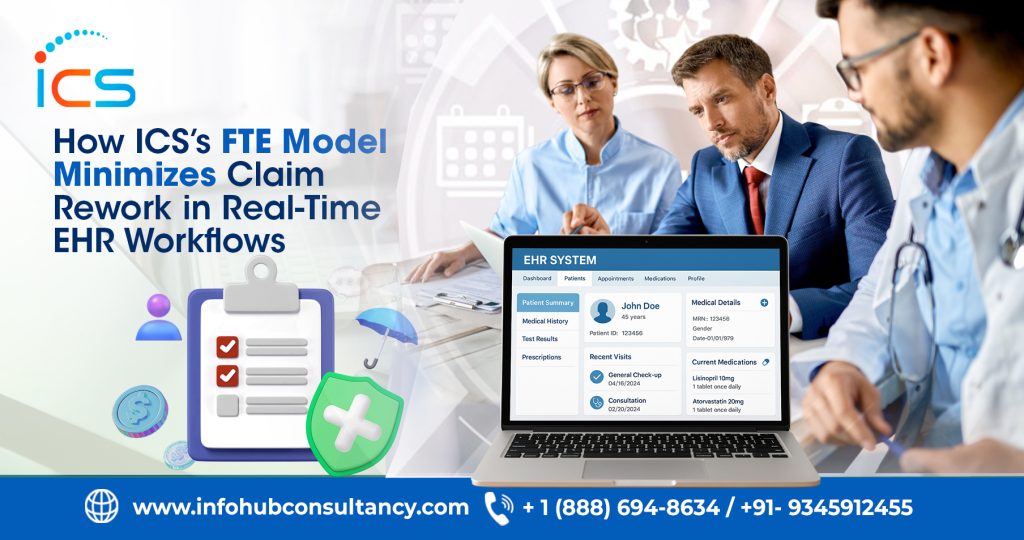
Did you know that around 19% of applicants were denied at the first attempt in 2023? Many healthcare providers also report that claim denials are rising, which makes revenue cycle management even more difficult.
But why are so many claims rejected when providers already use digital tools and workflows? Why does fixing and resubmitting these claims take so much time, increase costs, and delay payments? These questions show the real challenges most healthcare practices face today.
The idea of clean claims, meaning claims that are correct the first time, often feels hard to achieve. In fact, the cost of rework continues to increase. Staff spend hours fixing errors, payers take longer to reimburse, and providers struggle with cash flow disruptions. The approach of utilizing a Full-Time Equivalent (FTE) model combined with real-time Electronic Health Record (EHR) integrations and automation is the need of the hour.
InfoHub Consultancy handles complete medical billing, coding, and RCM for US healthcare providers — HIPAA compliant, offshore efficiency, proven results.
Get a Free Consultation →This blog will discuss how Info hub Consultancy Services, a specialist in offshore medical billing and coding services in India, uses such an approach to minimize claim rework.
Why does Claim Rework Happen?
Claim rework occurs when payers reject or return claims due to errors, missing data, or non-compliance with rules. In fact, high rework rates can significantly reduce revenue flow, create compliance risks, and demand more staff time. It can occur due to:
- Inaccurate Patient Data
When patient demographics or insurance details are incomplete or incorrect, claims are denied. This root cause delays processing, forces rework, and increases costs by wasting staff time and payer resources.
- Poor Documentation
If clinical notes do not justify treatment or fail to match submitted claims, denials occur. This leads to compliance risks, slows down approvals and necessitates costly corrections before resubmission.
- Coding Mistakes
Errors in ICD, CPT, or HCPCS codes result in immediate rejections. This reduces first-pass success, adds rework, and negatively impacts provider reimbursement which ultimately weakens cash flow and revenue.
- Ignoring Payer Rules
Claims often fail when bundling, modifier, or exclusion guidelines are not followed. This requires resubmission, prolongs payment cycles, and increases both administrative workload and operational costs.
- Eligibility and Authorization Gaps
Overlooking patient eligibility, benefits, or prior authorization blocks claim approvals. This necessitates repetitive verification, slows down billing workflows and diverts staff from higher-value activities for increasing overall operational expenses.
- Team Miscommunication
Breakdowns between clinical, coding and billing staff cause missing or mismatched details. This adds duplication, delays claim submission, and reduces efficiency which directly harms provider productivity and revenue.
Steps to Reduce Claim Rework with FTE + EHR
When healthcare providers combine an FTE model with real-time EHR workflows, they create a proactive system that identifies and fixes errors before claims are submitted. This approach not only prevents costly denials but also speeds up reimbursements.
Step 1: Real-Time Data Capture and Validation
In this step, the EHR system captures patient and clinical information as soon as it is entered. The integrated workflow to be supported by the FTE team, quickly validates the details to ensure accuracy and completeness. As a result, common mistakes like missing demographics, incorrect codes, or incomplete documentation are flagged immediately. In fact, providers prevent errors from reaching the payer by resolving these issues early.
Step 2: Automating Routine Front-End Processes
Automation tools powered by AI and robotic process automation (RPA) handle repetitive tasks such as eligibility checks, initial coding and documentation audits. These automated checks reduce the chance of human error in high-volume, low-complexity tasks. Simultaneously, the FTE team focuses on reviewing high-risk claims and cases that require the application of professional judgment. This balance ensures that both routine and complex claims are processed correctly.
Step 3: Pre-Submission Claim Scrubbing and Review
Before a claim is submitted, it undergoes pre-submission scrubbing through the EHR’s built-in rule engines. These engines identify potential issues like missing modifiers, invalid code combinations, or payer-specific errors. The FTE staff then reviews flagged claims, applies corrections, and validates compliance with payer rules. This hybrid process of automation and human oversight increases the chances of first-pass claim acceptance.
Step 4: Data Analytics and Continuous Feedback Loops
The FTE model also benefits from advanced analytics and dashboards that track key metrics including denial rates, claim rework frequency and payer trends. Every corrected claim adds valuable insights that improve future claim accuracy. Over time this feedback loop refines workflows, reduces repetitive errors and strengthens compliance with payer policies. Consequently, the number of denials steadily decreases.
Step 5: Proactive Compliance with Payer Rules
As payer regulations and CMS policies change frequently, staying compliant can be a significant challenge. With real-time EHR workflows and FTE support, claims are automatically checked against the latest payer requirements. Any discrepancies are flagged before submission, which prevents costly rejections caused by outdated coding or non-compliance. This proactive approach ensures smoother reimbursement cycles.
Step 6: Expert Human Oversight for Complex Cases
Although automation is efficient, it cannot handle every situation. The FTE team plays a critical role in reviewing complex claims that involve detailed documentation or medical necessity justification. Their expertise ensures that claims meet all payer-specific guidelines and clinical standards. As a result, the team reduces the risk of denials that automated systems might overlook.
Step 7: Accelerated Workflow and Faster Reimbursements
Finally, the entire billing cycle becomes faster and more efficient by combining automation with expert oversight. In fact clean claims are submitted promptly, reimbursements are processed efficiently, and rework volumes are minimized. This improved efficiency strengthens cash flow, reduces administrative stress, and allows providers to focus more on patient care rather than fixing denied claims.
Role of ICS in Minimizing Claim Rework
Outsourcing medical billing and coding service providers in India such as ICS plays a critical role in implementing the FTE model within real-time EHR workflows. ICS ensures claims are accurate, compliant and processed efficiently by combining skilled offshore teams with deep domain knowledge.
ICS goes beyond basic billing tasks by managing complex payer requirements, performing thorough quality checks, and optimizing workflows to ensure seamless operations. They provide continuous training and guidance to maintain high standards, reduce errors, and improve overall claim accuracy.
Also, ICS helps streamline operations, prevent costly rework, and accelerate reimbursements by seamlessly integrating with a provider’s EHR and revenue cycle management systems. Their structured approach allows both routine and complex claims to be handled with precision and consistency.
FAQs
Q: How quickly can offshore FTE teams adapt to new billing rules?
Ans: Trained teams can implement updates promptly to maintain compliance and accuracy.
Q: Do FTE teams provide reporting and analytics?
Ans: They deliver insights on denials, rework, and workflow efficiency.
Q: Can small practices benefit from an FTE model?
Ans: Even small practices can reduce rework and streamline billing with the help of FTE support.
Q: Is FTE integration with EHR suitable for all specialties?
Ans: The model can be customized to support diverse clinical workflows and coding needs.
For more on this topic, see our medical billing for any EHR.
Related Blogs
InfoHub Consultancy handles complete medical billing, coding, and RCM for US healthcare providers — HIPAA compliant, offshore efficiency, proven results.
Get a Free Consultation →