Revenue Cycle Management
  Insurance Verification
  Appointment Scheduling
  Charge Entry
  Denials Management
  Medical Billing
  Claims Submissions
  Payment Posting
  AR – Follow-ups
  Medical Coding
  Reporting
  Patient’s Statement
  Authorization
  Charge Review & Auditing (Coding & Billing)
  Compliance & Audit Readiness
  Clearing House & EDI Management
  Credentialing
  View All 65
Specialties
View All 65
Specialties Allergy and Immunology
  Ambulance
 Ambulatory Surgical Center
 Anesthesia
 Assisted Living Facility (ALF)
 Behavioral Health
 Cardiology
 Chiropractic
 Chronic Care Management (CCM)
 Community Behavioral Health
 Dental
 Dermatology
 Durable Medical Equipment
 Emergency Room
 Endocrinology & Diabetes
 Family Practice
 Gastroenterology
 General Surgery
 Geriatrics
 Healthcare
 7 mins read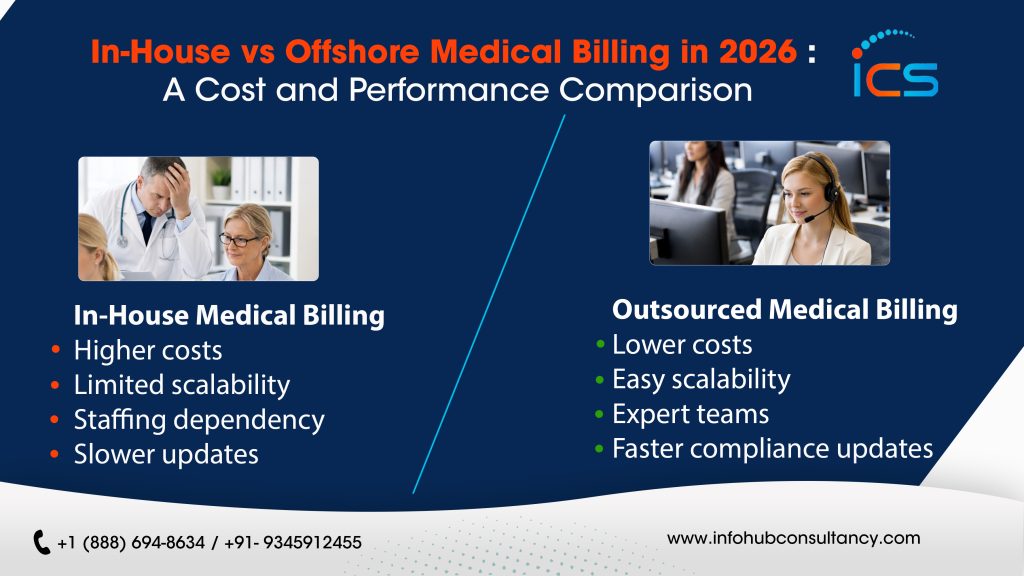
As healthcare operations become more complex in 2026, medical practices are increasingly rethinking how they manage billing. In fact, rising administrative burdens, ongoing workforce shortages, and tighter reimbursement timelines have turned billing efficiency into a critical driver of financial stability.
With administrative activities representing a significant share of overall operating effort, the choice between in-house and offshore billing models now directly influences cash flow, scalability, and operational resilience. As a result, this blog will help you understand how each approach performs under today’s pressures and help practices make informed decisions that support sustainable growth rather than short-term fixes.
Cost Comparison
Cost plays a critical role in selecting a medical billing model in 2026, as practices manage rising wages, operational pressure, and technology expenses. Although both in-house and offshore billing support revenue generation, they differ in how costs are structured, controlled, and scaled.
-
Cost Structure and Expense Type
In-house billing relies on a fixed-cost structure, where expenses remain constant regardless of patient volume. In fact, salaries, employee benefits, software subscriptions, office space, and training form the majority of costs. As a result, practices continue to absorb these expenses even during slow periods, affecting overall cash flow.
Offshore billing uses a variable cost structure that adjusts with workload and collections. This means that the practices pay for services instead of maintaining internal staff and infrastructure. Consequently, billing expenses align more closely with revenue activity that offers greater financial flexibility during both growth phases and volume fluctuations.
-
Cost as a Percentage of Collections
In-house billing generally consumes a higher percentage of net collections due to staffing and overhead expenses. Though costs are predictable, efficiency depends on steady claim volume and full staff productivity. In fact, the cost impact becomes more noticeable when workflows slow or payer delays increase.
Offshore billing typically requires a lower collection rate due to lower labor and infrastructure costs. In fact, pricing models are often bundled or performance-based to help practices maintain consistent billing expenses. This structure supports better margin stability even when reimbursement timelines vary.
-
Scalability and Cost Growth
Scaling in-house billing involves hiring new staff, expanding office space, and investing in training. These changes increase costs in fixed steps rather than gradually. As a result, rapid growth or sudden volume increases can create financial strain and reduce short-term cost efficiency.
Offshore billing enables quick scaling without significant cost escalation. Additional resources can be deployed as volume increases, with minimal setup time. Therefore, practices can support growth while avoiding long-term financial commitments tied to permanent staffing and physical infrastructure.
-
Technology and Infrastructure Spending
Internal billing practices must invest in billing software, automation tools, and cybersecurity systems. These technologies require regular upgrades to meet compliance and efficiency standards. Therefore, ongoing maintenance and replacement costs increase the total operating expenses of an in-house billing department.
Offshore billing providers typically include technology access, system upgrades, and security measures as part of their services. This eliminates the need for the practice to make direct technology investments. As a result, capital spending is reduced while access to updated billing tools is maintained.
-
Cost Stability During Workforce Changes
Staff turnover results in recruitment expenses, increased onboarding time, and temporary productivity losses under in-house medical billing models. During shortages, overtime or workload redistribution often increases costs. These disruptions can create unexpected financial pressure and impact billing performance until staffing levels stabilize.
Offshore billing reduces workforce-related cost volatility by managing staffing externally. In fact, service delivery continues smoothly even when team changes occur. Consequently, practices experience more stable billing costs and fewer unplanned financial disruptions related to personnel changes.
Performance Comparison
Performance in medical billing directly affects cash flow, compliance, and patient satisfaction in 2026. As claim complexity increases and payer requirements tighten, practices must evaluate how well each billing model supports accuracy, speed, and operational reliability.
-
Operational Control and Accountability
In-house billing offers direct control over daily activities, workflows, and staff priorities. In fact, managers can monitor performance in real time and address issues immediately. This close oversight supports faster internal decision-making and stronger alignment with clinical and administrative teams.
Offshore billing operates under defined service agreements, performance metrics, and reporting structures. Though direct oversight is limited, accountability is maintained through regular performance reviews. When properly managed, this model delivers consistent output while allowing practices to focus on higher-level oversight.
-
Accuracy, Coding Quality, and Compliance
Accuracy in in-house billing depends on staff training, experience, and workload balance. In fact, maintaining compliance requires continuous education and monitoring, which can be challenging during high-volume periods. Limited exposure to diverse cases may also affect coding depth across specialties.
Offshore billing teams often include certified coders with specialty-specific expertise. In fact, continuous training and standardized processes support consistent accuracy and compliance. This structured approach reduces variability and helps practices stay aligned with evolving payer and regulatory requirements.
-
Turnaround Time and Claim Processing Speed
Staffing levels and office hours influence claim processing speed in in-house billing. In fact, productivity may slow during absences or peak workloads. As a result, delays in charge entry or follow-ups can affect claim submission timelines.
Offshore billing benefits from extended working hours and time-zone advantages. In fact, claims can be processed continuously to improve turnaround time. Therefore, faster submissions and follow-ups help reduce processing delays and support more efficient revenue cycles.
-
Denial Management and Revenue Recovery
Denial management is often limited by available staff time and competing responsibilities. In fact, follow-ups on aged accounts may be delayed, which affects recovery rates. As a result, success depends heavily on individual expertise and on consistently prioritizing unresolved claims.
Offshore billing typically includes dedicated teams focused on denials and accounts receivable. Data-driven analysis helps identify root causes and improve appeal outcomes. This focused approach supports stronger recovery rates and reduces the accumulation of unresolved balances.
-
Communication and Workflow Integration
In-house teams communicate easily with providers and front-office staff, enabling quick clarification of documentation issues. In fact, shared systems and workplace culture support smooth workflow integration. This direct interaction often reduces delays caused by miscommunication.
Offshore billing relies on structured communication channels, scheduled updates, and precise documentation. Dedicated account managers help bridge time-zone differences. When processes are well-defined, collaboration remains effective, and workflow disruptions are minimized.
Choosing the Right Billing Model in 2026
Choosing the right medical billing model in 2026 largely depends on a practice’s size, operational maturity, and long-term goals. In-house billing remains a suitable option for large, stable healthcare organizations with predictable patient volumes, as it enables closer workflow control and stronger integration with internal teams. As a result, these practices can respond quickly to internal needs while maintaining consistent oversight across billing operations.
However, offshore billing presents a more flexible and cost-efficient alternative for growing or multi-specialty practices. In fact, healthcare organizations can manage increasing volumes without expanding internal staffing or infrastructure by leveraging the expertise and scalable resources available through offshore medical billing service providers in India, such as Infohub Consultancy Services. In many cases, hybrid models offer the best balance for allowing practices to maintain visibility and compliance oversight while benefiting from the efficiency, scalability, and performance advantages of offshore support.
FAQs
What role does automation play in medical billing in 2026?
Automation supports faster claim processing, error detection, and reporting across all billing models.
Are hybrid billing models becoming more common?
Hybrid models are increasingly adopted to balance efficiency with operational oversight.
Can offshore billing support compliance audits?
Structured documentation and reporting help practices prepare for audits more efficiently
Related Blogs

Is your startup or new medical practice struggling to balance growth with the demands of billing and coding? Are rising Read more

Healthcare organizations are facing growing financial pressure as administrative costs continue to rise and reimbursement processes become more complex. Studies Read more

Healthcare organizations lose nearly 5–10 percent of their annual revenue due to billing inefficiencies, delayed claims, and avoidable denials, while Read more