Revenue Cycle Management
  Insurance Verification
  Appointment Scheduling
  Charge Entry
  Denials Management
  Medical Billing
  Claims Submissions
  Payment Posting
  AR – Follow-ups
  Medical Coding
  Reporting
  Patient’s Statement
  Authorization
  Charge Review & Auditing (Coding & Billing)
  Compliance & Audit Readiness
  Clearing House & EDI Management
  Credentialing
  View All 65
Specialties
View All 65
Specialties Allergy and Immunology
  Ambulance
 Ambulatory Surgical Center
 Anesthesia
 Assisted Living Facility (ALF)
 Behavioral Health
 Cardiology
 Chiropractic
 Chronic Care Management (CCM)
 Community Behavioral Health
 Dental
 Dermatology
 Durable Medical Equipment
 Emergency Room
 Endocrinology & Diabetes
 Family Practice
 Gastroenterology
 General Surgery
 Geriatrics
 Healthcare
 7 mins read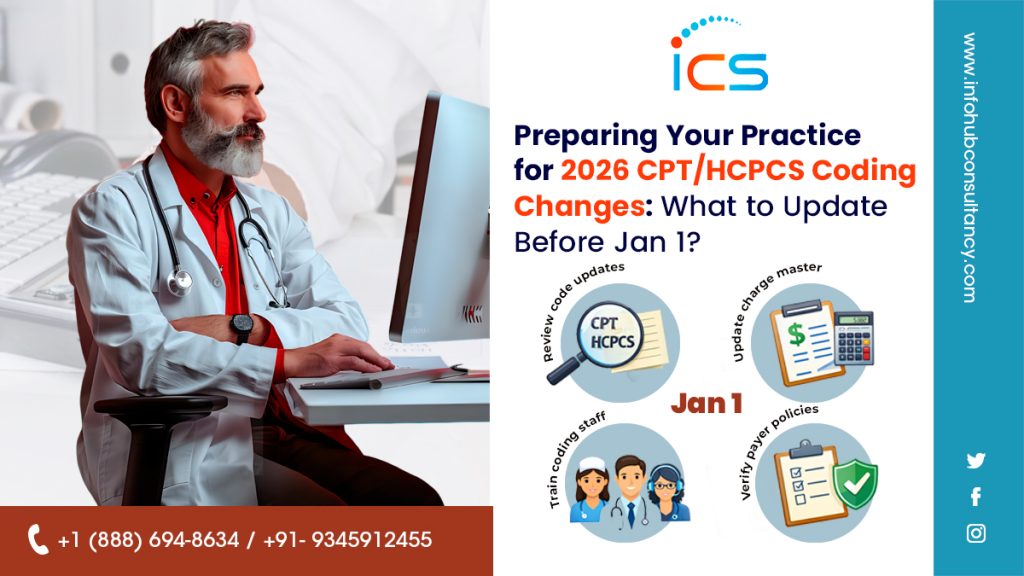
Are you fully prepared for the CPT and HCPCS coding changes coming in 2026 and their potential impact on your practice?
With hundreds of new, revised, and deleted codes, it can be challenging to stay compliant while ensuring accurate billing.
Do you know how the updated CMS reimbursement rules and physician fee schedule adjustments could affect your revenue and claim approvals?
Without proper preparation, even minor documentation or coding errors can lead to denied claims, delayed payments, or compliance issues.
This blog will discuss the key 2026 CPT and HCPCS coding changes and outline practical steps your practice can take before January 1, 2026.
Major CPT Coding Updates for 2026
The 2026 CPT updates reflect how healthcare delivery continues to evolve through technology, data-driven care, and specialized services. These changes aim to improve reporting clarity while ensuring that documentation and reimbursement remain aligned with modern clinical practices and regulatory expectations.
-
Remote Monitoring Services
CPT 2026 introduces new remote monitoring codes that allow reporting services delivered over shorter periods of 2–15 days within a month. Additionally, treatment management codes now require only 10 minutes monthly, making precise time tracking and supporting documentation increasingly necessary.
-
Augmentative and Assistive AI Services
New CPT codes now capture AI-supported services such as coronary plaque assessment, burn wound analysis, and cardiac risk evaluation. As these services rely on algorithm-based insights, documentation must clearly describe how AI tools contribute to diagnosis, clinical assessment, or treatment planning.
-
Hearing Device Services
Hearing device coding has been restructured by deleting legacy codes 92590-92595 and introducing new time-based codes, such as 92628-92629 and 92634-92635. This update allows providers to report evaluation, fitting, and follow-up services more accurately across care stages.
-
Lower Extremity Revascularization (LER) Codes
CPT 2026 replaces older lower extremity revascularization codes with 46 new procedure-specific options that reflect updated techniques and outpatient care trends. As a result, providers must document access methods, treated vessels, and procedural complexity to support correct code selection.
-
Proprietary Laboratory and Advanced Diagnostic Codes
A large share of new CPT additions applies to proprietary laboratory tests and molecular diagnostics. These test-specific codes require exact alignment between the performed assay and the CPT description, making accurate test identification and supporting documentation essential for successful reimbursement.
-
Category III Codes for Emerging Technologies
Category III codes added for 2026 primarily track emerging technologies such as AI-assisted imaging and digital diagnostics. Although reimbursement may be limited, consistent reporting helps establish utilization data that supports future coverage decisions and potential conversion to permanent CPT codes.
-
Updates to CPT Appendices for Telehealth
Several behavioral health and related services have been added to CPT Appendices P and T, recognizing audio-video and audio-only visits as equivalent to in-person care. Therefore, providers must ensure that telehealth documentation clearly supports the approved communication modality.
HCPCS Updates and Medicare Physician Fee Schedule (PFS) Changes
CMS has introduced HCPCS-related updates and payment adjustments through the 2026 Physician Fee Schedule. These changes influence service valuation, reimbursement calculations, and compliance requirements, making early evaluation critical for maintaining financial and operational stability.
-
Conversion Factor Adjustments
The 2026 Physician Fee Schedule includes a proposed conversion factor increase of approximately 2.5%, with separate adjustments for APM and non-APM participants. Consequently, the actual reimbursement impact varies by provider participation status and overall service mix.
-
Efficiency Adjustment to Work RVUs
CMS applies a 2.5% efficiency adjustment to work RVUs for many non-time-based services, reflecting assumptions about improved workflows and technology use. Therefore, documentation must clearly demonstrate clinical effort and complexity to help prevent unintended reimbursement reductions.
-
Specialty-Specific Valuation Updates
Several specialties, including cardiology and vascular care, are subject to updated RVU valuations under the 2026 PFS. These changes may increase or decrease payments depending on procedure complexity, technology use, and care setting, requiring careful revenue impact analysis.
-
Practice Expense and Site-of-Service Changes
CMS has refined practice expense calculations to better distinguish between facility and non-facility settings. As a result, accurate place-of-service reporting becomes increasingly essential, as reimbursement levels now more closely reflect where care is delivered.
-
Telehealth and Originating Site Policies
Telehealth-related HCPCS policies, including updates to code Q3014, clarify originating site eligibility and payment amounts for 2026. Accordingly, practices offering virtual care must ensure workflows and claims meet CMS coverage and documentation requirements.
-
Additional PFS-Level Coding Impacts
The 2026 PFS also introduces HCPCS updates affecting behavioral health add-ons, outpatient products, and reporting rules. In fact, reviewing these changes early allows practices to align workflows, reduce claim delays, and maintain compliance as reimbursement policies evolve.
How Your Practice Should Prepare Before January 1, 2026
Preparing for the 2026 CPT and HCPCS updates requires a coordinated approach across clinical, administrative, and billing operations. In fact, practices can reduce claim disruptions, maintain compliance, and ensure financial stability as new coding rules take effect by making structured updates in advance.
-
Update EHR and Billing Systems
As CPT and HCPCS codes change, practice management and billing systems must be updated to reflect all new, revised, and deleted codes. This step supports accurate charge capture, minimizes system errors, and ensures claims are generated using current code descriptions.
-
Revise Documentation Templates
Clinical documentation templates should be reviewed and revised to align with new service definitions. In fact, updated templates guide providers in consistently recording required details, helping reduce incomplete documentation and coding inaccuracies.
-
Strengthen Clinical Documentation Practices
With the introduction of time-based, AI-supported, and remote monitoring services, clinical documentation must clearly reflect service duration, technology usage, and medical necessity. Thereby, detailed records support correct coding and help prevent payer questions during claim review.
-
Train Coding and Billing Staff
Medical coding and billing staff should receive focused training on new code categories, revised descriptors, and deleted codes to support accurate implementation. In fact, ongoing education ensures teams apply updates correctly and remain confident when managing claims under the 2026 framework.
-
Improve Cross-Team Communication
Effective preparation depends on strong communication between providers, coders, and administrative staff. When teams work collaboratively, documentation and billing requirements remain aligned, reducing misunderstandings and minimizing downstream claim issues.
-
Conduct Pre-Implementation Coding Audits
Before the new codes take effect, internal coding audits help identify documentation gaps and potential errors. In fact, reviewing sample claims early enables practices to proactively correct issues and improve accuracy before submitting live claims.
-
Review Payer-Specific Policies
As payers may adopt CPT and HCPCS updates at different rates, reviewing payer-specific policies is essential. In fact, understanding coverage limitations and documentation expectations helps practices adjust billing strategies, especially for newer or technology-driven services.
-
Adjust Charge Master and Fee Schedules
Charge masters and internal fee schedules should be updated to reflect new and revised codes with appropriate pricing. This alignment ensures consistency across systems and supports accurate financial reporting as reimbursement structures evolve.
-
Test Claims and Billing Workflows
Testing claims in advance allows billing teams to confirm system logic, claim scrubbing rules, and clearinghouse acceptance. Early testing helps identify technical issues and reduces the risk of claim delays once the new codes go live.
-
Strengthen Compliance and Audit Readiness
With expanded coding complexity often comes increased audit attention. As a result, maintaining organized documentation, standardized workflows, and consistent coding practices helps practices remain compliant and respond effectively to payer reviews or audits.
Consider Offshore Medical Billing and Coding Services in India
As CPT and HCPCS requirements expand in 2026, outsourcing medical billing and coding service providers in India, such as InfoHub Consultancy Services, allows practices to manage complexity without increasing internal workload. ICS continuously monitors code updates, payer guidance, and CMS policy changes to ensure accurate, compliant claim submission from day one.
Additionally, ICS supports practices with specialized coders, advanced claim scrubbing, and workflow optimization across multiple EHR systems. This approach helps reduce denials, stabilize cash flow, and maintain compliance while allowing providers and staff to focus more on patient care rather than administrative tasks.
FAQs
Are telehealth services still covered under the new updates?
Updated guidelines clarify eligibility for telehealth services and payment for audio-video and audio-only visits.
Do practices need to revise their charge master for 2026?
Updating charge masters ensures accurate billing and reflects the latest codes and fee schedules.
Will payer-specific policies differ from CMS updates?
Some payers implement updates differently, so practices must verify each payer’s policy rules.
Related Blogs

Healthcare providers often face challenges with delayed payments, aging receivables and constant cash flow pressure. These issues not only slow down revenue Read more

Have you ever questioned why some healthcare organizations manage to receive reimbursements quickly whereas others struggle with long payment delays? Read more

Are healthcare practices selecting the right offshore billing partner, or are they overlooking crucial details that can impact their payments Read more