Revenue Cycle Management
  Insurance Verification
  Appointment Scheduling
  Charge Entry
  Denials Management
  Medical Billing
  Claims Submissions
  Payment Posting
  AR – Follow-ups
  Medical Coding
  Reporting
  Patient’s Statement
  Authorization
  Charge Review & Auditing (Coding & Billing)
  Compliance & Audit Readiness
  Clearing House & EDI Management
  Credentialing
  View All 65
Specialties
View All 65
Specialties Allergy and Immunology
  Ambulance
 Ambulatory Surgical Center
 Anesthesia
 Assisted Living Facility (ALF)
 Behavioral Health
 Cardiology
 Chiropractic
 Chronic Care Management (CCM)
 Community Behavioral Health
 Dental
 Dermatology
 Durable Medical Equipment
 Emergency Room
 Endocrinology & Diabetes
 Family Practice
 Gastroenterology
 General Surgery
 Geriatrics
 Healthcare
 6 mins read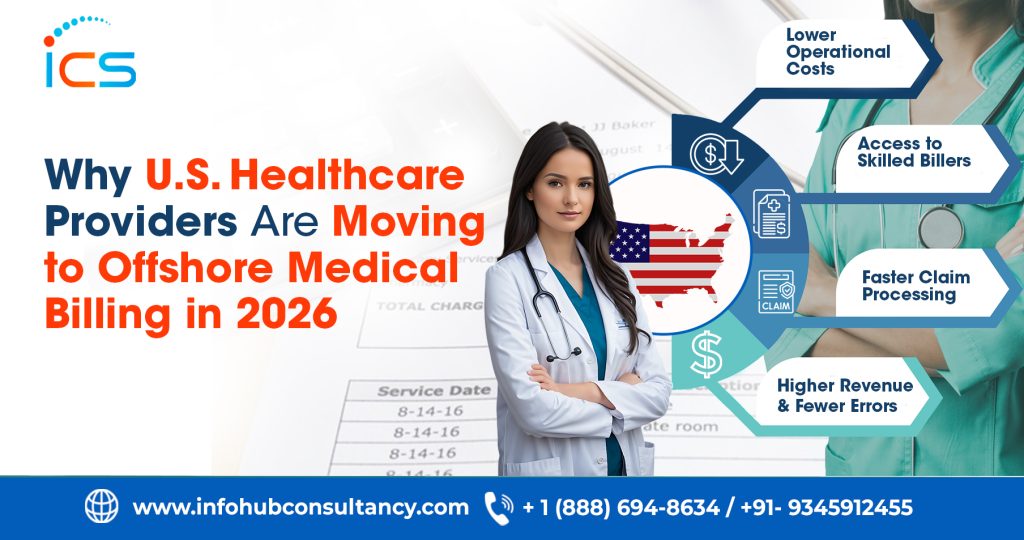
What is driving a growing number of U.S. healthcare providers to reconsider how their billing operations are structured in 2026?
As administrative demands increase and reimbursement processes grow more demanding, many healthcare organizations are recognizing that traditional billing models are struggling to keep up.
This blog will discuss why offshore medical billing is gaining momentum in 2026 and the key factors driving this shift across the U.S. healthcare landscape.
Key Drivers Behind the Shift to Offshore Medical Billing in 2026
In 2026, U.S. healthcare providers are increasingly re-evaluating how their billing operations are structured as administrative demands continue to grow. In fact, ongoing changes in payer requirements, workforce challenges, and tighter financial margins are prompting healthcare organizations to adopt more adaptable billing models. As a result, offshore medical billing and coding services in India are gaining attention as a reliable option that supports operational continuity, consistent performance, and long-term sustainability.
Increasing Claim Complexity Across Payers
Healthcare claims now involve more detailed payer rules, frequent edits, and stricter documentation standards. As requirements differ across Medicare, Medicaid and commercial insurers, claims must be processed with greater precision to avoid rejections. Offshore billing teams are organized to manage these complexities efficiently while maintaining consistency across multiple payer guidelines.
Persistent Billing Talent Shortages
The availability of experienced billing professionals in the U.S. remains limited, creating ongoing staffing challenges. At the same time, turnover and workload pressures can disrupt day-to-day billing operations. Thereby, offshore billing models address these issues by providing dedicated teams that ensure continuity and reduce dependency on local hiring cycles.
Rising Cost of Maintaining In-House Billing Teams
Maintaining an in-house billing department increases costs for compensation, training, compliance tools, and technology. In fact, these expenses place significant pressure on healthcare organizations. Offshore billing helps control these costs and maintains service reliability, allowing providers to manage resources more effectively.
Pressure to Improve Cash Flow and Reduce AR Days
Stable cash flow depends on timely claim submission and effective follow-up processes. However, delays in addressing rejections and denials can extend accounts receivable timelines. Offshore billing teams emphasize consistent follow-ups and faster issue resolution, which helps shorten AR days and support predictable reimbursement cycles.
Expansion of Value-Based and Quality-Linked Reimbursement
Payment models increasingly connect reimbursement to performance and quality outcomes. Consequently, billing accuracy and complete documentation have become essential to maintaining expected revenue levels. Offshore teams are trained to follow updated billing protocols, supporting alignment with quality-linked payment requirements.
Need for Round-the-Clock Billing Operations
Limited operating hours can slow claim processing and contribute to backlogs. Offshore billing enables extended workflows, allowing claims to be reviewed, corrected and submitted without interruption. This continuous processing improves turnaround times and keeps billing queues under control.
Access to Specialty-Specific Billing Knowledge
Many medical specialties involve unique billing requirements that demand focused expertise. Outsourcing medical billing and coding service providers in India often maintain teams trained in specialty-specific workflows, ensuring claims are handled accurately across diverse service lines. This approach supports consistency in both routine and complex billing environments.
Scalability During Volume Fluctuations
Billing volumes often fluctuate due to seasonal trends, regulatory changes, or practice growth. As a result, expanding or reducing in-house staff quickly can be difficult and costly. Offshore billing offers flexible capacity adjustments, allowing providers to manage workload changes without long-term staffing commitments.
Stronger Compliance and Audit Preparedness
Regulatory scrutiny and audit activity continue to increase, making accurate billing records essential. Offshore billing operations rely on standardized processes and quality checks that support compliance readiness. These controls help reduce errors and ensure documentation is readily available during reviews.
Shift Toward Leaner Administrative Operations
Healthcare organizations are increasingly focusing on reducing administrative burden to support clinical priorities. As a result, internal teams can dedicate more time to patient-focused activities by shifting billing responsibilities offshore. Therefore, offshore medical billing supports streamlined operations while maintaining accuracy and regulatory alignment.
Improved Transparency and Performance Tracking
Healthcare providers increasingly require clear visibility into billing performance, including claim status, denial trends, and turnaround times. Offshore billing partners typically offer structured reporting and regular performance reviews, which help providers monitor outcomes more effectively. This level of transparency supports informed decision-making and continuous improvement across the revenue cycle.
Faster Adaptation to Regulatory and Payer Changes
Billing rules and payer policies continue to evolve throughout the year, creating frequent operational adjustments. Offshore billing teams are structured to quickly absorb regulatory updates and apply them across workflows without disrupting daily operations. This adaptability helps providers remain aligned with changing requirements while reducing internal adjustment pressures.
Reduced Dependency on Internal Training Cycles
Training in-house billing staff on new rules, systems, and payer updates requires time and consistent oversight. Offshore billing models reduce this dependency by maintaining teams that are continuously trained and updated as part of their core operations. This approach allows providers to avoid repeated training cycles while maintaining stable billing performance.
Support for Practice Growth and Service Expansion
As healthcare organizations expand services or enter new markets, billing requirements often become more complex. Offshore billing support allows providers to accommodate growth without restructuring internal teams or systems. This flexibility ensures billing operations can scale alongside clinical expansion without creating operational bottlenecks.
Conclusion
The shift toward offshore medical billing in 2026 reflects a broader transformation in how U.S. healthcare providers manage complexity, risk, and sustainability. As billing requirements become more detailed and reimbursement models more performance-driven, providers need operating structures that deliver consistency, speed, and adaptability. Thereby, offshore billing addresses these needs by creating stable workflows that can absorb volume fluctuations, regulatory updates, and payer demands without disrupting day-to-day operations.
Moreover, working with established offshore medical biller and coder teams in India, such as InfoHub Consultancy Services, allows healthcare organizations to build long-term billing resilience rather than relying on short-term fixes. With dedicated teams, standardized quality controls, and continuous process optimization, ICS supports accurate claim handling and dependable revenue flow. This approach enables providers to maintain financial confidence, reduce administrative strain, and move forward in 2026 with a billing model designed for scale and stability.
FAQs
Is offshore medical billing suitable for small practices?
Offshore billing can scale to match smaller claim volumes without requiring additional in-house staff.
Can offshore billing reduce claim backlogs?
Dedicated offshore teams help clear backlogs by ensuring consistent claim processing and follow-up.
Does offshore billing help during audits or payer reviews?
Structured documentation and standardized workflows support faster audit responses.
Is offshore billing limited to specific medical specialties?
No, offshore billing supports a broad range of specialties, including complex and high-volume service lines.
Related Blogs

Claim denials are a significant drain on provider revenue and operational efficiency. According to the latest research, insurers denied approximately Read more
Have you ever questioned why some healthcare organizations manage to receive reimbursements quickly whereas others struggle with long payment delays? Read more

Are healthcare practices selecting the right offshore billing partner, or are they overlooking crucial details that can impact their payments Read more