6 mins read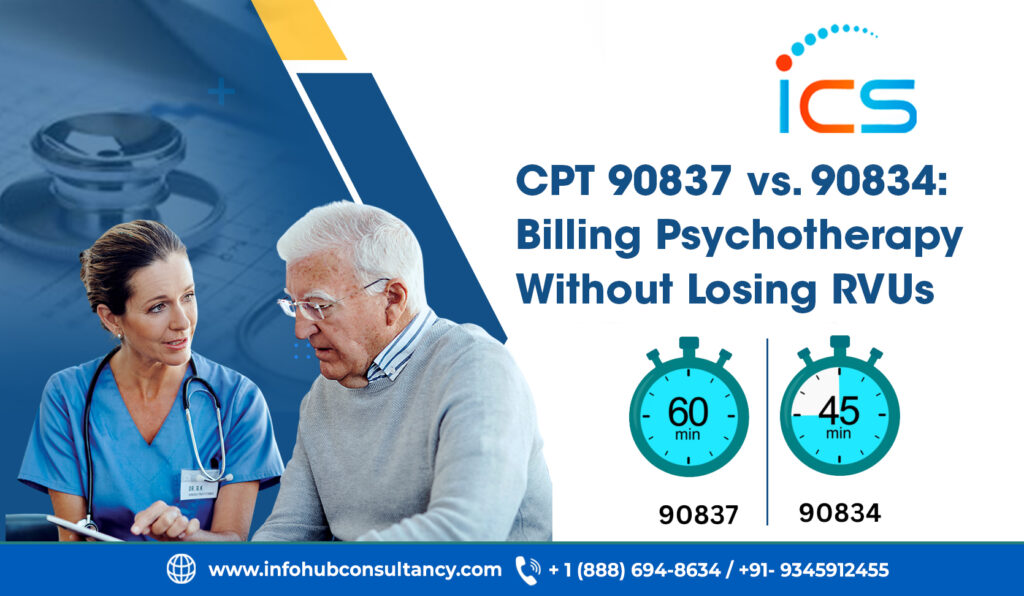
CPT 90834 and 90837 are time-based individual psychotherapy codes. For an otherwise eligible psychotherapy service, 90834 corresponds to 38-52 minutes and 90837 to 53 minutes or more. Code selection must reflect the service actually provided, documented psychotherapy time and applicable payer requirements. Diagnosis severity or the expected payment alone does not determine which code to report.
This guide explains session timing, documentation, payment context and payer checks. It does not replace the current code set, the treating professional’s clinical judgment or the policy applicable to a particular claim.
CPT Codes 90834 vs. 90837: Choosing the Right Psychotherapy Code for Accurate Billing
CPT 90834 and CPT 90837 are two commonly used billing codes for individual psychotherapy, whereby each serves a specific purpose. Thereby, it is important to understand when and how to use them correctly to help providers maintain both clinical integrity and financial sustainability. Let’s have a look at such differences
Session Duration and Clinical Need
For individual psychotherapy without a separately reported E/M service, use the documented time range: 38-52 minutes for 90834 and 53 minutes or more for 90837. Do not round a 52-minute session up to qualify for 90837. The treating professional determines the clinically appropriate duration; the claim should reflect the care provided rather than a scheduling slot or revenue target.
When to Use 90834 vs. 90837
Choose between these codes using the actual eligible psychotherapy time and the service performed. A diagnosis such as anxiety, depression or PTSD does not automatically select either code. Psychotherapy for crisis has separate coding requirements; do not assume that crisis intervention should be reported as routine 90837. When psychotherapy accompanies a separately identifiable E/M service, review the psychotherapy add-on code family rather than automatically using these standalone codes.
Documentation Essentials for Each Code
Document psychotherapy time, the intervention, the clinical need for treatment and the patient response or progress. First Coast Medicare guidance allows start and stop times or total psychotherapy time; follow any additional requirements of the applicable payer. Do not include separately reported E/M time in psychotherapy time. Select the diagnosis supported by the clinical record, not a more severe diagnosis to support a preferred procedure code.
See First Coast Medicare psychotherapy billing and documentation guidance. This local Medicare article must be read with its associated coverage policy and is not a rule for every payer.
Billing Accuracy and Insurance Expectations
Check the patient’s benefit, clinician eligibility, authorization requirements and payer documentation policy before billing. Repeated use of a code is not, by itself, proof of an incorrect claim. Each reported service must have supporting documentation. Authorization or an accepted claim does not guarantee payment.
Telehealth Billing Rules
For a remote session, verify the payer’s current rules for the date of service, including covered modality, place of service, modifiers, practitioner eligibility and patient location. Do not apply modifier 95 automatically to every remote encounter; audio-video and audio-only claims may have different instructions. Follow applicable privacy, consent and licensure requirements, documenting consent in the manner required for that service.
The HHS telebehavioral billing resource distinguishes Medicare, state Medicaid and private-insurance policies. Check current payer instructions rather than treating a general telehealth checklist as a complete claim rule.
Avoiding Revenue Loss and Audit Triggers
Review whether the documented psychotherapy time and service support the submitted code. Reporting a shorter time-based code for a qualifying longer service can understate the service; reporting a longer code without sufficient time or support can overstate it. Review discrepancies against the record rather than choosing a target mix of 90834 and 90837.
Payment and review outcomes depend on payer policy and claim circumstances. Internal checks can identify errors but cannot guarantee reimbursement or prevent an audit.
RVUs and Reimbursement Comparison
Medicare payment uses work, practice-expense and malpractice relative value components. The CMS Physician Fee Schedule documentation explains geographic adjustments, facility and nonfacility calculations, and the conversion factor.
There is no single payment amount that applies to every 90834 or 90837 claim. Verify the relevant year, payer, locality, practitioner and setting before comparing allowed amounts. Commercial contract terms can differ from Medicare. An allowed amount is also not necessarily the amount collected after cost sharing and other applicable adjustments. Do not choose the procedure code solely because one rate is higher.
Examples of Appropriate Use
If the documented service is eligible individual psychotherapy and lasts 45 minutes, its time falls within the 90834 range. An otherwise eligible 55-minute service falls within the 90837 range. These examples illustrate time boundaries; they do not establish coverage, clinical necessity or all coding requirements for an actual patient.
A diagnosis or therapy technique alone does not change the time threshold. Confirm the service family first, including whether E/M, crisis, family or group psychotherapy rules apply.
Billing Mistakes to Avoid
Check for inaccurate time, undocumented interventions, diagnosis codes unsupported by the record, incorrect service families and payer-specific telehealth or authorization errors. A session at the 53-minute boundary requires accurate timing; do not omit or add minutes to achieve a desired code.
Do not assume that every telehealth claim needs modifier 95, that every note must use start and stop times instead of total time, or that frequent 90837 use alone proves improper billing. Compare the actual documentation with the policy governing the claim.
Self-Auditing and Staff Training Tips
Review a sample of claims against the clinical record and current payer instructions. Train staff to distinguish standalone psychotherapy from E/M add-on, crisis and family services, and to preserve actual time rather than copying a scheduled duration.
EHR prompts can support documentation, but templates do not replace an individualized clinical note. ICS offshore mental health billing services in India can support agreed coding, authorization and denial workflows within the client’s clinical documentation and oversight process.
Outsourcing Mental Health Billing and Coding Services
InfoHub Consultancy Services provides India-based billing support for US healthcare organizations. An agreed scope can include coding checks, authorization tracking and denial follow-up. The treating professional remains responsible for clinical documentation, and payer requirements still apply. Outsourcing does not guarantee payment or remove compliance obligations. Review ICS medical billing and coding support and the relevant service scope below.
FAQs
1. What documentation is needed to support psychotherapy billing audits?
Notes should support the service, clinical need, psychotherapy time, intervention and patient response or progress. Follow the applicable payer’s signature and documentation requirements.
2. How often can I bill 90837 in a week?
There is no universal weekly number in this comparison. Check benefit limits, authorization and medical necessity for each service. Do not treat a time threshold as a frequency allowance.
3. Can interns or supervised therapists bill 90834 or 90837?
Eligibility depends on the practitioner’s credentials, licensure, payer enrollment and any applicable supervision or billing rules. Do not assume that listing a supervisor makes an otherwise ineligible service billable.
4. Can 90834 and 90837 be billed for couples or family sessions?
Choose the code family for the service actually performed. Family psychotherapy has separate codes and requirements; a family member’s presence does not by itself turn individual psychotherapy into a family service. See CMS Medicare contractor guidance on individual and family psychotherapy and check the applicable payer policy.
For psychotherapy coding, authorization and denial workflows, review ICS mental health billing services.
Related Blogs


InfoHub Consultancy handles complete medical billing, coding, and RCM for US healthcare providers — HIPAA compliant, offshore efficiency, proven results.
Get a Free Consultation →