7 mins read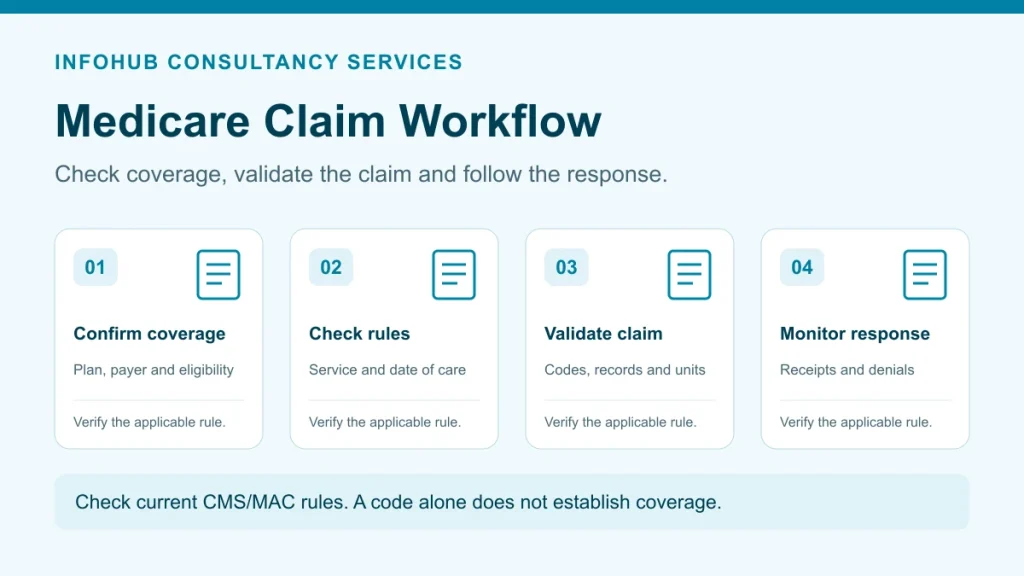
Medicare billing guidelines require more than a valid CPT or HCPCS code. A payable claim must connect the correct beneficiary, provider, place of service, diagnosis, procedure, units, modifiers and documentation to the coverage rules that apply on the date of service. This 2026 guide gives US practices a practical workflow for cleaner Medicare claims and fewer preventable denials.
Medicare billing guidelines: the 2026 checklist
| Claim checkpoint | What to verify before submission | Common failure |
|---|---|---|
| Eligibility | Active coverage, Medicare plan type and coordination of benefits for the date of service | Billing Original Medicare when a Medicare Advantage plan is primary |
| Provider data | Enrollment, NPI, taxonomy, reassignment and rendering/billing relationships | Mismatch between the provider record and claim |
| Coverage | Applicable NCD, LCD and MAC billing article | Service is coded correctly but does not meet coverage criteria |
| Coding | Current ICD-10-CM, CPT/HCPCS, units and code-pair edits | Unbundling, invalid code combinations or incorrect units |
| Modifiers | Clinical facts and documentation support every modifier | Using a modifier only to bypass an edit |
| Documentation | Medical necessity, orders, signatures, dates and service details are supported | Claim data cannot be traced to the medical record |
| Claim format | Correct professional or institutional transaction and required fields | Missing or inconsistent identifiers, dates or place-of-service data |
| Timely filing | Submit and correct the claim within the applicable Medicare deadline | Waiting until the filing window is nearly closed |
This checklist is a starting point, not a substitute for service-specific instructions. Coverage and billing details can vary by Medicare Administrative Contractor (MAC), jurisdiction, setting and service. Teams should confirm the current rule for the exact date of service before billing.
InfoHub Consultancy handles complete medical billing, coding, and RCM for US healthcare providers — HIPAA compliant, offshore efficiency, proven results.
Get a Free Consultation →1. Confirm eligibility and the correct payer path
Check eligibility on the date of service, not only when the appointment is scheduled. Confirm whether the patient has Original Medicare, Medicare Advantage, secondary coverage or another payer that must be billed first. Coordination-of-benefits errors can produce denials even when the clinical service and code selection are correct.
- Match the beneficiary name, Medicare Beneficiary Identifier and date of birth.
- Confirm Part A or Part B coverage relevant to the setting and service.
- Identify Medicare Advantage enrollment and plan-specific authorization rules.
- Review primary/secondary payer order before the claim is created.
2. Use the correct claim type and provider information
Professional and institutional claims follow different transaction structures. Professional services are generally sent electronically through the 837P; the CMS-1500 is the standard paper form when a qualified exception permits paper submission. Institutional services generally use the 837I or CMS-1450/UB-04 pathway. CMS provides the official CMS-1500 instructions and references.
Before release, validate billing and rendering NPIs, taxonomy, service location, place of service, enrollment status and reassignment relationships. A technically complete claim can still reject or deny when these fields conflict with Medicare enrollment records.
3. Check medical necessity against NCDs, LCDs and MAC articles
A code describes what was reported; it does not by itself establish coverage. Medicare National Coverage Determinations (NCDs) apply nationally. Local Coverage Determinations (LCDs) and related billing articles may add jurisdiction-specific detail when consistent with national policy. Search the official Medicare Coverage Database and verify the policy version that applies to the date of service.
- Does the diagnosis support the service under the applicable policy?
- Are frequency, setting or provider-type limits satisfied?
- Is an order, certification or prior authorization required?
- Does the record show why the service was reasonable and necessary?
4. Apply current coding and NCCI edits
Use code sets effective for the date of service and check quarterly updates. Medicare’s National Correct Coding Initiative includes Procedure-to-Procedure edits that address code pairs and Medically Unlikely Edits that address units of service. CMS explains the program and publishes current files on its Medicare NCCI page.
Do not append modifier 59 or an X{EPSU} modifier simply because a claim edit appears. A modifier should reflect a real, documented distinction such as a separate encounter, site, practitioner or service when the applicable rule allows it. CMS states that not every edit may be bypassed and that documentation must support the clinical circumstance.
5. Make the claim traceable to the medical record
Claims and records should tell the same story. Documentation should identify the patient, date of service, responsible clinician, service performed and clinical reason for the service. Orders, signatures, time, units, drug administration details and plan-of-care elements should be present when the service requires them.
A useful pre-bill test is simple: can an auditor move from every material claim field back to a legible, dated record entry? If the answer is no, route the account for clarification before submission instead of relying on a later appeal.
6. Submit on time and monitor acknowledgments
Medicare fee-for-service claims generally must be filed within one calendar year after the date of service, subject to limited exceptions. Confirm the current instruction in the Medicare Claims Processing Manual. Operationally, the safer target is much earlier: submit promptly, read clearinghouse and payer acknowledgments, and work rejections before they consume the filing window.
7. Separate rejections, denials and appeals
| Outcome | What it usually means | First action |
|---|---|---|
| Rejection | The claim did not enter adjudication because of a data or transaction issue | Correct the error and resubmit promptly |
| Denial | The payer adjudicated the claim but did not allow payment as billed | Read the reason code, policy and remittance details before correcting or appealing |
| Underpayment | The claim paid, but the amount may not match the expected allowed amount | Compare contract/fee-schedule logic, units, reductions and coordination of benefits |
| Appeal | A formal request asks Medicare to reconsider an adverse determination | Follow the correct appeal level, deadline and evidence requirements |
Track denial trends by reason, service line, provider, payer, location and root cause. Corrected claims should fix claim data; appeals should challenge an adverse decision with relevant evidence. Sending the wrong response wastes time and may weaken recovery.
A practical Medicare pre-bill workflow
- Verify eligibility, plan type and coordination of benefits.
- Confirm provider enrollment and claim-format requirements.
- Validate NCD, LCD and MAC policy for the service and date.
- Check diagnosis-to-procedure support, coding edits, units and modifiers.
- Confirm required documentation, orders and signatures.
- Run claim edits and resolve exceptions before release.
- Monitor acknowledgments, remittance and denial trends through closure.
When should a practice consider billing support?
Outside support may help when the internal team has growing backlogs, repeated Medicare denials, inconsistent follow-up or limited capacity to monitor policy changes. The right scope can cover a defined workflow—such as eligibility, claim submission or denials—or an agreed end-to-end process within the practice’s existing systems.
Frequently asked questions
What are the most important Medicare billing guidelines?
Verify eligibility and payer order, use the correct claim type and enrolled provider data, confirm coverage and medical necessity, apply current codes and NCCI edits, support modifiers and units with documentation, and submit within the applicable deadline.
What is the difference between an NCD and an LCD?
An NCD is a national Medicare coverage determination. An LCD is issued by a Medicare Administrative Contractor for its jurisdiction and may address coverage detail where national policy allows. Teams should also review related billing and coding articles.
How long do providers have to submit Medicare claims?
Medicare fee-for-service claims generally have a one-calendar-year filing limit from the date of service, with limited exceptions. Practices should verify the current CMS and MAC instruction and submit much earlier so rejections can be corrected in time.
Can a modifier automatically override an NCCI edit?
No. Some edits do not permit an override, and a permitted modifier must still represent a documented clinical circumstance. Modifier selection should never be driven only by the desire to obtain payment.
Information is current as of September 2026 and is provided for general operational education. Always verify service-specific CMS and MAC instructions for the date of service.
Reduce Medicare denials with a defined workflow
See our denials management services and medical billing services for US healthcare organizations, delivered through an India-based team.
Related Blogs



InfoHub Consultancy handles complete medical billing, coding, and RCM for US healthcare providers — HIPAA compliant, offshore efficiency, proven results.
Get a Free Consultation →