8 mins read
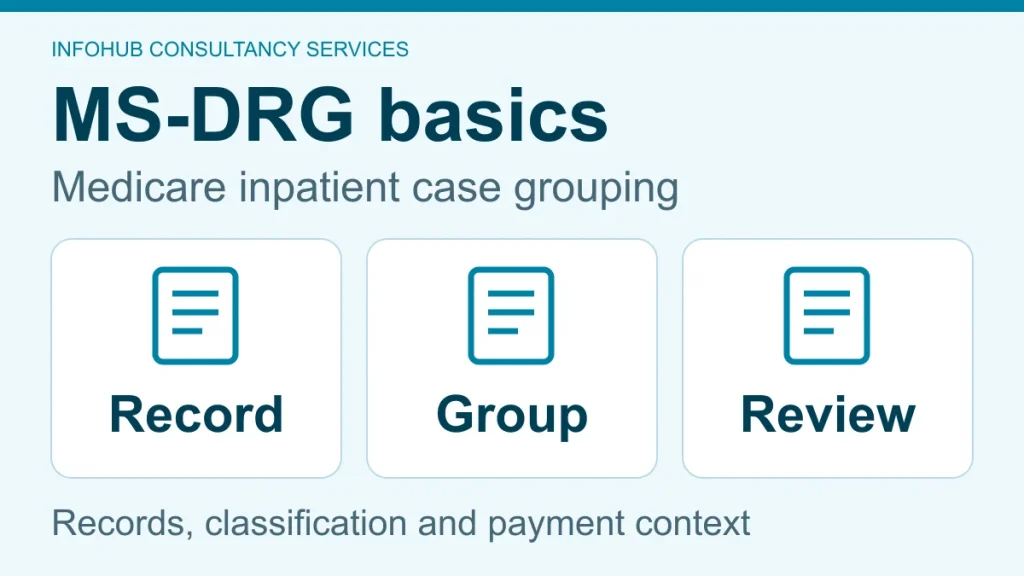
Imagine two patients walking into different hospitals — one in New York City and another in a small rural town in Texas. Both have the same condition, i.e., a broken hip.
For a covered acute inpatient stay paid under Medicare’s Inpatient Prospective Payment System (IPPS), the hospital facility payment is calculated on a per-case basis. The same diagnosis does not guarantee the same MS-DRG assignment or the same payment at different hospitals. Case classification, hospital factors and applicable adjustments matter.
Sounds simple, right?
InfoHub Consultancy handles complete medical billing, coding, and RCM for US healthcare providers — HIPAA compliant, offshore efficiency, proven results.
Get a Free Consultation →But behind that single payment is a complex system that is quietly reshaping how hospitals operate, doctors document care, and insurers reimburse providers. That system is called DRG-based billing which has changed hospital payments from long lists of individual charges to a more streamlined, diagnosis-based payment.
In this blog, we will understand about the foundation of DRGs as an important factor for offshore medical billing and coding services in India.
What are DRG-Based Payments?
Diagnosis-related groups classify inpatient cases with similar clinical characteristics and expected resource use. Medicare uses Medicare Severity Diagnosis-Related Groups (MS-DRGs) for acute inpatient hospital facility payment under IPPS. A group is assigned from the coded case; it is not a separate payment for every diagnosis or an automatic guarantee of coverage.
See the CMS explanation of MS-DRG classification. Other hospital settings and payers can use different payment systems.
Benefits of the DRG System
Medicare began its phased transition to DRG-based hospital payment on October 1, 1983, as described in this contemporary review of the new payment system. This replaced cost-based payment for hospitals participating in the transition; it did not establish one identical rate for every hospital or eliminate billing records.
- Case-based payment: MS-DRG weights reflect relative resource use, while hospital-specific and other payment adjustments can affect the amount.
- Structured classification: Coded diagnoses, procedures and relevant case details support grouping. Hospitals still need accurate claims and supporting records.
- Resource planning: Prospective payment can inform cost and care-pathway review. It does not by itself guarantee better clinical outcomes or fewer readmissions.
Different Types of DRG
For Medicare IPPS, it helps to understand the different parts of MS-DRG classification and payment. The CMS Version 44 definitions manual applies from October 1, 2026 through March 31, 2027. Use the version applicable to the discharge date.
1. Major Diagnostic Categories
MDCs organize related principal diagnoses into broad clinical areas. The manual also contains pre-MDC logic for certain cases. An MDC is a category used in grouping, rather than the final MS-DRG assigned to the discharge.
2. Medical and Surgical Groups
MS-DRGs can be medical or surgical. Procedure designations and the applicable grouping hierarchy help determine surgical assignment. Having a procedure documented does not by itself establish a particular group; the full coded case and current logic matter.
3. Severity Splits
Some groups split according to major complications or comorbidities (MCC), complications or comorbidities (CC), or neither. Other groups do not split this way. Reportable diagnoses, exclusions and other grouping rules determine whether a condition affects assignment.
4. Age and Case-Specific Rules
Age and discharge status affect certain groups. The manual includes newborn and neonatal categories, but a generic pediatric label does not identify the correct group or payer system. Check the applicable hospital payment system and case logic.
5. Transfer Payment Rules
An MS-DRG is still assigned when a qualifying transfer occurs. The applicable transfer policy can adjust payment; a transfer is not a separate universal family of DRG codes. Review the IPPS transfer section of the CMS payment guide linked below.
For operational support with hospital documentation and grouping workflows, review ICS medical coding services. This overview does not replace the grouper or the complete coding instructions for an actual case.
How do DRGs Work in Medical Billing?
DRGs form the backbone of inpatient billing under Medicare and many other healthcare systems. Instead of billing separately for every test, treatment, or day of stay, DRGs offer a payment model that bundles services and standardizes and simplifies reimbursement. Here is how the process works:
1. Categorizing the Patient
For a covered acute inpatient hospital discharge under Medicare IPPS, MS-DRG classification uses the reported coded case. Multiple cases can share the same MS-DRG; it is not a unique identifier for an individual admission. Relevant inputs include:
- Principal diagnosis and reportable additional diagnoses
- Procedures performed
- Age, sex or discharge status where relevant to the applicable group
- Presence of complications or comorbidities
Hospitals assign each individual to one of more than 700 distinct DRGs, with the aim of grouping together similar cases into similar groups clinically and expected to require similar levels of hospital resources.
2. Setting the Payment Amount
The MS-DRG relative weight is one input to payment, not the complete payment amount. Medicare applies operating and capital payment rules, geographic wage adjustments and applicable hospital or case adjustments. Some qualifying cases may receive outlier or new-technology payments, while transfer and other policies can change the amount.
A complication or comorbidity must be supported and reportable under the applicable coding and grouping rules; a diagnosis such as diabetes does not automatically increase payment. Consult the CMS Medicare Payment Systems guide, particularly its IPPS sections, for payment factors and exceptions. No rate or patient-specific payment calculation is supplied here.
3. The Efficiency Game
Prospective payment gives hospitals a reason to review resource use alongside clinically appropriate care. Payment policy does not prescribe an individual patient’s treatment or discharge timing, and DRG assignment alone does not establish improved outcomes or fewer readmissions.
For example, two pneumonia cases assigned to the same MS-DRG can still have different payments because applicable hospital, transfer, outlier or other adjustments may differ. Review the coded case and payment rules rather than assuming that the diagnosis or group alone determines the final amount.
Challenges in DRG-Based Hospital Billing
Though the DRG system has made hospital billing and reimbursement easier, it also poses a number of issues that healthcare providers have to closely monitor. One of the biggest obstacles is coding accuracy. Incomplete or inaccurate coding can result in denied claims or decreased payments, consequently impacting a hospital’s financial performance and revenue directly.
A hospital’s Case Mix Index (CMI) summarizes its mix of cases using DRG relative weights. The CMS definition of CMI describes the average DRG weight: the sum of weights for the included Medicare discharges divided by the number of discharges. Transfer-adjusted and unadjusted measures can differ. Interpret CMI using the relevant population, period and methodology.
A higher CMI can reflect a more resource-intensive case mix; it is not a quality score or a guarantee of higher payment on every claim. Clinical documentation, compliant code assignment and the actual cases treated all matter. Review unexpected changes for accuracy rather than adding unsupported diagnoses to increase the index.
Regulatory compliance is also a significant concern. Hospitals have strict Medicare and insurance regulations to follow when assigning DRG codes. Non-compliance can lead to audits, fines, or repayment requests. Also, hospitals have to deal with the issue of resource allocation during the provision of high-quality care within the budget constraint of fixed DRG payments. This calls for meticulous planning, optimal workflows, and continuous monitoring of patient outcomes.
The Role of ICS in Supporting Physicians
InfoHub Consultancy Services provides India-based billing and coding support for US healthcare organizations. An agreed hospital workflow can include record review, coding checks, clarification requests and claim or denial follow-up.
The treating team remains responsible for clinical documentation. Coders should use supported, reportable diagnoses and procedures and seek clarification through the client’s approved process when needed. Reviewing records does not itself create a missing diagnosis or guarantee an assigned group or payment.
The client and ICS should define responsibilities, access controls, quality checks and escalation paths. Outsourcing does not remove the hospital’s payer, documentation or compliance obligations.
FAQs
1. What is the main goal of DRG-based payments?
Under Medicare IPPS, MS-DRGs support prospective case-based hospital facility payment. The final amount also depends on applicable hospital and case adjustments; a group does not guarantee an identical payment everywhere.
2. How can hospitals get better results from DRG payments?
Hospitals can review documentation, code assignment, grouping inputs and payment exceptions against the applicable rules. CMI can help monitor the case mix when its population and methodology are clear; increasing CMI should not replace accurate coding or clinically appropriate care.
3. What do billing and coding professionals do in DRG-based systems?
Billing and coding teams review supported diagnoses and procedures, check grouping and claim inputs, and route discrepancies for clarification. The hospital retains responsibility for clinical documentation and applicable billing obligations; support services do not guarantee payment.
4. Why is it important to use the right codes in DRG billing?
Incorrect or unsupported inputs can change grouping or payment and may require correction or review. Accurate coding reflects the documented case under the applicable rules; it does not automatically establish coverage or prevent an audit.
5. Do DRG payments cover all hospital services?
Medicare MS-DRGs apply to acute inpatient hospital facility payment under IPPS. They do not cover every hospital setting or every separately billed professional service. Outpatient and excluded inpatient settings have different payment rules, and other payers may use their own arrangements.
For more on this topic, see our hospital medical billing services.
Related Blogs


InfoHub Consultancy handles complete medical billing, coding, and RCM for US healthcare providers — HIPAA compliant, offshore efficiency, proven results.
Get a Free Consultation →